147 - Addiction Training in Adolescent Medicine Fellowship: A National Survey
Friday, April 24, 2026
5:30pm - 8:00pm ET
Publication Number: 1137.147
Adam Kronish, Mass General Brigham for Children, Watertown, MA, United States; Emma Barrett, Childrens Hospital of Philadelphia, Philadelphia, PA, United States; Jessica B. Calihan, MassGeneral Hospital for Children, Boston, MA, United States; Maria Herrera, Yale School of Medicine, New Haven, CT, United States; Emily Rider-Longmaid, University of California, San Francisco, School of Medicine, San Francisco, CA, United States; Sarah Green, Children's Hospital of Philadelphia, Philadelphia, PA, United States; Scott E. Hadland, Mass General Brigham for Children / Harvard Medical School, Boston, MA, United States
Adolescent Medicine Physician Mass General Brigham for Children Medford, United States
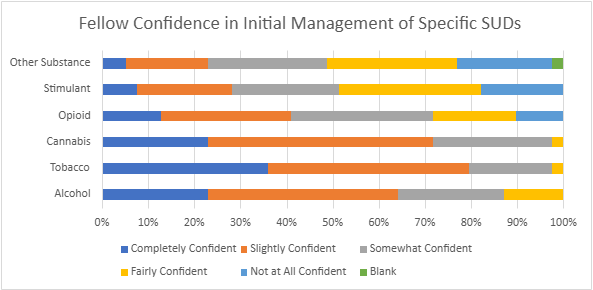
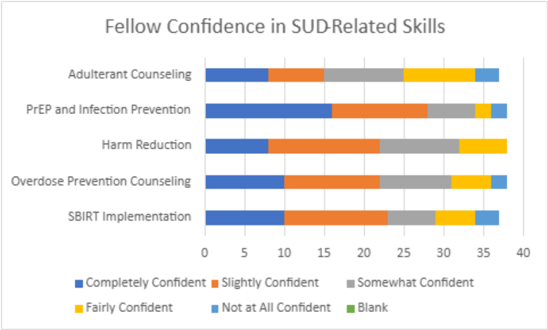
Background: Substance use disorders (SUDs) are a leading cause of preventable morbidity and mortality among adolescents and young adults. Although adolescent medicine (AM) fellowship includes basic substance use competencies, little is known about variation in education across programs. Objective: We aimed to describe the education, practices, and confidence of AM fellowships in management of adolescent SUDs. Design/Methods: During the 2024-5 academic year, we distributed a national survey to AM fellows, program directors (PDs),associate PDs, and early career faculty (i.e. completed fellowship in the prior 5 years). Participants were recruited via email, WhatsApp, and snowball sampling and received a $5 gift card for participation. The 46-item RedCap survey assessed demographics, prior education, confidence via Likert scales, and experiences with SUD-related medications and inpatient care. County-level overdose mortality data were obtained from 2023 CDC WONDER and binarized into high/low overdose. Data analysis included descriptive statistics and inferential tests (e.g. Chi-square). The CHOP IRB exempted the study as an educational survey of providers. Results: A total of 39 fellows (39.0% of US AM fellows), 15 PD/APDs (32.6%), and 21 early career faculty (13.7% of total recent graduates) completed the survey. Most participants were pediatrics-trained (82.1% fellows and 93.3% PD/APDs); they endorsed a median of 3.0 hours of didactics on substance use in residency and 9.0 hours in fellowship. Of competencies, fellows were most confident in understanding mental illnesses in adolescence (90.0% of fellows) and least confident in the initial management of SUDs (35.9%). For specific substances, fellows felt less confident in the initial management of opioid (41.0%), stimulant (28.2%) and other (23.1%) SUDs, compared to tobacco (79.5%), cannabis (71.8%), and alcohol (64.1%) use disorders (p < 0.001). Apart from nicotine replacement (92.3%), under half of fellows had prescribed other medications for SUDs. Between PDs and fellows, there were no significant differences in competency confidence. However, those who trained in high overdose counties reported greater confidence in initial OUD management (p < 0.05); other OUD-related skills were unaffected by geography.
Conclusion(s): AM fellows reported varied experiences and confidence in SUD management with fewer than half reporting high confidence in initial management by training completion. Next steps include identifying and replicating programs that produce high-confidence graduates, enhancing faculty expertise, and integrating SUDs into routine adolescent care for trainees.
Figure 1: Proportions of Fellow Confidence in Initial Management of Different Substance Use Disorders
Figure 2: Distribution of Fellow Confidence in Skills Related to Substance Use Disorders