62 - Sleep Problems and Developmental Correlates in Extremely Preterm Infants at 2-Year Follow-Up
Friday, April 24, 2026
5:30pm - 8:00pm ET
Publication Number: 1055.62
Courtney Walker, University of Mississippi Medical Center, Jackson, MS, United States; Carla M. Bann, RTI International, Apex, NC, United States; Waldemar Carlo, University of Alabama, Birmingham, AL, United States; Hannah Ford, University of Mississippi School of Medicine, Jackson, MS, United States; Mobolaji Famuyide, University of Mississippi School of Medicine, Jackson, MS, United States; Sara DeMauro, Children's Hospital of Philadelphia, Philadelphia, PA, United States; Abhay Bhatt, University of Mississippi School of Medicine, Jackson, MS, United States; on behalf of NICHD Neonatal Research Network, NICHD Neonatal Research Network, Bethesda, MD, United States
Associate Professor University of Mississippi Medical Center Jackson, Mississippi, United States
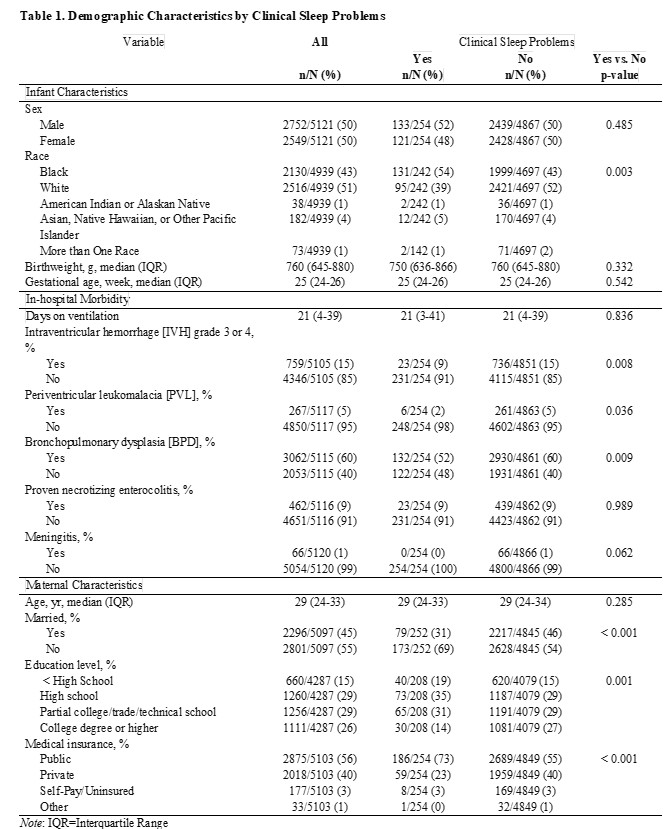
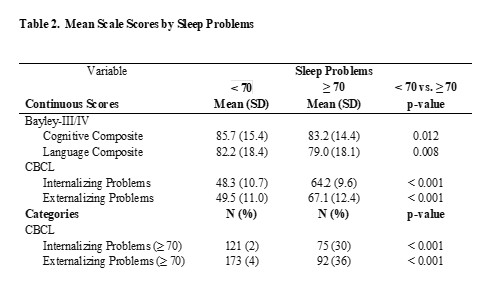
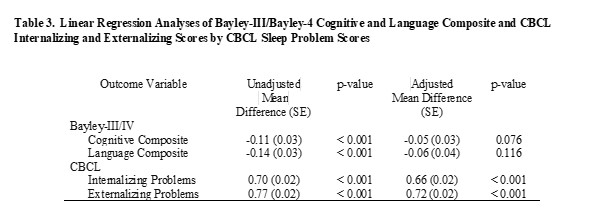
Background: Sleep is essential for neurodevelopment, supporting memory consolidation, synaptic pruning, and neural plasticity. Early childhood sleep problems are linked to difficulties with attention, memory, executive function, and emotional/behavioral regulation. While sleep in term children is well studied, less is known about its impact in extremely preterm (EPT) toddlers. Preliminary evidence suggests EPT children are at greater risk for sleep problems associated with adverse behavioral outcomes. Prior studies are limited by small samples, exclusion of children with developmental challenges, and reduced generalizability. Objective: To examine associations between sleep problems (SP) and neurodevelopmental and emotional/behavioral functioning in a large cohort of EPT toddlers. Design/Methods: Participants were 5,121 children born EPT, assessed at 22-26 months' corrected age through the NICHD Neonatal Research Network's Generic and Follow-Up databases (Table 1). SP and emotional/behavioral outcomes were measured with the Child Behavior Checklist for Ages 1.5-5 (CBCL; Sleep Problems, Internalizing, Externalizing subscales). Neurodevelopmental outcomes were assessed using the Cognitive and Language subtests of the Bayley Scales of Infant and Toddler Development, Third and Fourth Editions. Independent t-tests compared mean scores, and linear regressions examined links between sleep problems and outcomes. Clinical SP was defined as T-Score > 70. LASSO regression was used to select covariates. Results: About 5% of children had clinical SP. Participants with clinical SP differed on certain medical (e.g., BPD) and sociodemographic variables (e.g., private insurance, single parent; Table 1). Those with clinical SP had lower cognitive and language scores and higher internalizing and externalizing symptoms than peers without clinical SP (Table 2). Regression analyses showed SP were positively associated with internalizing and externalizing outcomes, but not with cognitive or language scores once other risk factors were controlled (Table 3).
Conclusion(s): Findings suggest sleep problems in EPT toddlers are more directly tied to emotional and behavioral regulation, but not language and cognitive skills. Shared risks, such as medical complications of prematurity, may underlie these associations. Limitations include reliance on parent-reported versus objective sleep measures. Future research should examine specific sleep variables (e.g., duration) and identify medical and contextual risk factors for clinical sleep problems in EPT children to inform intervention.
Table 1. Demographic Characteristics by Clinical Sleep Problems
Table 2. Mean Scale Scores by Sleep Problems
Table 3. Linear Regression Analyses of Bayley-III/Bayley-4 Cognitive and Language Composite and CBCL Internalizing and Externalizing Scores by CBCL Sleep Problem Scores









.jpg "Courtney Walker, PhD (she/her/hers) photo")