416 - Adherence to Guideline-Recommended Diagnostic Testing in Youth with Hypertension
Friday, April 24, 2026
5:30pm - 8:00pm ET
Publication Number: 1399.416
James T. Nugent, Yale School of Medicine, New Haven, CT, United States; David Kaelber, Case Western Reserve University School of Medicine, Shaker Heights, OH, United States
Assistant Professor of Pediatrics Yale School of Medicine New Haven, Connecticut, United States
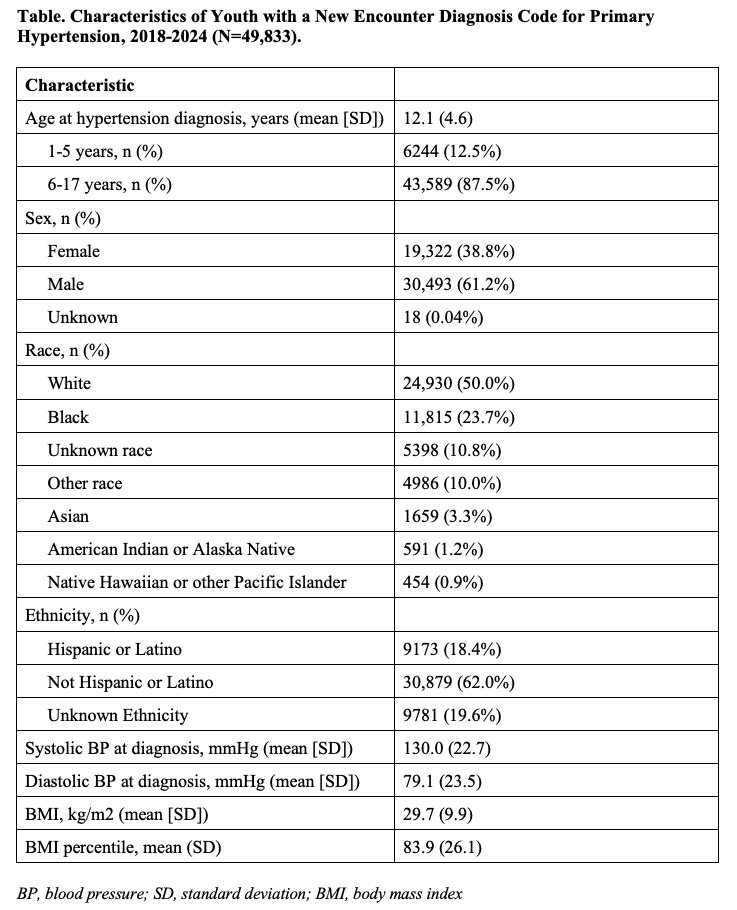
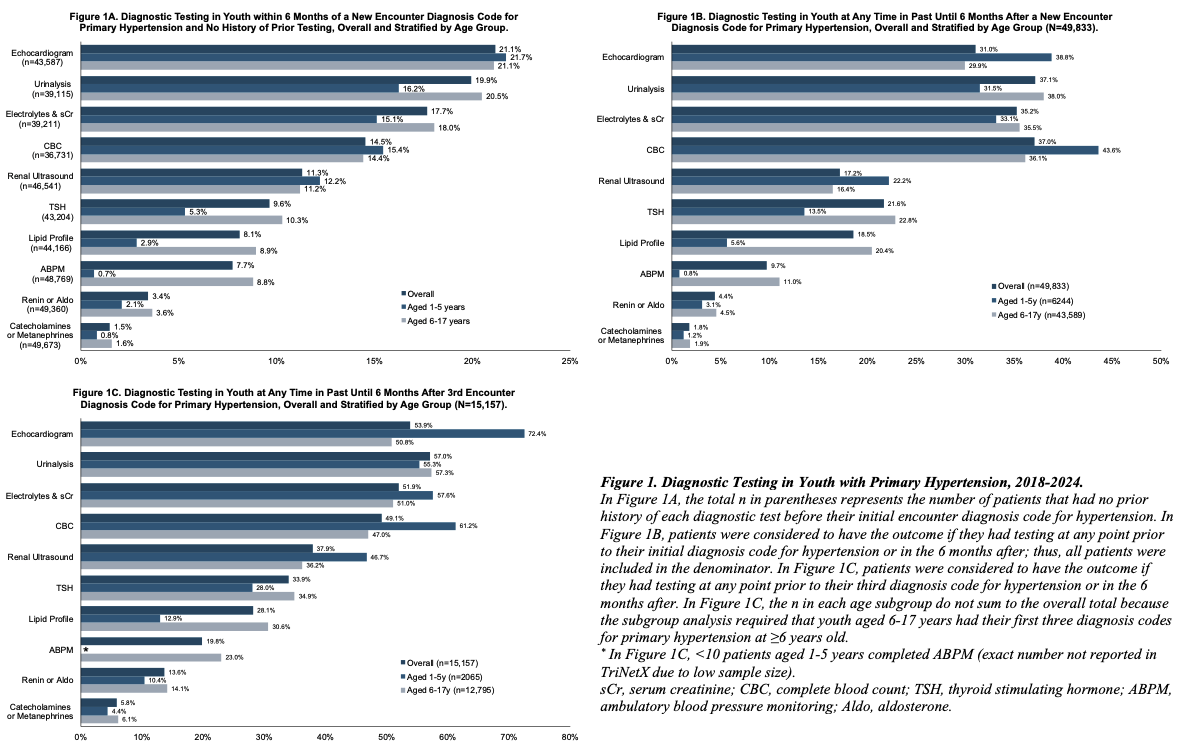
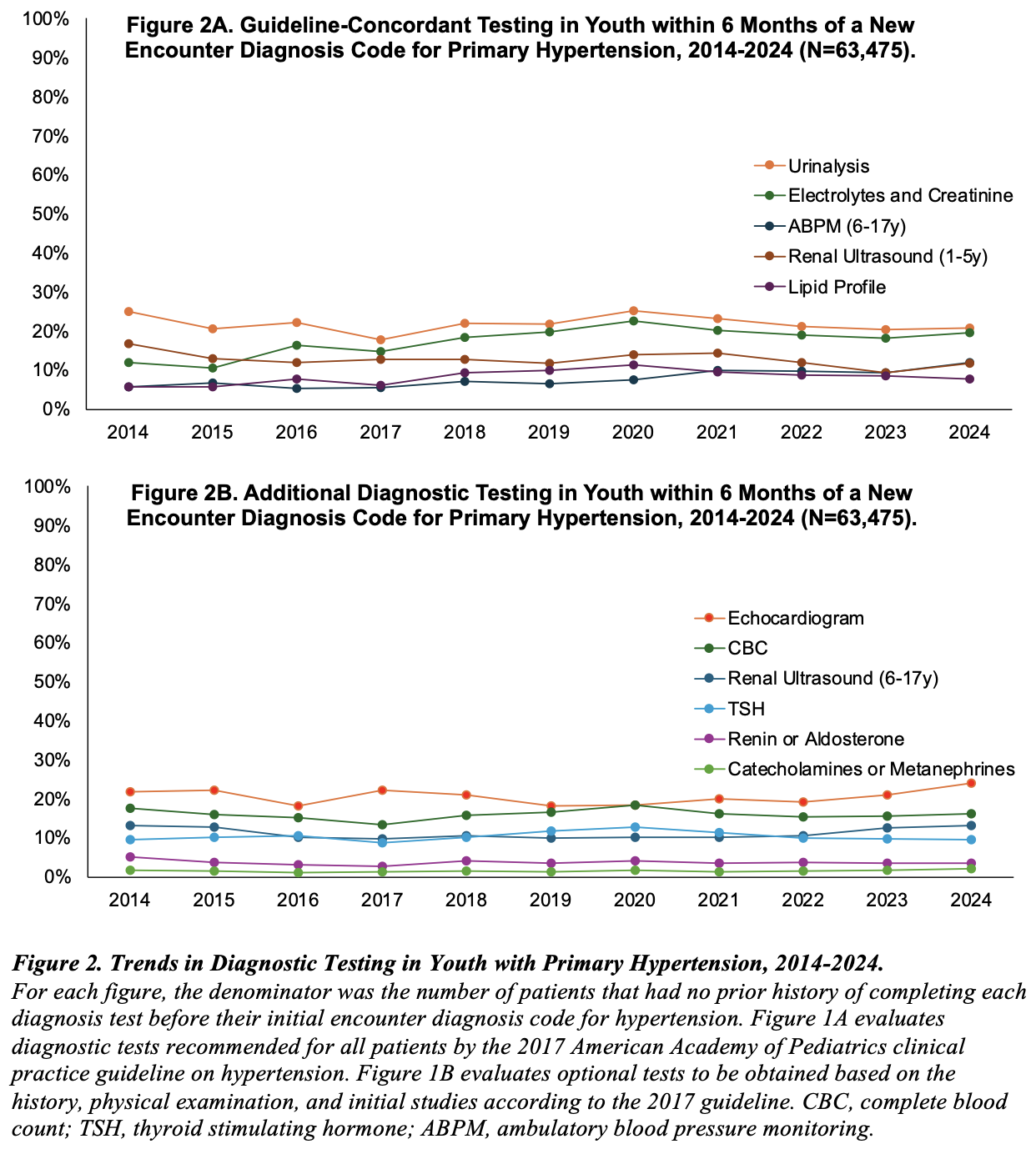
Background: The 2017 American Academy of Pediatrics guideline on hypertension provides recommendations for diagnostic testing in youth with incident hypertension. Adherence to guideline-recommended testing in a national sample of U.S. youth with hypertension is unknown. Objective: (1) To determine the prevalence of guideline-concordant diagnostic testing in youth with incident hypertension; (2) To explore trends in testing before and after the 2017 guideline. Design/Methods: We performed a retrospective cohort study using aggregated electronic health record data in the TriNetX U.S. Research Network, a repository of >96 million patients from 53 health systems. We identified youth aged 1-17 years with an initial ICD-10 encounter diagnosis code for primary hypertension (I10) at an ambulatory visit from 2014-2024. We excluded children with a history of any ICD-10 encounter diagnosis code for a hypertension-related disorder (I10, I11, I12, I13, I15, I16, I1A). We determined the prevalence of lab testing, ambulatory blood pressure monitoring (ABPM), echocardiogram, and renal ultrasound based on procedure codes within six months after the initial diagnosis code for hypertension in youth that never had the test previously. We performed sensitivity analyses in youth with ≥3 diagnosis codes for hypertension and by adjusting the time window of testing. Results: A total of 49,833 youth had an incident encounter diagnosis code for primary hypertension from 2018-2024 (mean age 12.1 years [SD, 4.6], 38.8% female, 50.0% White, 23.7% Black, 18.4% Hispanic) (Table). Among youth without prior diagnostic testing, the most frequent tests in the six months after the initial diagnosis code for hypertension were echocardiogram (21.1%), urinalysis (19.9%), and serum electrolytes and creatinine (17.7%) (Fig 1A). The prevalence of other guideline-concordant tests included renal ultrasound in 12.2% of youth aged 1-5 years, ABPM in 7.7% of youth aged 6-17 years, and lipid profile in 8.1% of all youth. From 2014-2024, there was a significant increase in ABPM from 5.7% to 11.9% (P < 0.001 for trend) and electrolyte and creatinine testing from 12.0% to 19.5% (P < 0.001 for trend) (Fig 2). For the 15,157 youth with ≥3 diagnosis codes for hypertension from 2018-2024, diagnostic testing was completed more frequently yet most did not undergo guideline-recommended testing (Fig 1C).
Conclusion(s): The prevalence of guideline-recommended testing in youth with a new diagnosis code for hypertension is low. Future work is needed to explore determinants and improve completion of guideline-recommended testing.
Table. Characteristics of Youth with a New Encounter Diagnosis Code for Primary Hypertension, 2018-2024 (N=49,833).
Figure 1. Diagnostic Testing in Youth with Primary Hypertension, 2018-2024.
Figure 2. Trends in Diagnostic Testing in Youth with Primary Hypertension, 2014-2024.