417 - Association of GERD by ICD-10 Codes with Blood Pressure Severity, Target Organ Injury, and Cardiovascular Health at Baseline in Youth Receiving Subspecialty Care for Hypertension: A SUPERHERO Analysis
Friday, April 24, 2026
5:30pm - 8:00pm ET
Publication Number: 1400.417
Maggie Murphy, University of Kentucky College of Medicine, Lexington, KY, United States; Stefan G. Kiessling, Kentucky Children's Hospital, Lexington, KY, United States; Nermin Ahmed, University of Kentucky, Lexington, KY, United States; Andrew M.. South, Wake Forest School of Medicine of Wake Forest Baptist Medical Center, Winston Salem, NC, United States
Assistant Professor/Pediatric Renal Dietitian University of Kentucky College of Medicine University of Kentucky Healthcare Lexington, Kentucky, United States
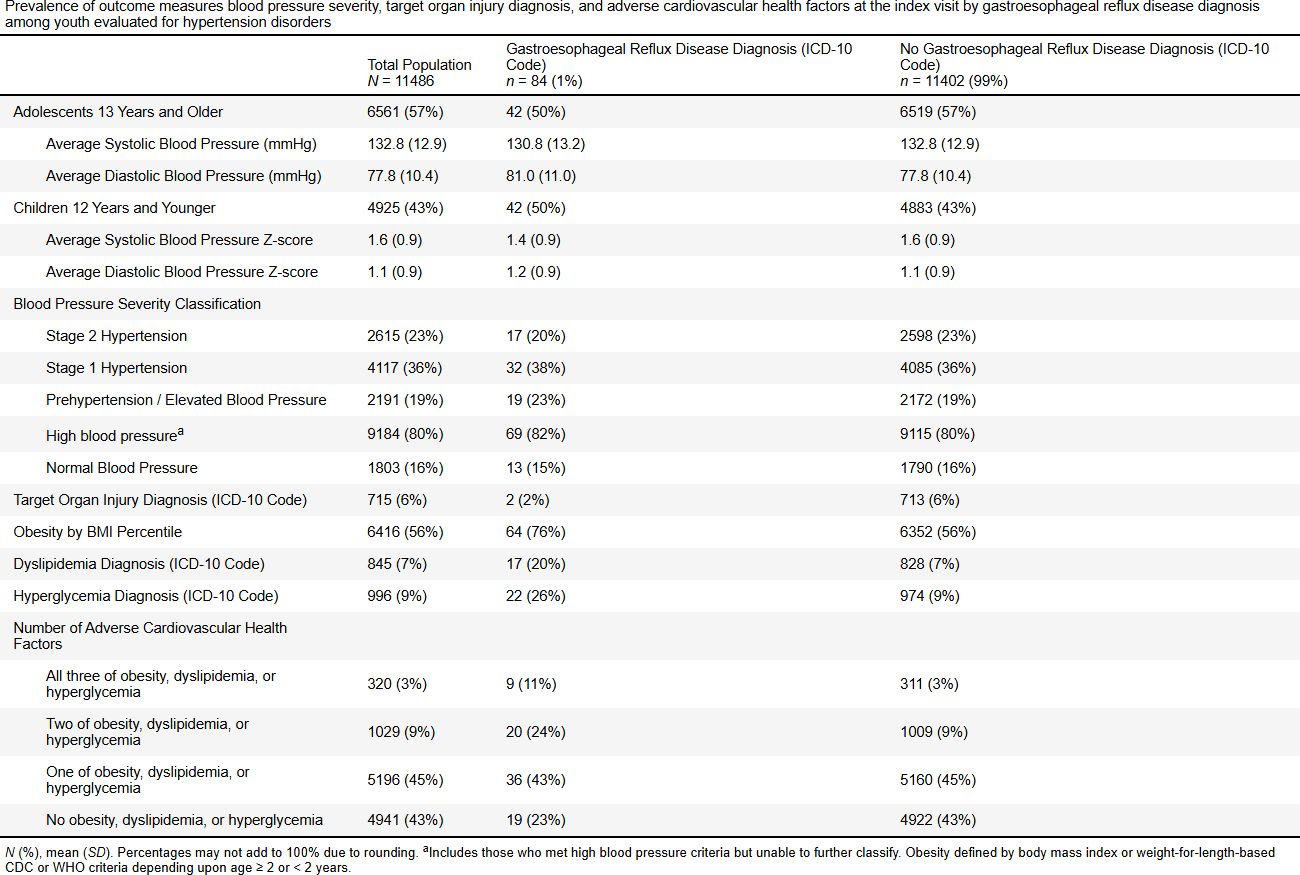
Background: Gastroesophageal reflux disease (GERD) is one of the most prevalent gastrointestinal conditions globally with up to 25% of children and adolescents affected. Patients with GERD often present with several comorbidities including hypertension (HTN). However, GERD's impact on cardiovascular health in youth with HTN is unknown Objective: Investigate association of GERD with blood pressure (BP) severity, target organ injury (TOI), and cardiovascular health at baseline in youth with HTN disorders. Design/Methods: Cross-sectional analysis of baseline data from the Study of the Epidemiology of Pediatric Hypertension (SUPERHERO), a multisite retrospective Registry of youth receiving subspecialty care for HTN disorders using electronic health record data. Inclusion criteria were an initial subspecialty clinic visit for HTN disorders identified by ICD-10 codes from 1/1/2016-12/31/2023 and age < 19 years. Exclusion criteria were kidney failure on dialysis, kidney transplantation, or pregnancy by ICD-10 codes. Exposure was GERD by ICD-10 codes. DAG-informed adjusted generalized linear models estimated the association of GERD with the outcomes of BP severity with z-scores and classification per US guidelines, TOI, dyslipidemia, and hyperglycemia by ICD-10 codes. Results: Of the 11,486 participants, the mean (SD) age was 12.6 ± 4.7 years, 62% were male, 54% were white, and 1% (n=84) had GERD. Youth with GERD had 2.16 times higher risk of dyslipidemia (95% CL 1.34 to 3.49 and 2.42 times higher risk of hyperglycemia (95% CI 1.59 to 3.69). GERD was not significantly associated with higher risk for BP severity or TOI.
Conclusion(s): In a large multisite registry of youth receiving subspecialty care for HTN disorders, GERD was associated with higher risk for dyslipidemia and hyperglycemia. Ongoing work in this registry includes collecting laboratory data and echocardiogram data. If validated, GERD could be a modifiable risk factor in improving cardiovascular health and long-term outcomes in youth with HTN disorders.
Systolic and diastolic blood pressure z-scores at the index visit by GERD diagnosis among youth>13 years old evaluated for hypertension disorders
Prevalence of outcome measures by the GERD diagnosis among youth evaluated for hypertension disorders










.png)