780 - Clear View, First Try: A Quality Improvement Approach to Neonatal Intubation
Friday, April 24, 2026
5:30pm - 8:00pm ET
Publication Number: 1756.780
Erin Hanft, Children's Hospital Medical Center (Cincinnati, OH), Montgomery, OH, United States; Katherine Harsh, Cincinnati Children's Hospital Medical Center, Cincinnati, OH, United States; Beth Ann Johnson, Cincinnati Children's Hospital Medical Center, Cincinnati, OH, United States; Stacey L. Dornette, Cincinnati Children's Hospital Medical Center, Harrison, OH, United States; Robin Breig, Cincinnati Children's Hospital Medical Center, CINCINNATI, OH, United States; Susan Williams, Cincinnati Children’s Hospital, Cincinnati, OH, United States; Stefanie L. Riddle, Cincinnati Children's Hospital Medical Center, Cincinnati, OH, United States; Harley Brown, Cincinnati Children's Hospital Medical Center, Florence, KY, United States; Sarah M. Wiley, Cincinnati Children's Hospital Medical Center, South Lebanon, OH, United States; Alexis Hornberger, Cincinnati Children's Hospital Medical Center, Lawrenceburg, IN, United States; Morgan E. Hill, Cincinnati Children's Hospital Medical Center, Loveland, OH, United States
Assistant Professor Children's Hospital Medical Center (Cincinnati, OH) Montgomery, Ohio, United States
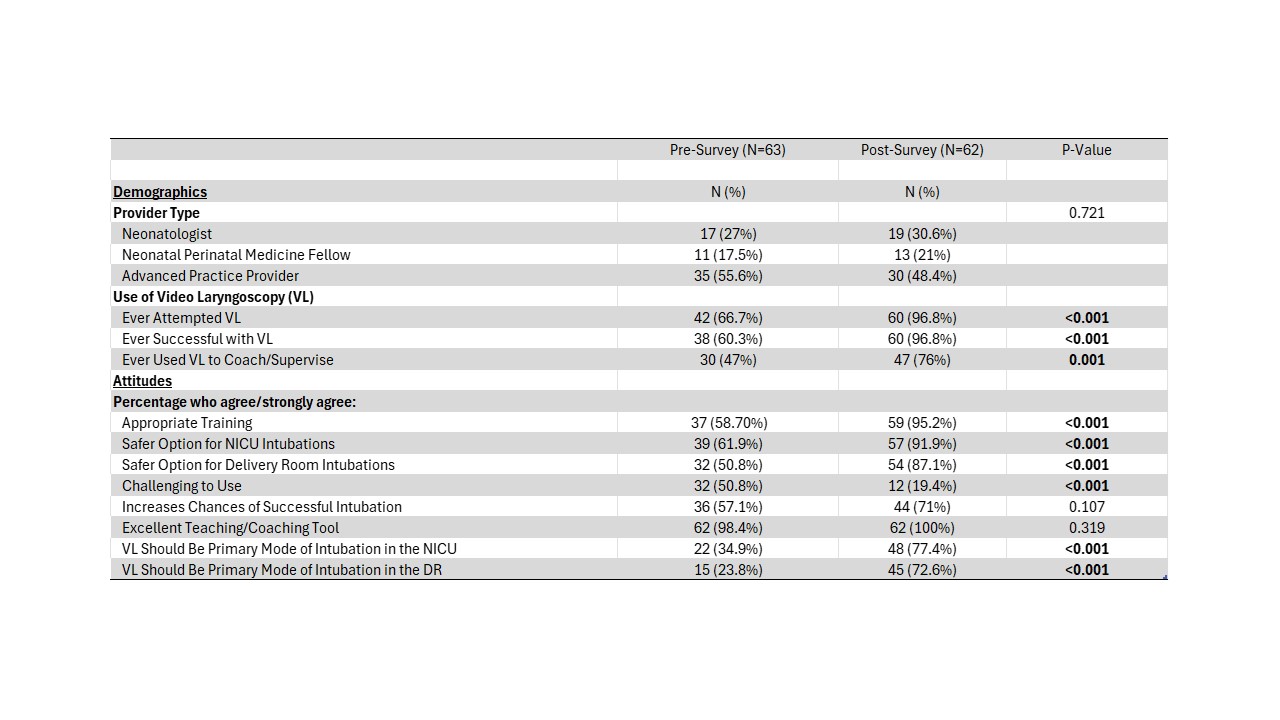
Background: Tracheal intubation may be lifesaving for neonates. The National Emergency Airway Registry for Neonates (NEAR4NEOS) reports first attempt success rates of 49% for Neonatal Intensive Care Unit (NICU) intubations. At our Fetal Care Center (FCC) delivery room (DR) and Level IV NICU all intubations by neonatal providers had a first attempt success rate of 65%. While this exceeded published rates, we sought further improvement. Although video laryngoscopy (VL) has been shown to improve success and reduce complications, it was used in only 30% of intubations at our institution. Objective: This quality improvement (QI) initiative aims to increase first attempt intubation success rates in the NICU and FCC from 65% to 80% in one year. We also aim to improve attitudes surrounding the use of VL and increase its use from 30% to 50%. Design/Methods: All infants intubated by neonatal providers in the NICU and FCC were included. An interprofessional team of physicians, advanced practice providers and respiratory therapists created a process map and key driver diagram (Figure 1). PDSA cycles included simulation sessions, a standardized airway bundle and focused video review for FCC intubations. Intubation attempt is defined as an airway maneuver that starts with the insertion of the laryngoscope blade into the patient's mouth and ends when it is removed. First attempt success is defined as successful tracheal intubation on the first attempt by the first airway provider. Control charts were used to track first attempt success rates and VL use. A survey assessed attitudes regarding use of VL before and after interventions. Statistical significance was assessed using chi-squared tests. Results: VL use rose from 30% to 75% in one year (Figure 2a). First attempt success rate remained stable at 65% (Figure 2b). Balancing measures included the incidence of bradycardia (remained stable at 5%) and the incidence of hypoxia (decreased from 20% to 10%). Sixty-three providers completed the pre-survey (Fall 2023); 62 providers completed the post-survey (Summer 2025). Providers reporting VL use increased from 66.7% to 96.8% (p= < 0.001), and attitudes surrounding use of VL became more positive; now >70% of providers believe VL should be the primary mode of intubation in the DR and NICU (Table 1).
Conclusion(s): QI methodology increased VL use and improved VL attitudes while reducing hypoxia-related events. However, this did not translate to increased first attempt success rates. We speculate this may be due to a high baseline success rate, making further improvements challenging for the high-risk patient population in our level IV NICU.
Figure 1. Key Driver Diagram
Figure 2a. Control chart: Patients Intubated with Video Laryngoscopy: Jan 2024-Present; Figure 2b. Control chart: First Attempt Success Rate on All Intubations: Sept 2023-Present










.jpg)
.jpg)