








Neonatal Pulmonology
Session: Neonatal Pulmonology - Basic/Translational Science 3: Pulmonary Vascular Biology and Stem Cells
.jpg "Nuria Daghbouche-Rubio, PhD, PhD (she/her/hers) photo")
Nuria Daghbouche-Rubio, PhD, PhD (she/her/hers)
Postdoc
University of California, Davis, School of Medicine
Davis, California, United States
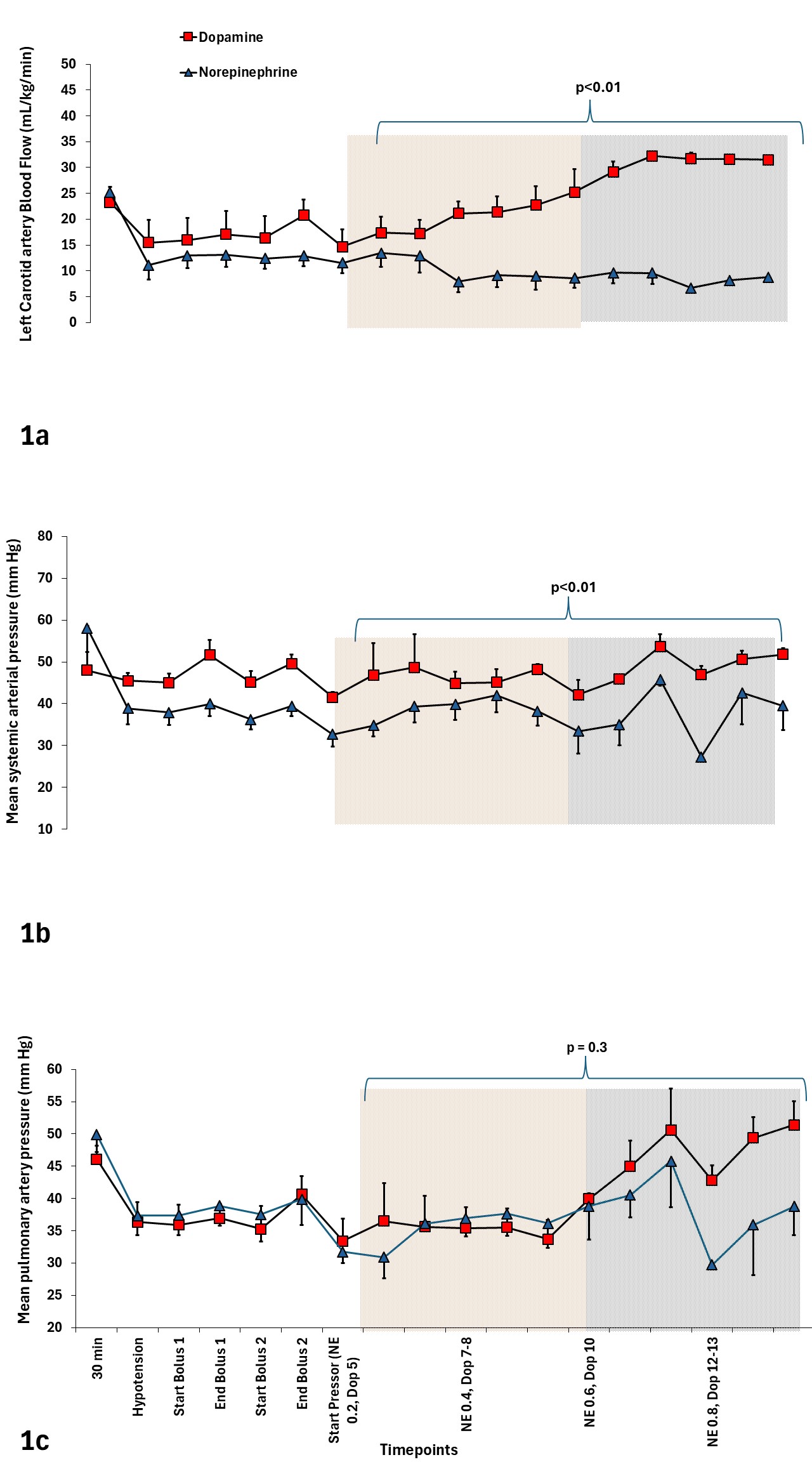 Carotid artery blood flow and SAP were higher with dopamine whereas the PAP was not different. When comparing carotid blood flow with lower doses (dopamine <10 mcg/kg/min and norepinephrine < 0.4 mcg/kg/min), p=0.01, and when comparing carotid blood flow with higher doses (dopamine > or equal to 10 mcg/kg/min and norepinephrine > or equal to 0.6 mcg/kg/min), p <0.0001. Similarly for left pulmonary artery blood flow, comparison of dopamine vs norepinephrine at lower doses had p=0.005, and comparison of higher doses had p= 0.02. On the contrary, the PAP was not different at lower (p= 0.67) or higher doses (p=0.34). Data presented as mean and standard error of mean, compared using ANOVA repeated measures. The peach shaded area represents comparison between lower doses and gray shaded area represents comparison between higher doses.
.jpg) Table and Figure 2. Table shows baseline characteristics for lambs with asphyxia, MAS and PPHN that received dopamine and norepinephrine, respectively, to treat systemic hypotension. Comparison of cerebral systemic vascular resistance (figure 2a) and pulmonary vascular resistance (PVR, figure 2b) between dopamine and norepinephrine showed higher cerebral SVR with norepinephrine (p < 0.01) and PVR was not different. When comparing cerebral SVR at lower doses (dopamine <10 mcg/kg/min and norepinephrine < 0.4 mcg/kg/min), p=0.005, and when comparing cerebral SVR with higher doses (dopamine > or equal to 10 mcg/kg/min and norepinephrine > or equal to 0.6 mcg/kg/min), p< 0.0001. On the contrary, for pulmonary vascular resistance, comparison of dopamine vs norepinephrine at lower doses and higher doses respectively were not different. Data presented as mean and standard error of mean, compared using ANOVA repeated measures. The peach shaded area represents comparison between lower doses and gray shaded area represents comparison between higher doses.
Table and Figure 2. Table shows baseline characteristics for lambs with asphyxia, MAS and PPHN that received dopamine and norepinephrine, respectively, to treat systemic hypotension. Comparison of cerebral systemic vascular resistance (figure 2a) and pulmonary vascular resistance (PVR, figure 2b) between dopamine and norepinephrine showed higher cerebral SVR with norepinephrine (p < 0.01) and PVR was not different. When comparing cerebral SVR at lower doses (dopamine <10 mcg/kg/min and norepinephrine < 0.4 mcg/kg/min), p=0.005, and when comparing cerebral SVR with higher doses (dopamine > or equal to 10 mcg/kg/min and norepinephrine > or equal to 0.6 mcg/kg/min), p< 0.0001. On the contrary, for pulmonary vascular resistance, comparison of dopamine vs norepinephrine at lower doses and higher doses respectively were not different. Data presented as mean and standard error of mean, compared using ANOVA repeated measures. The peach shaded area represents comparison between lower doses and gray shaded area represents comparison between higher doses..jpg) Ex vivo receptor-mediated contraction to norepinephrine was greater in 3rd generation systemic arteries compared to 5th generation pulmonary arteries suggesting that norepinephrine is relatively selective to systetmic circulation. On the contrary, the receptor-mediated contraction to dopamine was similar in systemic and pulmonary arteries, suggesting that dopamine is a non-selective agent. The non-receptor-mediated constriction to 118 mM KCl indicating the inherent ability to constrict was higher in systemic arteries than in pulmonary arteries. Data presented as raw tension in mN and compared using two-way ANOVA for dose response curves to norepinephrine and dopamine and unpaired t-test for contraction to 118 mM KCl.
Ex vivo receptor-mediated contraction to norepinephrine was greater in 3rd generation systemic arteries compared to 5th generation pulmonary arteries suggesting that norepinephrine is relatively selective to systetmic circulation. On the contrary, the receptor-mediated contraction to dopamine was similar in systemic and pulmonary arteries, suggesting that dopamine is a non-selective agent. The non-receptor-mediated constriction to 118 mM KCl indicating the inherent ability to constrict was higher in systemic arteries than in pulmonary arteries. Data presented as raw tension in mN and compared using two-way ANOVA for dose response curves to norepinephrine and dopamine and unpaired t-test for contraction to 118 mM KCl. 