49 - Amyloid-β Variants Associated with Alzheimer’s Disease Are Elevated in the Cord Blood of Premature Infants
Friday, April 24, 2026
5:30pm - 8:00pm ET
Publication Number: 1042.49
Saminathan Anbalagan, University of South Alabama Children's and Women's Hospital, Mobile, AL, United States; Kalsang Dolma, University of South Alabama Children's and Women's Hospital, Mobile, AL, United States; Althea deWeever, University of South Alabama College of Medicine, MOBILE, AL, United States; Linn Ayers, University of South Alabama College of Medicine, MOBILE, AL, United States; Manimaran Ramani, University of Alabama School of Medicine, Birmingham, AL, United States; Troy Stevens, University of South Alabama College of Medicine, Mobile, AL, United States
Assistant Professor University of South Alabama Children's and Women's Hospital Mobile, Alabama, United States
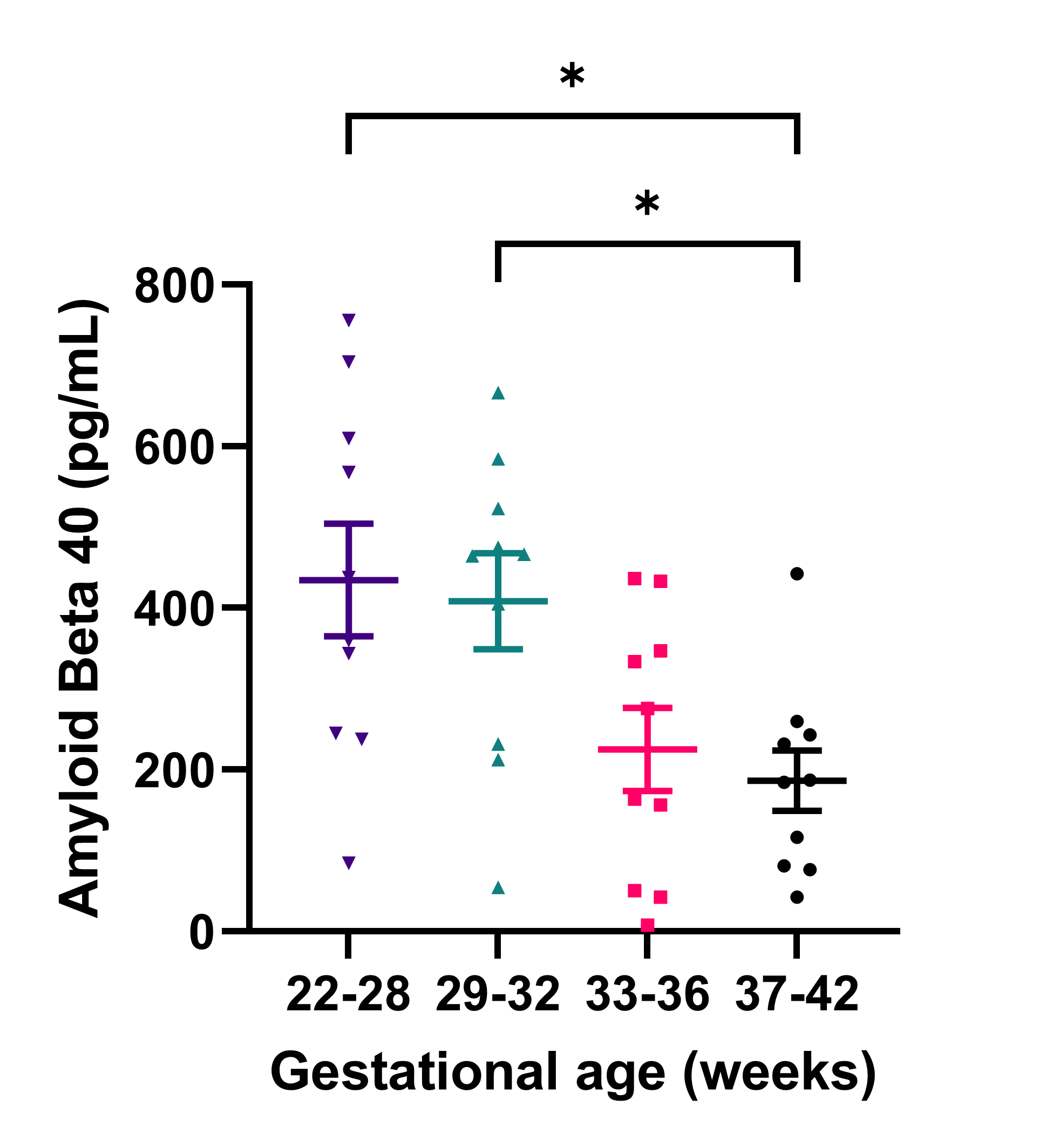
Background: Amyloid precursor protein (APP), a transmembrane protein expressed in neuronal, non-neuronal, and vascular tissues, can be cleaved to produce the amyloidogenic Amyloid Beta (Aβ) variants implicated in Alzheimer's disease. Recent studies have found the Aβ variants even in the cord blood of term neonates. However, gestational age-specific reference levels and developmental patterns remain unknown. Objective: This study aims to investigate Aβ isoforms across different gestational ages and correlate them with perinatal factors and neonatal outcomes. Design/Methods: Umbilical cord blood samples were collected from infants born at the University of South Alabama Children's and Women's Hospital after obtaining appropriate IRB approval. Infants were categorized into four groups: 22 -28 weeks (extremely preterm), 29 - 32 weeks (very preterm), 33 - 36 weeks (late preterm), and 37 - 42 weeks (term) of gestational age (GA). Baseline maternal and infant demographic data were collected from electronic records. Beta amyloid concentrations (Amyloid beta 38 (Aβ38), 40 (Aβ40), and 42 (Aβ42) isoforms) were measured using Meso-Scale Discovery electrochemiluminescence (ECL) immunoassay. Standard statistical tests were used. Results: Umbilical cord blood from 40 infants was analyzed. Amyloid beta 40 variant (313.5 ± 201.9 pg/mL) and amyloid beta 42 variant (42.2 ± 56.6 pg/mL) were present in all samples, with concentrations at least 2 times higher than healthy adult plasma. Aβ40, but not Aβ42, was found to be statistically different across different GA groups, and it decreased with increasing gestational age (r= -0.55, p< 0.001) (Figure 1). There were no differences in Aβ40 and Aβ342 levels based on gender, mode of birth, chorioamnionitis, placental vascular malformations, fetal growth restriction, and pregnancy-induced hypertension. However, the Aβ42/40 ratio showed a trend towards significance for intraventricular hemorrhage among infants born < 32 weeks (n=4/20, p=0.079). Aβ38 was not consistently detected.
Conclusion(s): Isoform-specific beta amyloids are present in high concentrations in the cord blood of extremely preterm neonates with an inverse correlation with gestational age. While proportions of Aβ42/40 may reflect an active period of neurogenesis and angiogenesis, preliminary, hypothesis-generating data suggest a role for neuronal injury. Further large-scale research is necessary to deepen the understanding of its developmental specificity and potential role as a biomarker for neuronal or vascular injury.
Figure 1. Cord blood amyloid beta 40 concentration across different gestational ages.