Session: Mental Health 2: Provider and Family Perspectives
144 - Stakeholder Perspectives on Factors Influencing Mental Health Following Mild Traumatic Brain Injury
Friday, April 24, 2026
5:30pm - 8:00pm ET
Publication Number: 1134.144
Vincent R.. Alexander, Cincinnati Children's Hospital Medical Center, Cincinnati, OH, United States; Lillian Klein, Cincinnati Children's Hospital Medical Center, Independence, KY 41051-8659, KY, United States; Shari L.. Wade, Cincinnati Children's Hospital Medical Center, Cincinnati, OH, United States; Tess Guzman, Cincinnati Children's Hospital Medical Center, Cincinnati, OH, United States; Teresa Pestian, Cincinnati Children's Hospital Medical Center, Cincinnati, OH, United States; Lisa M.. Vaughn, Cincinnati Children's Hospital Medical Center, Cinc, OH, United States; Richa Patel, Cincinnati Children's Hospital Medical Center, Cincinnati, OH, United States; KellyAnn Bonanno, Cincinnati Children's Hospital Medical Center, Cincinnati, OH, United States; Kelly R. Molloy, University of Cincinnati; Cincinnati Children’s Hospital Medical Center, Cincinnati, OH, United States; Sabrina Bothwell, University of Cincinnati, Cincinnati, OH, United States; Lynn Babcock, Cincinnati Children's Hospital Medical Center, Cincinnati, OH, United States; Brad G. Kurowski, Cincinnati Childrens and University of Cincinnati, Cincinnati, OH, United States
Assistant Professor Cincinnati Children's Hospital Medical Center Cincinnati, Ohio, United States
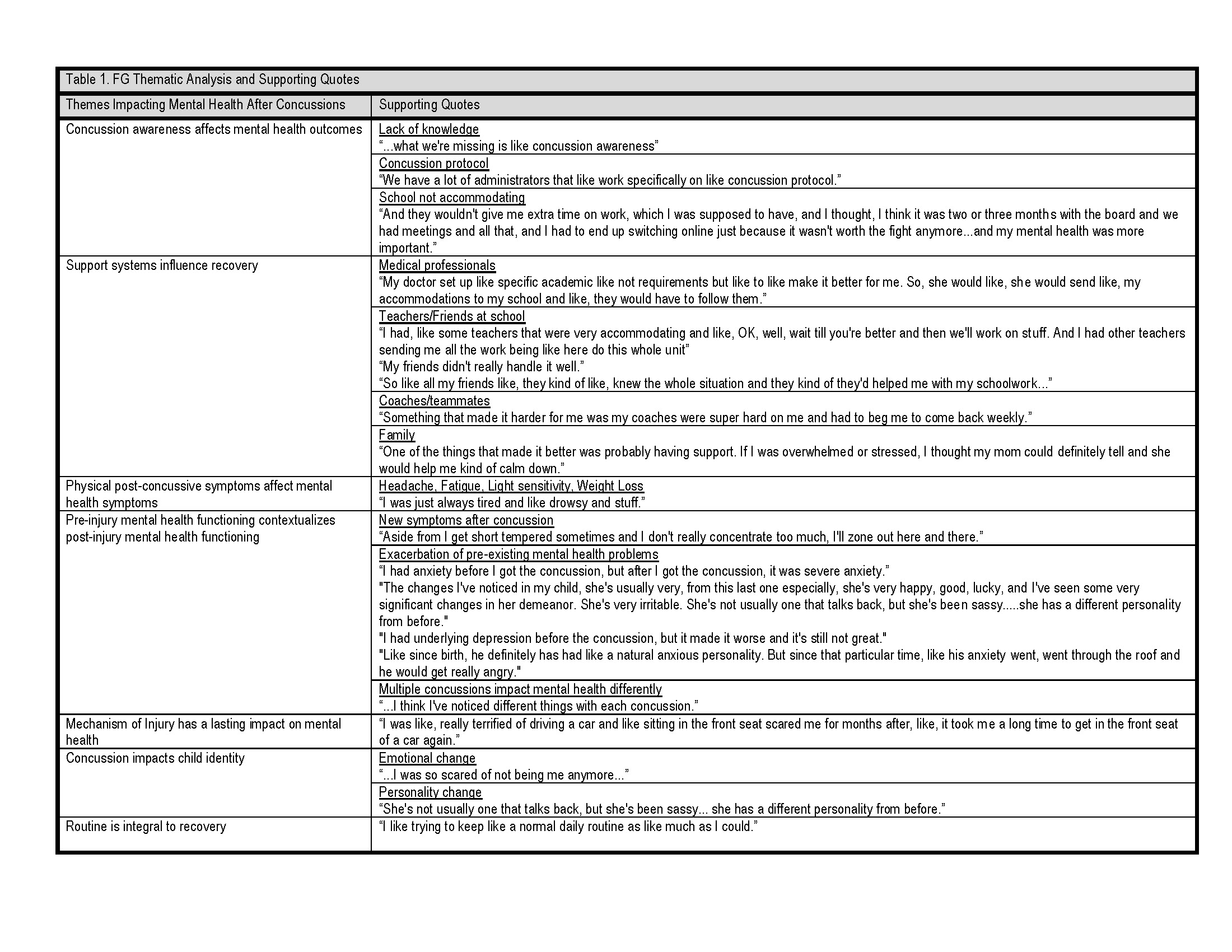
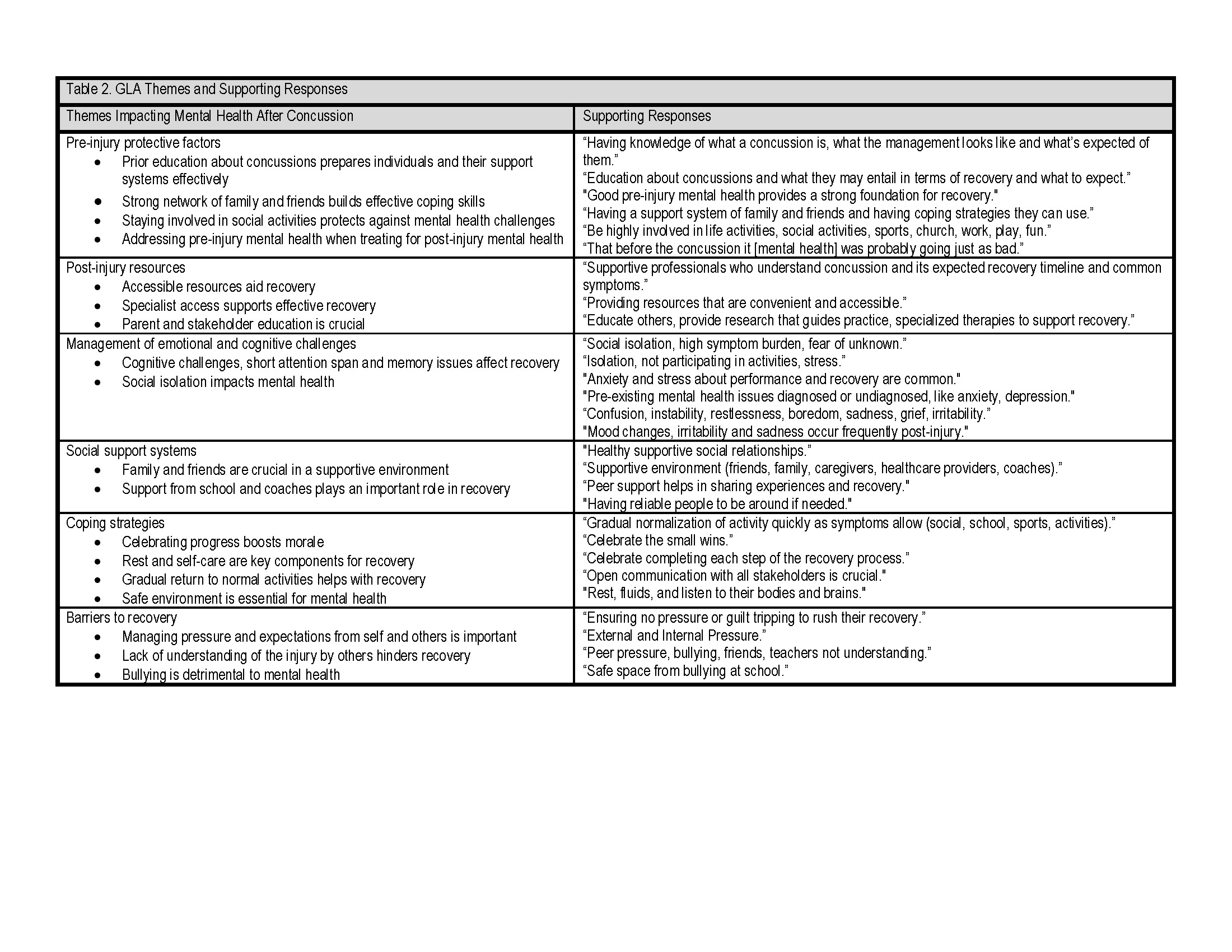
Background: Adolescents with mild traumatic brain injury (mTBI) often experience mental health challenges, yet the factors shaping these outcomes remain underexplored and poorly characterized. Gathering perspectives from stakeholders can shed light on social and environmental drivers and inform screening and support. Objective: To characterize factors influencing mental health following mTBI via input from adolescents with mTBI, their parents, and community stakeholders. Design/Methods: This IRB approved qualitative study employed both focus groups (FG) and group-level assessments (GLA). Virtual, moderator-led sessions included adolescents with a recent mTBI, parents, clinicians, athletic trainers, coaches, and school staff. FG sessions followed semi-structured guides to elicit individual experiences related to mental health after mTBI. GLA sessions employed a structured six-step process to generate, reflect on, and prioritize shared insights. Thematic analysis was applied to FG transcripts, while GLA themes were collaboratively developed by participants. Themes from both methods were synthesized using card-sort methodology and iterative team review. Results: FG included 20 participants (15 adolescents, 5 parents); GLA included 32 (10 adolescents, 9 parents, 13 other stakeholders). Themes and supporting quotes/responses for FG and GLA are described in Table 1 and 2, respectively. Across methods, five convergent themes emerged: (1) concussion knowledge: education and informed care reassured, whereas limited knowledge, dismissal, and delays increased distress; (2) support systems: family, peer, school, and clinician support with timely accommodations protected mental health, whereas lack of support, bullying or peer pressure, and pressure to recover quickly hindered recovery; (3) pre-injury mental health: prior anxiety or depression heightened risk and complicated recovery; (4) identity and sense of self: adapting expectations and embracing a new normal aided adjustment, whereas isolation and role change added strain; (5) post-injury coping strategies: paced return to activities, rest, self-care, consistent routines, and celebrating small gains supported recovery, whereas rapid return without pacing was detrimental.
Conclusion(s): These stakeholder insights identify pre-injury and post-injury factors linked to post-mTBI mental health across individual, family, school, and care contexts. Implications include clear education, consistent accommodations, coordinated communication across settings, routine mental health assessment, and timely follow-up.
Table 1. FG Thematic Analysis and Supporting Quotes