720 - Trends in Asthma-Related Pediatric Mortality
Monday, April 27, 2026
8:00am - 10:00am ET
Publication Number: 4703.720
Isabel J. Hardee, Boston Children's Hospital, Boston, MA, United States; Michael Monuteaux, Boston Children's Hospital, Boston, MA, United States; ROBERT HOFFMANN, Boston Children's Hospital, Boston, MA, United States; Alexander Hirsch, Boston Children's Hospital, Boston, MA, United States; Susan Lipsett, Boston Children's Hospital, Boston, MA, United States; Kyle Nelson, Harvard Medical School, Boston Children's Hospital, Boston, MA, United States; Mark Neuman, Harvard Medical School, boston, MA, United States
Pediatric Emergency Medicine Fellow Boston Children's Hospital Boston, Massachusetts, United States
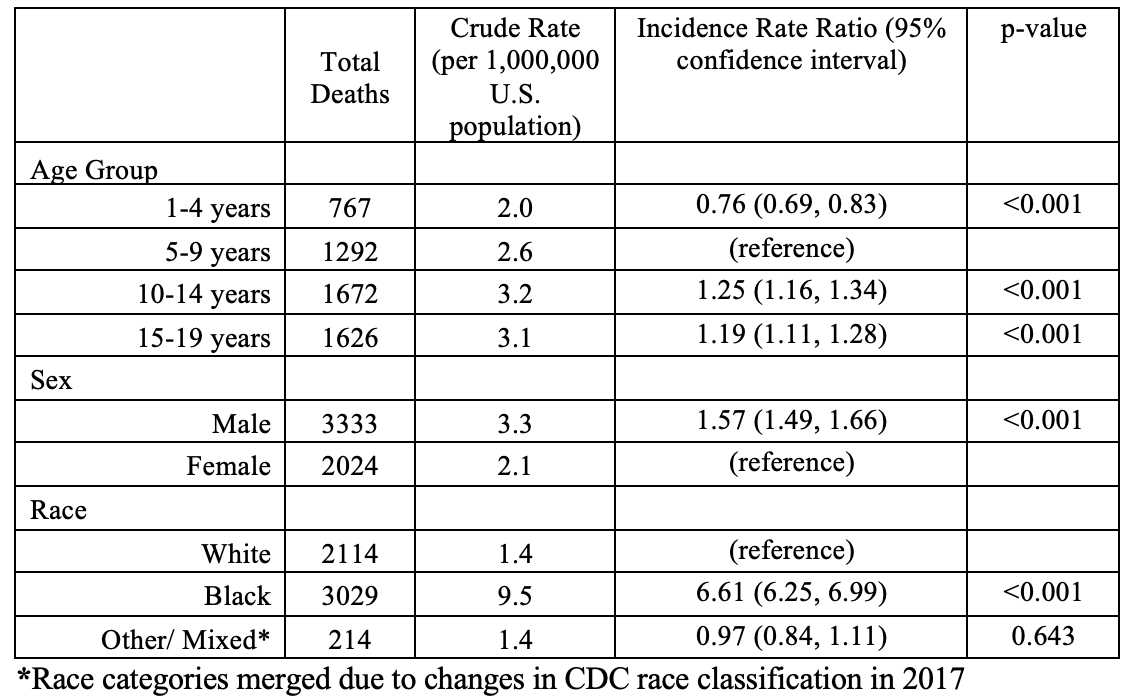
Background: Asthma is a leading cause of pediatric mortality. Advances in pediatric asthma management have improved outcomes including fewer exacerbations and emergency department visits for children with persistent asthma, however it is unclear whether these advances are associated with lower mortality rates in children. Objective: Describe trends in pediatric asthma mortality overall and by demographic group. Design/Methods: We conducted a cross-sectional analysis of asthma-related mortality among children in the US as reported in the US Center for Disease Control (CDC) WONDER database. We included children 1-19 years of age with cause of death ICD-10 codes for asthma (J45 and J46) from 1999-2023, overall and stratified by year, age, sex, race, and census region. U.S. Census Bureau population estimates were used to calculate rates. We used Poisson regression with year as the independent variable to test the linear temporal trend in overall asthma-related mortality rate over time. Incidence rate ratios with 95% confidence intervals (CI) and p-values were calculated to compare asthma mortality rates by age, sex, race and region. Results: Over the study period, there were 5,357 asthma deaths with a mortality rate of 3 per 1,000,000 US children. The mortality rate did not significantly change over the study period (annual mean percent change -0.4%; incidence rate ratio (IRR) 0.996 (95% CI=0.993, 1.000; Figure 1)). Mortality rates were higher in older children in the 10-14 (IRR 1.25, 95% CI 1.16, 1.34) and 15-19 (IRR 1.19, 95% CI 1.11, 1.28) year age groups, when compared younger age groups (p < 0.001). Asthma mortality was higher in males (IRR 1.57, 95% CI 1.49, 1.66), and in Black children (IRR 6.61, 95% CI 6.25, 6.99) compared to White children (Table 1). The Great Lakes Region had the highest asthma related mortality (Table 1, Figure 2).
Conclusion(s): Asthma-related mortality rates remained stable from 1999 to 2023, despite advances in pediatric asthma management. Mortality rates among Black children were six times higher than that of White children, underscoring potential differences in access to care and social determinants of health. Mortality rates also differed significantly among various US regions. This study may inform future research aimed at elucidating factors associated with, and treatment approaches to prevent pediatric asthma death.
Table 1. Asthma-related mortality rate by demographic group
Figure 1. Pediatric asthma mortality over time
Figure 2. Pediatric asthma-related mortality by census region 1999-2023










.png)
.png)
