








Neonatal Infectious Diseases/Immunology
Session: Neonatal Infectious Diseases/Immunology 2: Basic and Translational Science in Neonatal Infections

Sarah G. Cioffi
Undergraduate Research Assistant
Case Western Reserve University School of Medicine
Rocky Hill, Connecticut, United States
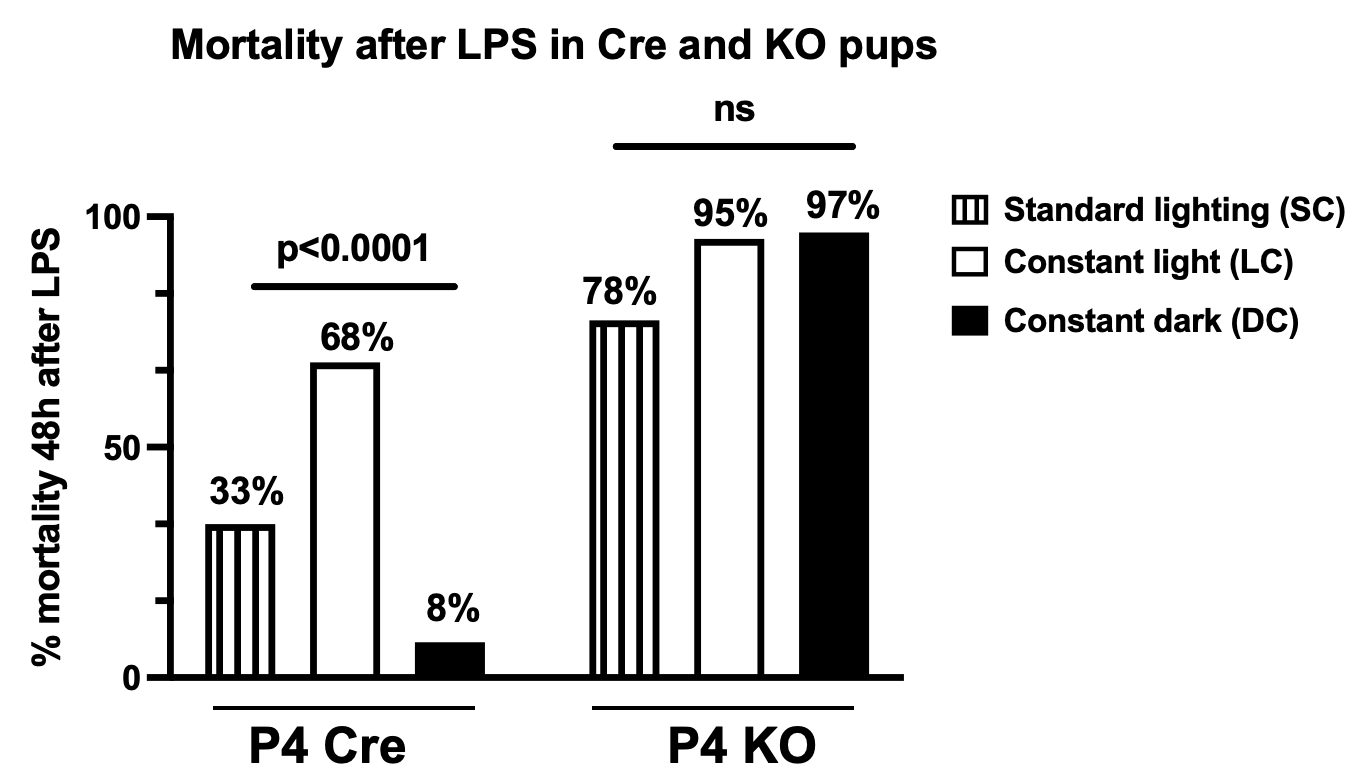 Fig. 1. Mortality within 48 hours after intraperitoneal LPS injection (5ug/gm) on P4 after pups were housed in SC, LC, or DC conditions from birth (P0) till P4. Pups were continued in the same conditions for 48h after LPS. Whereas LC increases mortality significantly in Cre pups and DC confers an almost 100% protection, KO pups exhibit uniformly high mortality across all circadian conditions and higher mortality than Cre pups for all respective circadian conditions. N=20-25 pups per condition; Chi-square test for trend used for analysis. ns=not significant.
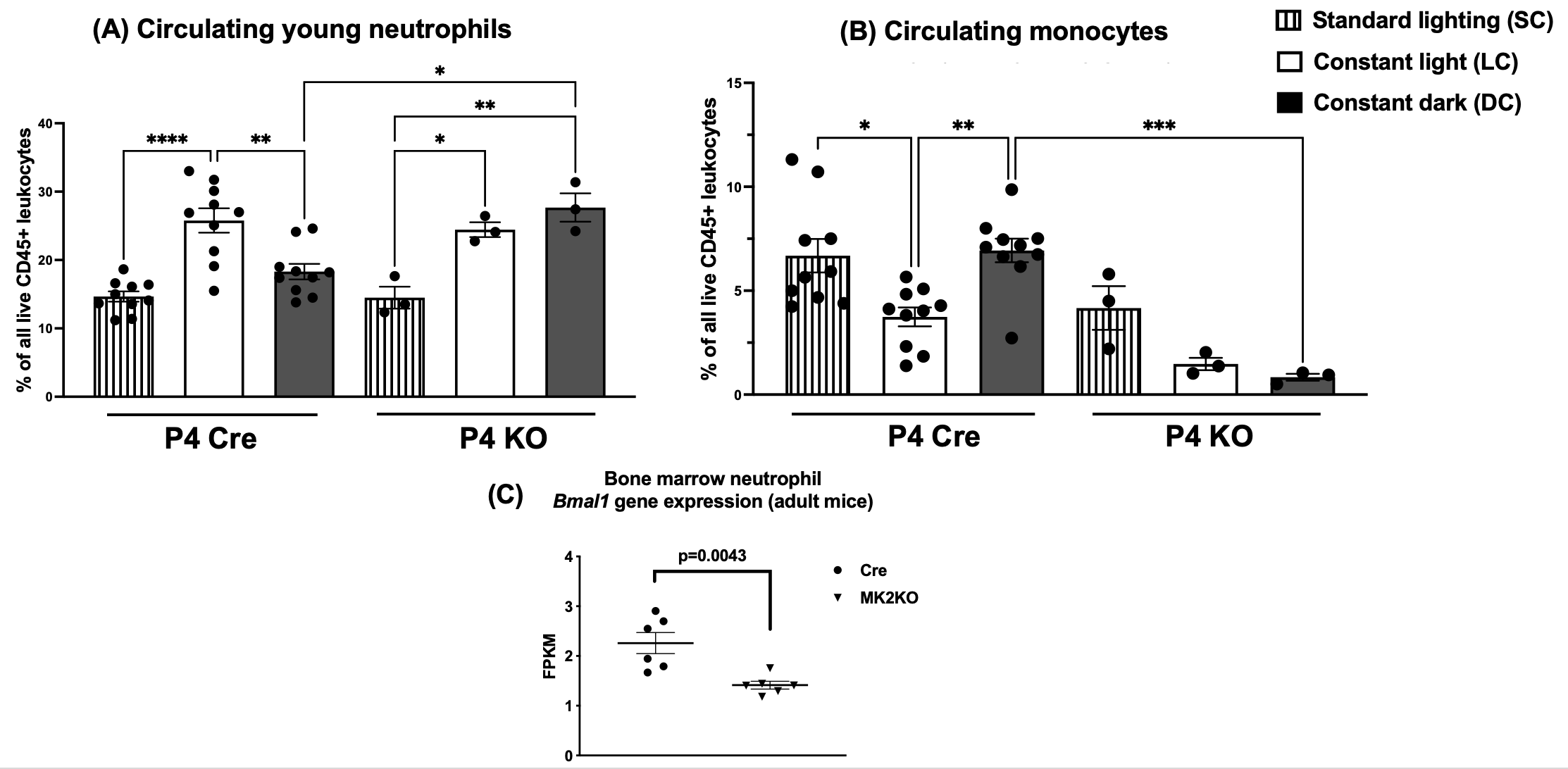 Fig. 2. (A) Percentage of circulating young neutrophils out of all CD45+ leukocytes in P4 Cre (control) and P4 KO mice under standard lighting (SC), constant light (LC), or constant dark (DC) conditions. P4 Cre mice show a significant increase in young neutrophils in LC compared to SC and DC. P4 KO mice show a significant increase in young neutrophils in both LC and DC compared to SC. Additionally, the P4 KO DC young neutrophil population shows a significant increase compared to P4 Cre DC, indicating a loss of DC protection from the inflammatory young neutrophils and increased mortality. One-way ANOVA with multiple comparisons was used. (B) Percentage of circulating monocytes in P4 Cre and P4 KO mice under the same circadian conditions. P4 Cre mice show a significant decrease in monocyte levels in LC compared to SC, and a considerable increase in monocyte levels in DC compared to LC. P4 KO mice show a reduction in circulating monocytes across all light conditions, and a significant decrease in monocyte levels in P4 KO DC compared to P4 Cre DC. One-way ANOVA with multiple comparisons was used. (C) Bone marrow neutrophil BMAL1 gene expression in adult Cre and KO mice. BMAL1 expression is significantly reduced in KO neutrophils compared to Cre controls (p = 0.0043); a T-test was used.