87 - Variation in the Observed Population Incidence of Pediatric Urinary Tract Infection (UTI) in Children <5 Years of Age by Different UTI Case Definitions
Saturday, April 25, 2026
3:30pm - 5:45pm ET
Publication Number: 2083.87
Marie E. Wang, Marie Wang, Sunnyvale, CA, United States; Alan Schroeder, Stanford University School of Medicine, Palo Alto, CA, United States; Tyler Chervo, Kaiser Permanente Northern California Division of Research, Berkeley, CA, United States; Victor Ritter, Stanford University School of Medicine, Palo Alto, CA, United States; Ross Perry, Kaiser Permanente - Oakland Medical Center, Oakland, CA, United States; Tara L. Greenhow, Kaiser Permanente Northern California, San Francisco, San Francisco, CA, United States
Clinical Professor of Pediatrics Stanford University School of Medicine Palo Alto, California, United States
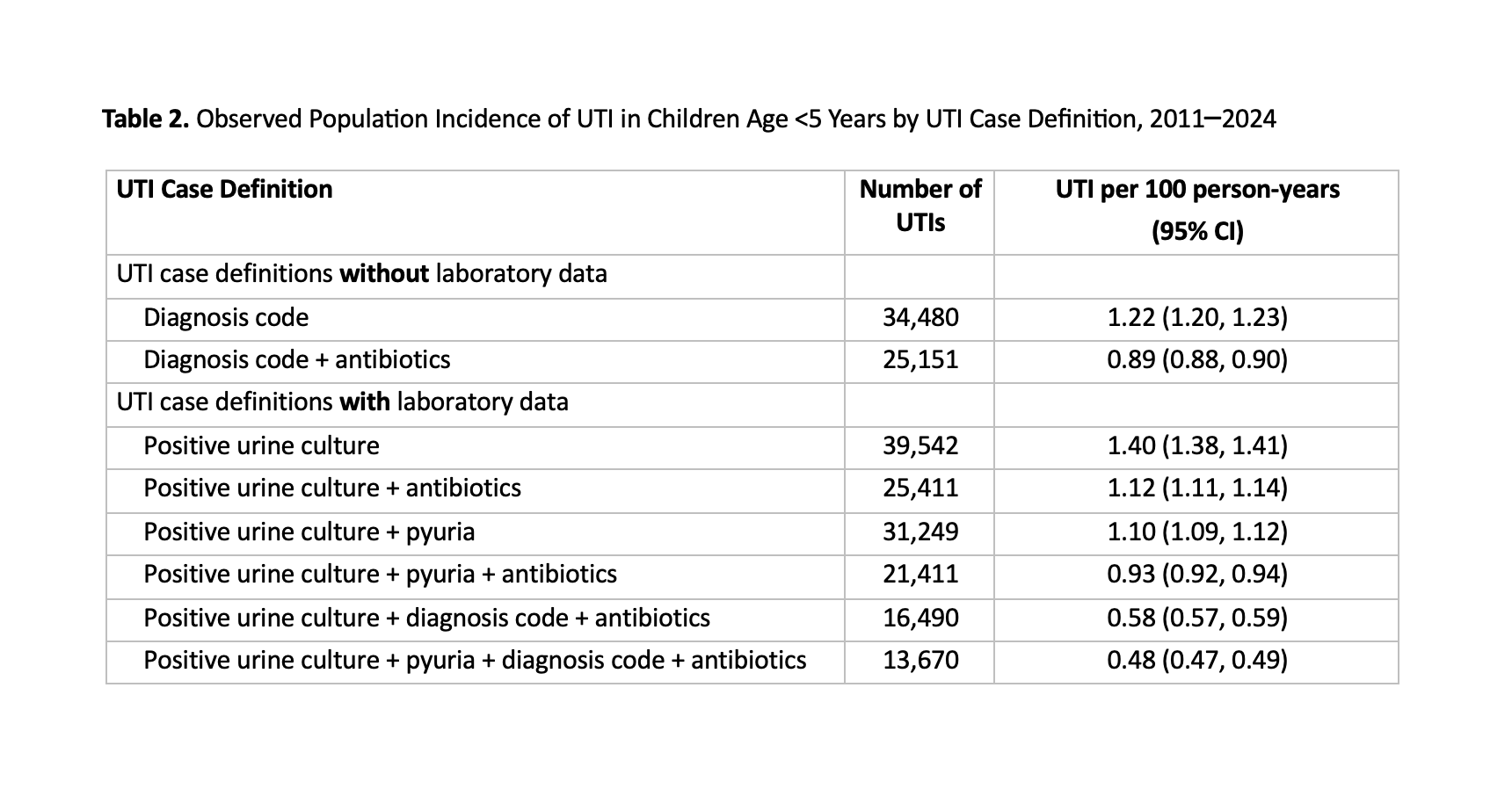
Background: Although urinary tract infections (UTI) are the most common serious bacterial infection in children < 5 years, data on UTI population incidence in this age group are limited. Recent incidence estimates are drawn from large databases that define UTI using diagnosis codes with or without an antibiotic prescription, but lack urine culture and urinalysis results. Conversely, smaller studies of UTI in specific groups (e.g., febrile infants) have generally defined UTI using urine culture (+/- urinalysis) results. It is unknown how different approaches to UTI case definitions impact observed population incidence, which is crucial for accurately assessing disease burden. Objective: To analyze how the observed population incidence of UTI in children < 5 years of age varies by different UTI case definitions. Design/Methods: We conducted a cross-sectional study of children < 5 years insured by Kaiser Permanente Northern California, a large integrated healthcare organization, from 2011-2024. Using the electronic health record database, we identified UTIs from outpatient and inpatient encounters using eight UTI case definitions requiring one or more of the following criteria: 1) UTI diagnosis code, 2) UTI-related antibiotic prescription, 3) positive urine culture (>=50,000 CFU/mL of a uropathogen), and 4) pyuria (>=5 WBC/hpf or at least trace leukocyte esterase on urinalysis or urine dipstick). Multiple encounters with UTI within a 14-day period were counted as a single UTI. For each UTI case definition, we calculated incidence (UTIs per 100 person-years [100-PY]) and stratified by age and sex. Results: We included 1,056,369 children < 5 years (Table 1). We observed a 3-fold difference in the observed population incidence of UTI across the different case definitions. UTI incidence was lowest (0.48 UTIs/100-PY) when all four criteria (diagnosis code, antibiotics, positive urine culture, pyuria) were required, and highest (1.44/100-PY) when only a positive urine culture was required (Table 2). When stratified by age, UTI incidence ranged from 0.79-2.63/100-PY in age < 2 months, 0.45-1.46/100-PY in age 2 months- < 2 years, and 0.49-1.31/100-PY in age 2-4 years (Table 3a). UTI incidence ranged from 0.83-2.27/100-PY in females and 0.15-0.56/100-PY in males (Table 3b).
Conclusion(s): The observed population incidence of UTI can vary by as much three-fold depending on the case definition used. Recognizing this variation is essential in interpreting the UTI literature, as it affects our understanding of disease burden, which ultimately informs clinical practice, guideline development and priorities in research and public health.
Table 1. Characteristics of Pediatric Enrollees Age <5 Years, 2011-2024
Table 2. Observed Population Incidence of UTI in Children Age <5 Years by UTI Case Definition, 2011-2024
Table 3a. Observed Population Incidence of UTI in Children Age <5 Years by UTI Case Definition and Age Group, 2011-2024; Table 3b. Observed Population Incidence of UTI in Children Age <5 Years by UTI Case Definition and Sex, 2011-2024









.png)
.png)
