629 - School-Age Follow Up of the Transfusion of Prematures (TOP) Trial: Neurodevelopmental Outcomes by Hemoglobin Transfusion Thresholds
Saturday, April 25, 2026
3:30pm - 5:45pm ET
Publication Number: 2614.629
Amy L. Conrad, The University of Iowa, Iowa City, IA, United States; Sara DeMauro, Children's Hospital of Philadelphia, Philadelphia, PA, United States; Sylvia M. Tan, 001924420833, Washington, DC, United States; Haresh Kirpalani, McMaster University Michael G. DeGroote School of Medicine, Burlington, ON, Canada; Kristina Ziolkowski, Childrens Hospital of Philadelphia, Phiadelphia, PA, United States; Susan R.. Hintz, Stanford University School of Medicine, Palo Alto, CA, United States; Betty R. Vohr, Women & Infants Hospital, Alpert Medical School of Brown University, Bristol, RI, United States; Victoria E. Watson, Women & Infants Hospital of Rhode Island, Providence, RI, United States; Tarah Colaizy, University of Iowa Stead Family Children's Hospital, Iowa City, IA, United States; Edward F. Bell, University of Iowa, Iowa City, IA, United States; Jane E. Brumbaugh, Mayo Clinic, Rochester, MN, United States; Carla M. Bann, RTI International, Apex, NC, United States; Jamie E. Newman, RTI International, Research Triangle Park, NC, United States; Abhik Das, RTI, Gaithersburg, MD, United States; on behalf of NICHD Neonatal Research Network, NICHD Neonatal Research Network, Bethesda, MD, United States
Associate Professor The University of Iowa Iowa City, Iowa, United States
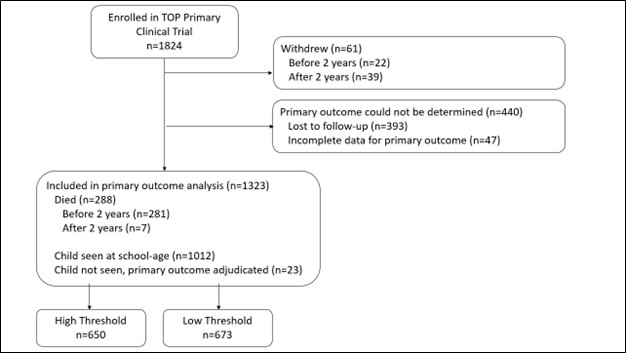
Background: Extremely low birth weight (ELBW) infants are at risk for anemia, compromising oxygen transport and reduces iron stores. The TOP Trial randomized infants to higher or lower transfusion thresholds. At 2 years there were no significant differences in neurodevelopmental impairment (NDI) or death at 2 years of age between higher and lower transfusion thresholds. However, neurodevelopmental impacts of differing iron loads may not appear until after 2 years, and later impacts of transfusion thresholds remain unknown. We hypothesized that treatment effects would emerge at school age, manifested by different rates of NDI. Objective: The TOP 5 Study reports outcomes of surviving TOP participants in early school age. Design/Methods: Surviving infants (BW ≤1000 g and GA 22-29 weeks) enrolled in the NICHD-Neonatal Research Network TOP Trial were assessed at 5-7 years corrected age. The test battery measured cognitive, achievement, and neuromotor functioning. Primary outcome was: At least one of: Cognitive delay (DAS-II < 70); Cerebral palsy with GMFCS level ≥II or m-ABC-2 ≤5th Percentile; Academic delay (T-score < 30 on two DAS-II school readiness subtests) or death prior to assessment. A sample of 1574 participants would provide 90% power to detect an absolute difference of >8% in survival without NDI (2-sided Type I error = 0.05). Results: Follow up assessments began in 2019 and ended in March 2025. Of the 1824 participants in the TOP Trial, 61 parents withdrew; 288 infants died, and 393 families were lost to follow-up. A total of 1012 children had complete data at school age and 23 had outcome data adjudicated. The final total with primary outcome was 1323 (650 higher and 673 lower threshold; 73% of eligible infants). See Figure 1 study flow 9/30/2025. Median corrected age at assessment was 5.9 years (IQR 5.7-6.4). Treatment allocation, baseline Hgb, number of transfusions, and number of donor exposures were similar between participants in the analysis cohort and those lost to follow up (Table 1). However, they had lower birthweight, gestational age, and Apgar scores. Primary outcome analyses underway will be available for presentation at PAS.
Conclusion(s): This is the largest school-age follow-up of an RCT to compare higher versus lower RBC transfusion thresholds in ELBW children. Results will provide key information on longer-term outcomes of different thresholds, ultimately guiding treatment of ELBW infants with anemia of prematurity.