Session: Neonatal Less Than 25 Weeks 3: Predicting Prognosis, Counseling, and Potpourri
767 - Periviability Counseling by the Numbers: Awareness and Use of NICHD and VON Extremely Preterm Birth Outcome Tools within the New England Tiny Baby Collaborative
Saturday, April 25, 2026
3:30pm - 5:45pm ET
Publication Number: 2748.767
Helen Healy, Beth Israel Deaconess Medical Center, Brookline, MA, United States; Cheryl L. Cheryl Slater, boston medical center, WILMINGTON, MA, United States; Elisa Abdulhayoglu, Brigham & Women's Hospital, Lynnifeld, MA, United States; Megan Aurora, MassGeneral Hospital for Children, Boston, MA, United States; Laura B. Bernardini, Brigham and Women's Hospital and Harvard Medical School, Boston, MA, United States; Jaclyn Boulais, Tufts Childrens Hospital, Jamaica Plain, MA, United States; John F.. Ciannella, Stamford Health, Stamford, CT, CT, United States; Lindsay D'Angelo, Tufts Childrens Hospital, Boston, MA, United States; Kathleen Figurido, Massachusetts General Hospital, Boston, MA, United States; Elizabeth Y. Flanigan, Elizabeth, Westford, MA, United States; Noa Fleiss, Yale School of Medicine, New Haven, CT 06510, CT, United States; Annmarie Golioto, Connecticut Children's, Hartford, CT, United States; Shah Hossain, Boston Medical Center Brighton, Brighton, MA, United States; Jennifer James, The Barbara Bush Children's Hospital at Maine Medical Center, Portland, ME, United States; Hasene Ozlem. Kasaroglu, Women & Infants Hospital of Rhode island, Milton, MA, United States; Zuzanna Kubicka, Boston Children's Hospital, Boston, MA, United States; Julia Litzky, The University of Vermont Children's Hospital, Burlington, VT, United States; Priya Mukherjee, Yale-New Haven Children's Hospital, Bridgeport, CT, United States; Morgan Nealy, The University of Vermont Children's Hospital, Essex Junction, VT, United States; Stephanie Neville, Brigham and Women's Hospital, Stoneham, MA, United States; Margaret Parker, UMass Chan School of Medicine, Worcester, MA, United States; Alan Picarillo, The Barbara Bush Children's Hospital at Maine Medical Center, Cape Elizabeth, ME, United States; Hala Saneh, Connecticut Children's Medical Center, Hartford, CT, United States; Bharati Sinha, Boston University School of Medicine, Boston, MA, United States; Rodica M. Turcu, Harvard Medical School, Boston, MA, United States; Michelle D. Tyler, Dartmouth-Hitchcock Medical Center - Lebanon, NH UNITED STATES - Lebanon, NH, Lebanon, NH, United States; Ruben Vaidya, Baystate Children's Hospital, Springfield, MA, United States; Hayley Wilcox, Tufts University School of Medicine, Boston, MA, United States; Avery Zierk, Women & Infants Hospital of Rhode Island, Providence, RI, United States; Matthew Rysavy, McGovern Medical School at the University of Texas Health Science Center at Houston, Houston, TX, United States; Kristen T. Leeman, Boston Children's Hospital, Winchester, MA, United States; John Zupancic, Harvard Medical School, Boston, MA, United States; Christy Cummings, Boston Children's Hospital, Boston, MA, United States; Annie Sullivan, Boston Children's Hospital, Boston, MA, United States
Neonatologist Beth Israel Deaconess Medical Center Brookline, Massachusetts, United States
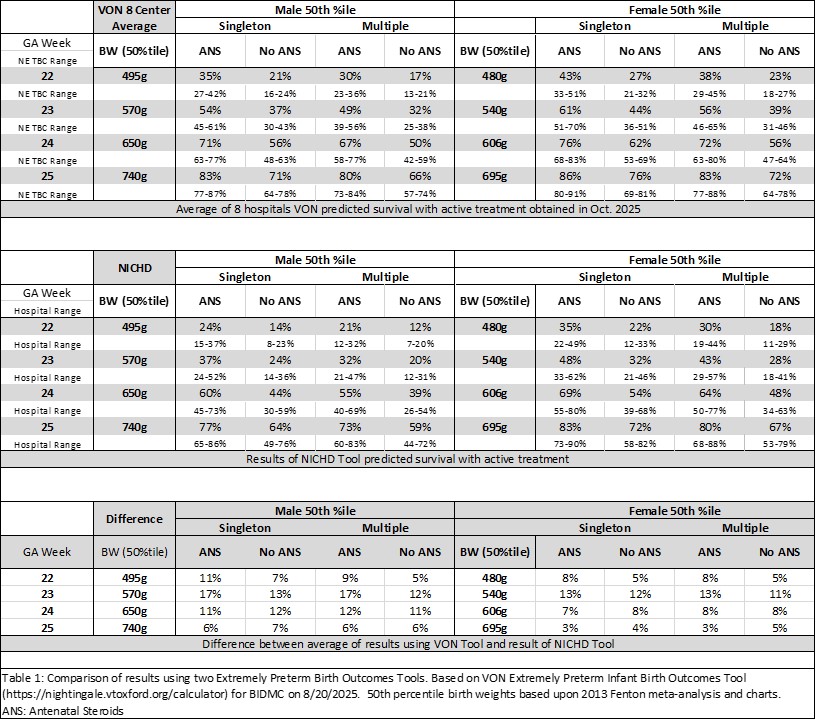
Background: Both the National Institute of Child Health and Human Development (NICHD) and Vermont Oxford Network (VON) web-based interfaces provide prognostic statistics based on infant characteristics at birth. Statistics are sometimes used to support communication of potential outcomes during antenatal counseling, which must also integrate parental values and goals, and provide support. The NICHD tool is based on births 2006-2012 and describes 2-year follow-up outcomes. The VON tool describes in-hospital mortality for births 2020-2024, provides center-specific estimates when applicable, and requires institutional login. Objective: (1) To survey site leaders in the New England Tiny Baby Collaborative (NE TBC) about awareness and use of each tool; and (2) to describe differences between the results of the NICHD and VON tools' estimated survival with active treatment (eSAT) in the NE TBC using case scenarios. Design/Methods: Site leaders (representatives from each NICU to the NE TBC) received a survey about their and their colleagues' awareness and use of each tool. Sites also anonymously provided their VON eSAT, requiring institutional login, for specific case scenarios, which were compared to the same scenarios on the public NICHD website. Results: Of 20 NE TBC site leaders, 18/20 were aware of the NICHD tool; 11/20 were aware of the VON tool (Figures 1 and 2). When preparing for consultations before 24 weeks' gestational age (GA), 11/20 reported never using the VON tool; 15/20 used the NICHD tool most or every time. Eight NICUs provided local VON eSAT. Each NICU received the same 32 scenarios, yielding 256 estimates (Table 1). The average VON eSAT was greater than the NICHD eSAT in all 32 scenarios. The difference ranged from 3% (females of 25 weeks' GA) to 17% (males of 23 weeks' GA). NICUs' VON eSATs were higher than the NICHD eSAT in 243/256 (95%) cases; for 11/256 (4.3%) scenarios they were ³ 20% higher and for 110/256 scenarios (43%) they were ³ 10% higher.
Conclusion(s): While the NICHD tool is used more often by neonatologists in the NE TBC, there are important differences in eSAT between NICHD and VON tools. Differences may be substantial enough to impact expectations or shared decision making. Understanding the reasons behind these differences is necessary to empower clinicians to provide accurate information that supports shared decision-making with families.
Note: VON played no role in the design, conduct, analysis, interpretation, or reporting. The views, conclusions, and opinions expressed are solely those of the authors and do not represent those of VON.
Table 1. Comparison of Estimated Survival with Active Treatment using NICHD and VON Extremely Preterm Birth Outcome Tools
Figure 1. New England Tiny Baby Collaborative Site Leaders Reported Awareness of Two Extremely Preterm Birth Outcomes Tools
Figure 2. New England Tiny Baby Collaborative Site Leaders Reported Use of Two Extremely Preterm Birth Outcomes Tools









.png)
.png)
