186 - Parents' Perspectives on Newborn Screening Communication – Comparing False Positive and Normal Result Experiences
Saturday, April 25, 2026
3:30pm - 5:45pm ET
Publication Number: 2179.186
Anne Atkins, Children’s National Hospital, Madison, WI, United States; Kelly Christensen, Children's National Hospital, Gaithersburg, MD, United States; Thevaa Chandereng, Children's National Health System, Washington, DC, United States; Brianne Zielinski, BrownWinick Law Firm, Waukee, IA, United States; Christen Crews, Virginia Department of Health, Midlothian, VA, United States; Tia Tyson, Children's National Health System, Hyattsville, MD, United States; Mary Lowe, Virginia Department of Health, Richmond, VA, United States; Lindsay Cooper, Johns Hopkins University School of Medicine, Phoenix, MD, United States; Knute Carter, University of Iowa College of Public Health, Iowa City, IA, United States; Lisa Opipari-Arrigan, Children's National Health System, Cohasset, MA, United States; Tara Lavelle, Tufts Medical Center, Boston, MA, United States; Beth A. Tarini, Co-Director, Silver Spring, MD, United States
Clinical Research Program Manager Children’s National Hospital Madison, Wisconsin, United States
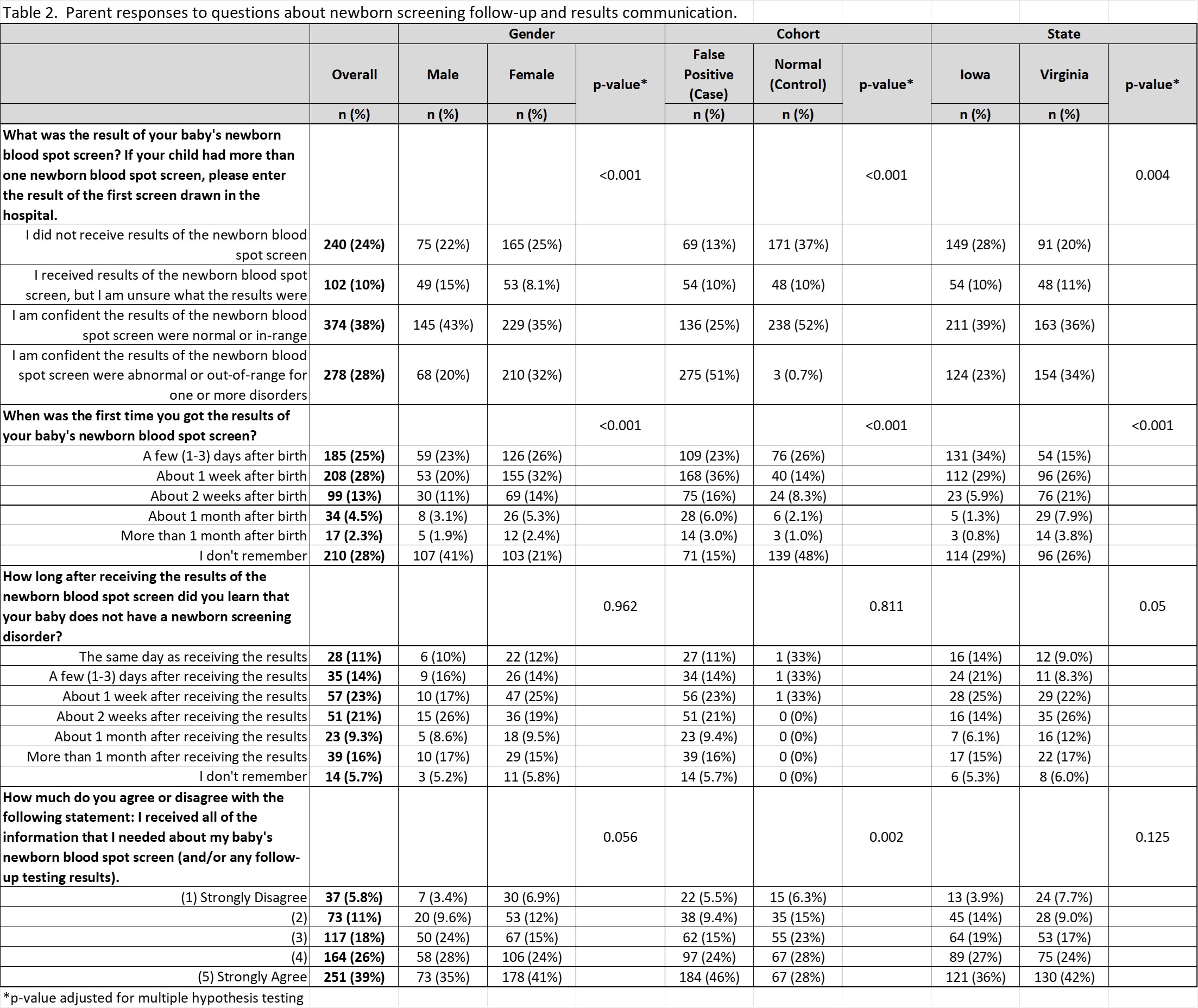
Background: Few studies examine parents' self-reported newborn screening (NBS) experiences, and fewer still include parents who received false positive (FP) and normal (NL) results. Objective: We compared survey responses examining NBS communication as part of a multi-site NIH-funded R01 (5R01 HD095068, Pl: Tarini), the largest longitudinal NBS study of parents who received FP NBS results. Design/Methods: From Summer 2020 to Spring 2023, 1007 parents responded to survey questions recalling their newborn screening experience in Iowa or Virginia. Questions explored prior knowledge of NBS, their recollection of the NBS collection (Table 1), and the communication of results (Table 2). Summary statistics and multinomial logistic regression were used to examine responses comparing the FP and NL group, gender of responding parent, and state. Results: 540 FP parents and 467 NL parents responded to the survey. NL parents took the baseline survey earlier than the FP parents (baby age: 131 days vs. 167 days). 52% of parents recalled understanding the purpose of NBS before the birth of their child, having learned during a previous pregnancy (56%) or the current pregnancy (23%). This result was not statistically different across gender, cohort, or state. Male parents were less confident in their responses to NBS communication questions (e.g. 23% male vs. 14% female responded "I don't remember" when asked if someone explained NBS in the hospital). In general, FP parents recalled receiving more information at the hospital and receiving more communication (e.g., 70% FP vs. 51 % NL recalled seeing the NBS collected). 25% of FP parents responded that their initial NBS result was normal. The NL cohort were more likely to report not having received the NBS results at all (37% NL vs. 13% FP). When asked about satisfaction with NBS communication in the hospital using a likert scale, FP parents tended to have more extreme responses (not at all satisfied or extremely satisfied). A t-test revealed a statistically significant difference in mean satisfaction levels between the FP (mean = 3.04) and the NL parents (mean = 3.24), with the NL group exhibiting higher satisfaction (mean difference = -0.20, 95% Cl: -0.339 to -0.061, p = 0.0047).
Conclusion(s): We found parent-reported experiences recalling communication around NBS differed by FP and NL result, by parent gender, and by state. Understanding these differences can help the NBS community improve NBS education and ensure the timely and accurate delivery of NBS results.
Parent responses to questions about newborn screening communication prior to result delivery.
Parent responses to questions about newborn screening follow-up and results communication.










.jpg)