614 - Association of Gender with Funding Source in Neonatal Randomized Controlled Trials
Saturday, April 25, 2026
3:30pm - 5:45pm ET
Publication Number: 2599.614
Luna Hurtado-A, Beth Israel Deaconess Medical Center, Brighton, MA, United States; Kim Ruiz-Arellanos, Beth Israel Deaconess Medical Center, Boston, MA, United States; Maria Laura Mourão, Beth Israel Deaconess Medical Center, Boston, MA, United States; Sofia Gnecco, Beth Israel Deaconess Medical Center, Brookline, MA, United States; Santiago Reyes, Beth Israel Deaconess Medical Center, Boston, MA, United States; Brian King, Harvard Medical School, Boston, MA, United States; Adrian Baca-Arzaga, University of Miami, Miami, FL, United States; Marianna B. Castellanos, The Children's Hospital at Montefiore, Bronx, NY, United States; Grace E. Fuller, The University of North Carolina at Chapel Hill School of Medicine, Chapel Hill, NC, United States; John Zupancic, Harvard Medical School, Boston, MA, United States; Susanne Hay, Harvard Medical School, Boston, MA, United States
Post Doctoral Research Fellow Beth Israel Deaconess Medical Center Brighton, Massachusetts, United States
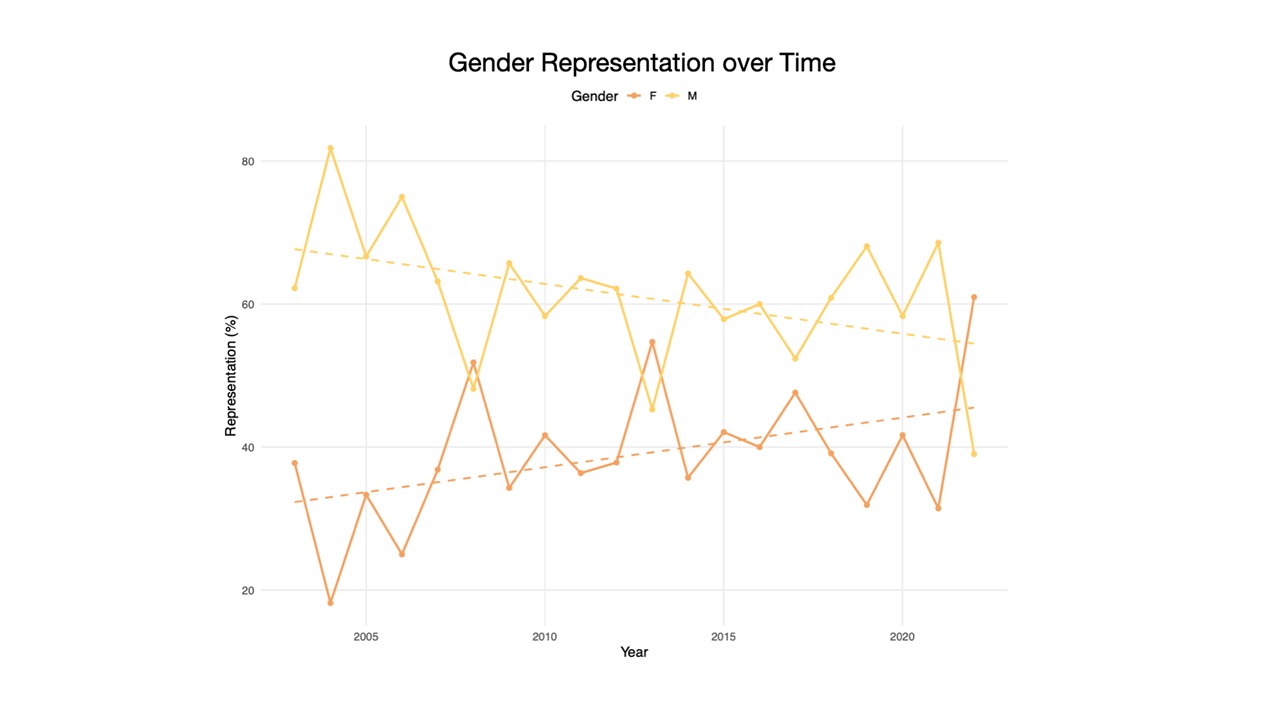
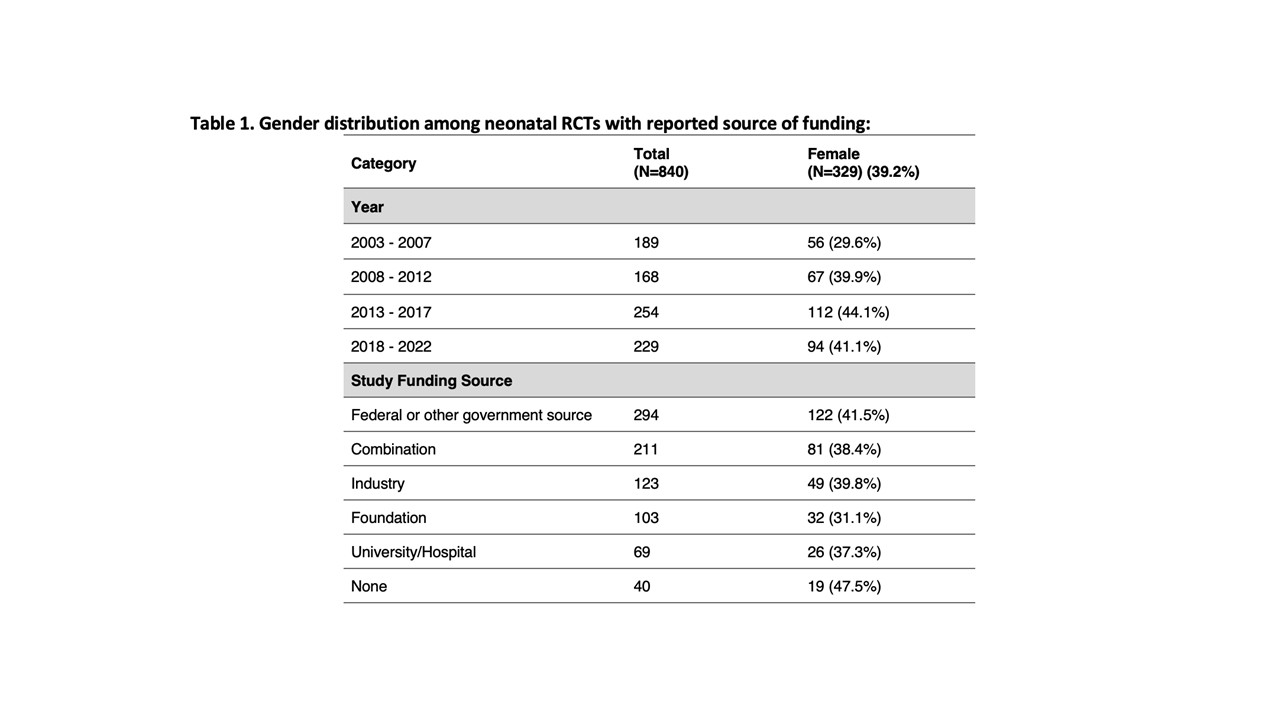
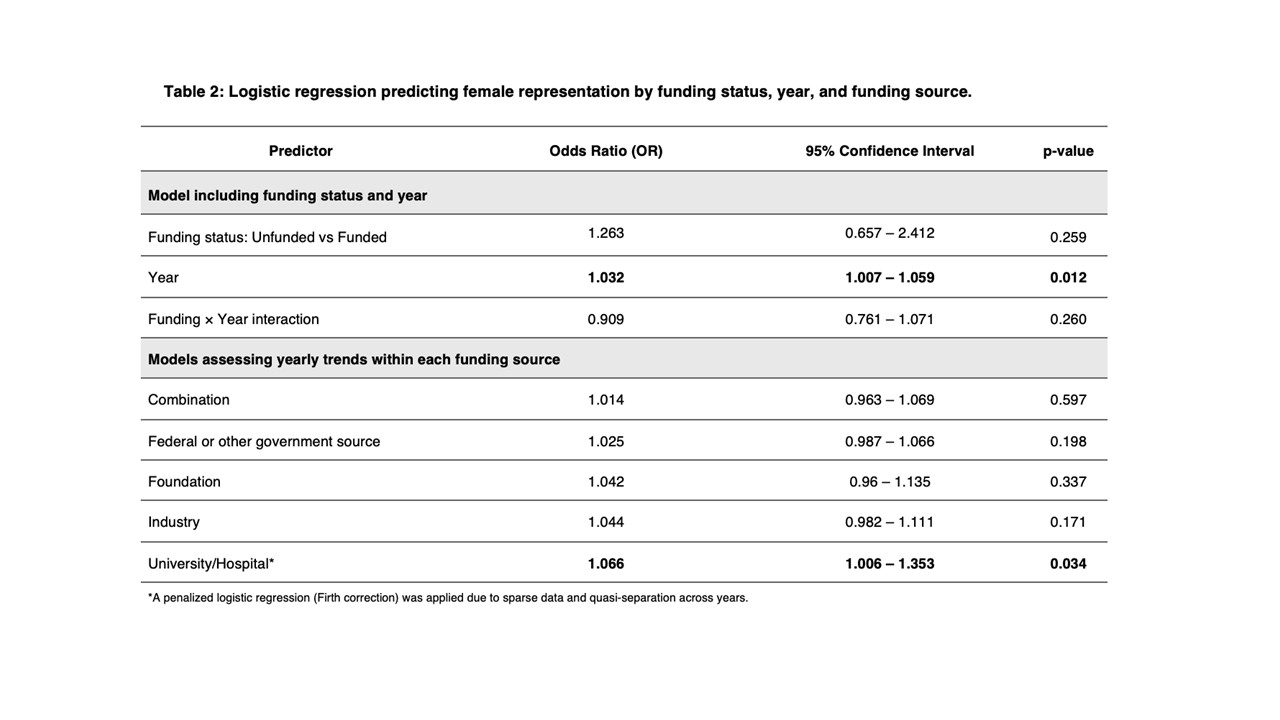
Background: Gender disparities in pediatric research persist despite efforts to promote equity. Female-identifying pediatricians remain underrepresented in leadership roles and scholarly productivity. Understanding whether gender gaps vary across funding sources can help identify structural barriers to women's participation and career development in research. Objective: To examine gender representation across funding sources in neonatal randomized controlled trials (RCTs) in the United States published between 2003 and 2022. Design/Methods: We searched NeoCanon, a validated database of all neonatal RCTs published between 2003 and 2022, for studies with a primary author with a U.S affiliation. Senior author's first name, and the RCT's funding source, were extracted from the original study publication. Gender was inferred from first names using Gender-API (https://gender-api.com/en/), a prediction tool with over 6 million validated names from 191 countries. A probability threshold of 0.70 was applied; when probability was below this value or gender remained unknown, individual searches of professional pages were conducted. Association between gender, year, and funding were tested using chi-square and logistic regression analyses. Results: Of a total of 1060 RCTs with US primary authors, 840 had explicitly reported funding data and were analyzed (Table 1). Overall, 39% of senior authors were predicted to be female. There were no significant differences in gender distribution between funded and unfunded studies (χ²=0.88, p= 0.35) or across funding categories (p>0.05), indicating that women remained in the minority across all groups. Female representation increased significantly over time (OR=1.03 per year, indicating an estimated 3% annual increase, 95% CI [1.01-1.06], p = 0.012) (Fig 1). When analyzed separately by funding source, only University/Hospital-funded studies showed a significant yearly rise in female authorship (OR=1.07, 95% CI [1.01-1.35], p=0.03), while annual increases in female representation by other funding sources was not statistically significant (Table 2).
Conclusion(s): Female authorship in neonatal RCTs has increased over time, yet women remain underrepresented as senior authors in funded studies, despite comprising nearly half of the neonatology workforce. This under-representation is uniform across most funding sources, except for University/Hospital funded studies, where progress toward equality is evident. Continued efforts from key sectors - funding sources, journals and academia - are essential to achieve gender equity across all sectors of pediatric research.
Figure 1. Female Authorship Representation Over time
Table 1. Gender distribution among neonatal RCTs with reported source of funding
Table 2. Logistic regression predicting female representation by funding status, year and funding source