365 - Qualitative Analysis of Cough Symptomatology in Pediatric Patients Presenting with Pharyngitis
Saturday, April 25, 2026
3:30pm - 5:45pm ET
Publication Number: 2354.365
Aleese McKinnon, Children's National Health System, Apex, NC, United States; Patrick Dolan, PM Pediatric Care, Palatine, IL, United States; Youness Arjoune, Children's National Health System, washington, DC, United States; Raj Shekhar, Children's National Health System, Washington, DC, United States; Trong N. Nguyen, AusculTech Dx, Silver Spring, MD, United States; Jeffrey S. Dome, Children's National Hospital, Washington, DC, United States; David Mathison, PM PEDIATRICS, Bethesda, MD, United States; Rana F. Hamdy, Children's National Health System, Washington, DC, United States
Regional Medical Officer PM Pediatric Care Palatine, Illinois, United States
Background: Pharyngitis, and concern for Group A Streptococcus (GAS) pharyngitis, is a common indication for pediatric urgent care visits. The presence of cough has been shown to be negatively associated with GAS pharyngitis, and the American Academy of Pediatrics recommends not testing for GAS in a patient with a cough. Nevertheless, some patients with definitive GAS pharyngitis report having a cough. Objective: The objective of the study was to conduct a qualitative analysis describing the qualities and characteristics of a cough in patients presenting with and without GAS pharyngitis. Design/Methods: This is a sub-study of a larger multicenter prospective study developing novel artificial intelligence-based software for diagnosing GAS pharyngitis. Patients in the parent study are eligible to be included if they are between the ages of 3 and < 18 years, being evaluated for GAS pharyngitis with a GAS test, and without exposure to antibiotics in the preceding 48 hours. Presenting symptoms (including presence of cough as a binary variable) are collected for the parent study. Within the parent study, 46.5% of all patients reported cough.
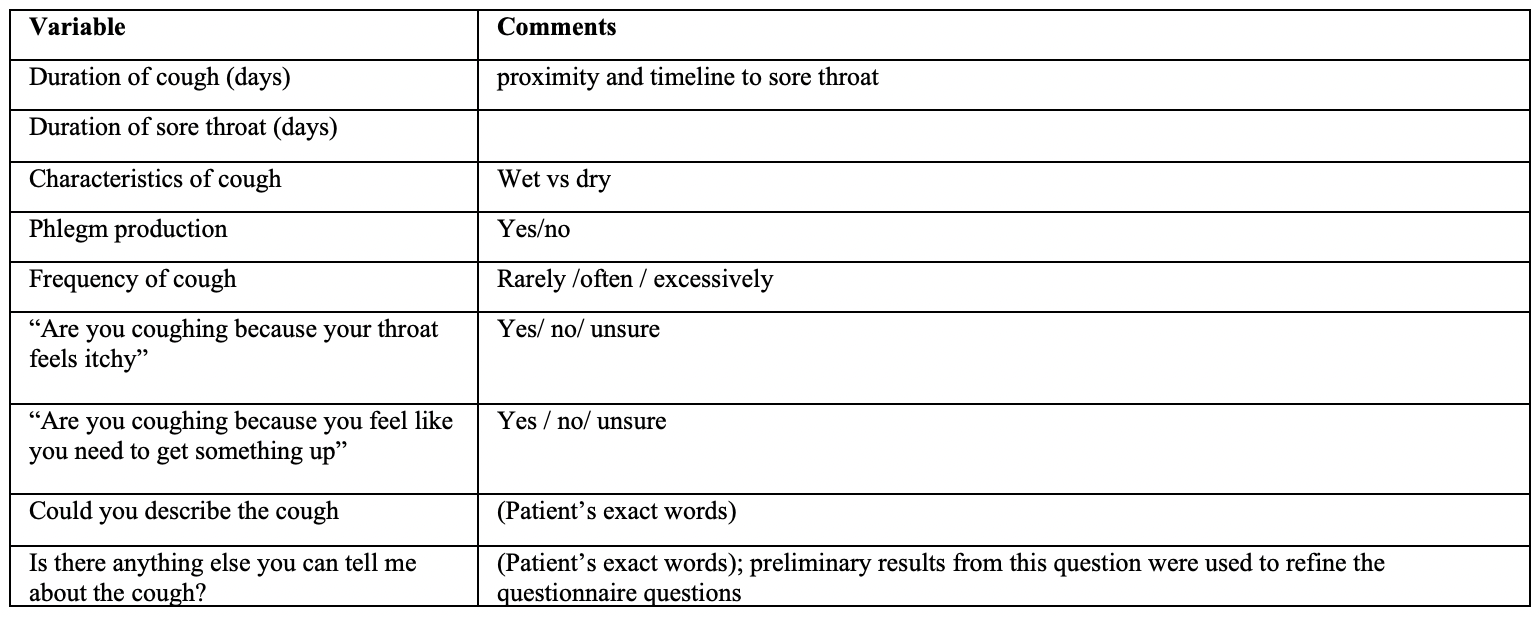
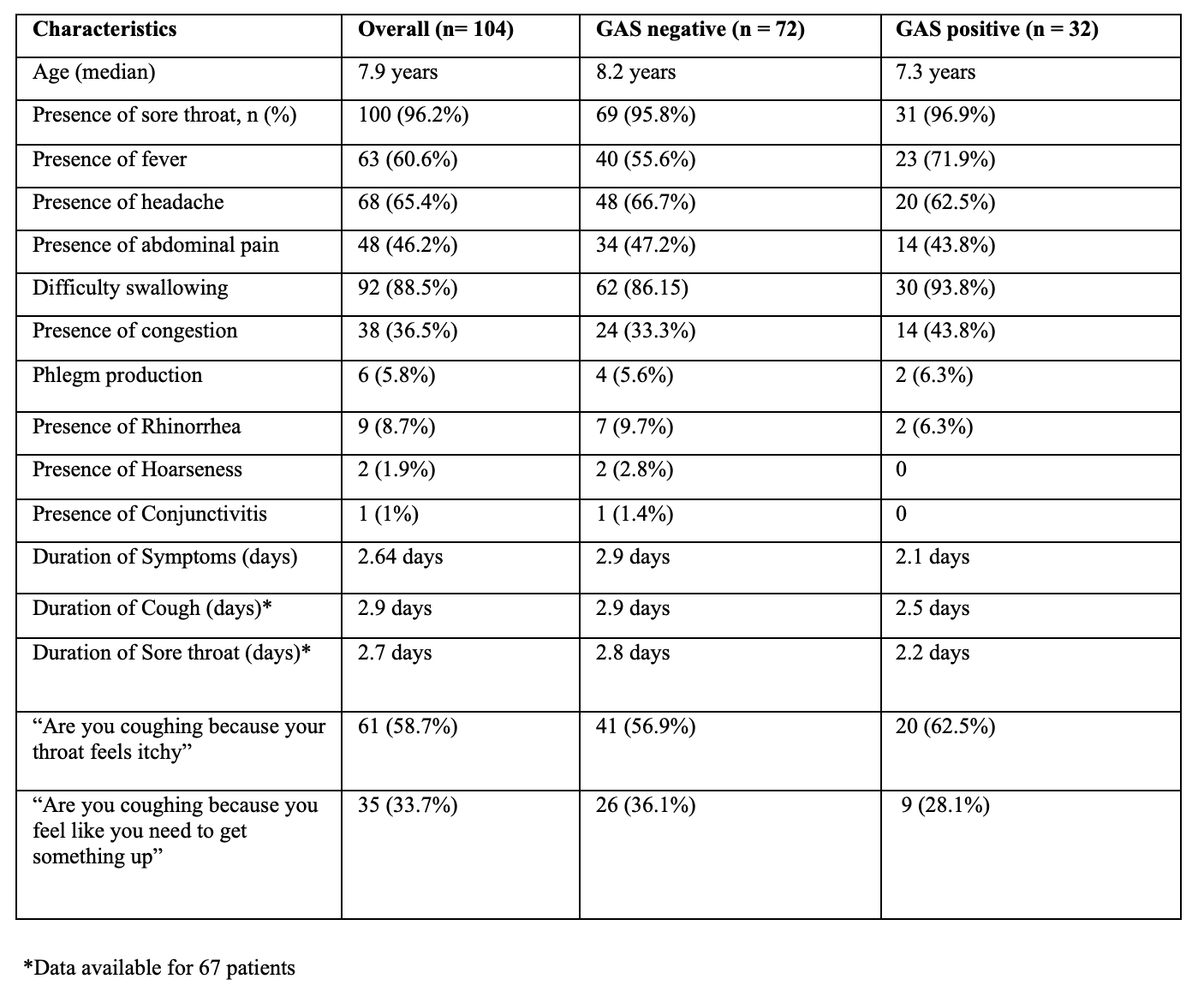
This sub-study is a single-center study including patients enrolled in the parent study who report presence of a cough. Additional historical features related to the quality, frequency, and duration of the cough were collected (Table 1); questions in the questionnaire were refined based on preliminary qualitative data. We used descriptive statistics to summarize the characteristics of cough in patients who did and did not test positive for GAS pharyngitis. Results: 104 patients have been enrolled in the sub-study. The median age was 7.9 years. Sore throat was present in 96.2% and fever was present in 60.6% overall (55.6% of those who tested negative vs 71.9% in those who tested positive for GAS). Phlegm production was uncommon (5.8%) with less than half (33.7%) of all patients reporting coughing to get something out. More than half (58.7%) of patients report coughing because their throat feels itchy, though this was common in both patients who tested negative (56.9%) and those who tested positive (62.5%).
Conclusion(s): The results of this study suggest there may be more qualitative characteristics of a patient's cough when evaluating "absence of cough" as a Centor score criterion. Further research needs to be conducted to determine if there are certain characteristics of cough that can help distinguish GAS from non-GAS pharyngitis.