41 - Use, Trust, and Perceived Helpfulness of Artificial Intelligence Tools Among Caregivers of Hospitalized Newborns
Saturday, April 25, 2026
3:30pm - 5:45pm ET
Publication Number: 2038.41
Kim Ruiz-Arellanos, Beth Israel Deaconess Medical Center, Boston, MA, United States; Maria Laura Mourão, Beth Israel Deaconess Medical Center, Boston, MA, United States; Smita ektare, Boston Children's Hospital, Los Gatos, CA, United States; Luna Hurtado-A, Beth Israel Deaconess Medical Center, Brighton, MA, United States; Sofia Gnecco, Beth Israel Deaconess Medical Center, Brookline, MA, United States; Santiago Reyes, Beth Israel Deaconess Medical Center, Boston, MA, United States; John Zupancic, Harvard Medical School, Boston, MA, United States; Kristyn S. Beam, Beth Israel Deaconess Medical Center, Needham, MA, United States
Post Doctoral Research Fellow Beth Israel Deaconess Medical Center Boston, Massachusetts, United States
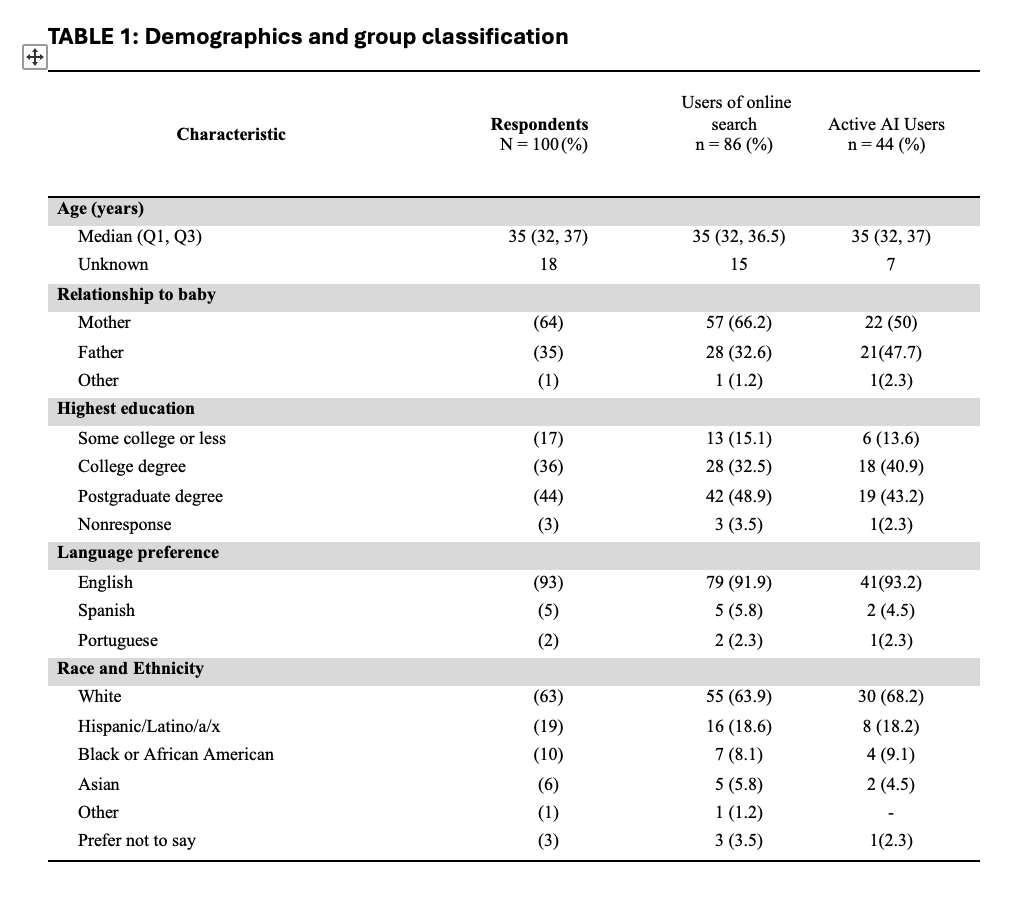
Background: With the growing use of artificial intelligence (AI), parents increasingly access online tools for medical information. Understanding how families of hospitalized newborns use and perceive these resources can guide communication and education strategies in neonatal care. Objective: To assess use, trust, and perceived helpfulness of AI tools and traditional internet searches among parents and caregivers of infants hospitalized in the NICU or Mother-Baby Unit (MBU). Design/Methods: We conducted a cross-sectional, anonymous survey (September-October 2025) among parents/caregivers of NICU or MBU infants. The 15-item survey (English, Spanish, Portuguese; paper or REDCap) assessed online behaviors, perceived usefulness, and trust of AI versus traditional sources. Respondents were categorized as Active AI users (used AI tools to ask infant-related questions), Search-only users (used Google/Bing only), or non-users. Descriptive statistics summarized responses; confidence was rated on a 5-point scale (1: decreased trust, 5: increased trust). Wilcoxon signed-rank and Kruskal-Wallis tests compared perceptions across groups and education levels. Results: Of 100 respondents, median age was 35 (IQR 32-37); 64% were mothers and 93% preferred English. Eighty-six participants reported using any online tool for infant information, and 44 were active AI users (Table 1). Among AI users, ChatGPT was most frequent (72.7%), while all search-only users relied exclusively on Google. The main reason for use was "fast answers" (61.7%). Most questions concerned general infant care (AI 87%, search-only 76.2%). AI users rated tools as more helpful than search-only users (p=0.03). Within active AI users, confidence in AI was significantly lower when compared with healthcare providers (Median=2 [IQR 1-3]) than with internet searches (Median=3 [IQR 2-4], p < .001). Overall, 72.7% trusted AI less than healthcare providers, while 77.3% trusted AI equally or more than internet searches. Perceived helpfulness differed by education (p=0.009): participants with some college or less were less likely to rate AI as "very helpful" (66.7%) compared with those with college (88.9%) or postgraduate degrees (84.2%). Education was not associated with trust (p=0.2).
Conclusion(s): Most caregivers use online and AI tools for rapid information about their infant's care. AI is perceived as helpful and generally trusted more than internet searches but less than healthcare providers. Higher education correlates with greater perceived helpfulness but not higher trust, suggesting that AI functions as a complementary, not replacement. source of neonatal information.
TABLE 1: Demographics and group classification
Figure 1: Types of questions, perceived helpfulness, and trust in AI tools versus traditional sources among NICU/MBU caregivers










.png)
