291 - Household Disinfectant Use and Benzalkonium Chloride (BAC) Exposure in the Prenatal Environment
Saturday, April 25, 2026
3:30pm - 5:45pm ET
Publication Number: 2281.291
Mary Akel, Ann & Robert H. Lurie Children's Hospital of Chicago, Chicago, IL, United States; Jiahe Yu, Northwestern University, McCormick School of Engineering, Evanston, IL, United States; Abigail Aron, Anne & Robert H. Lurie Children’s Hospital, Chicago, IL, United States; Shelby J. Tillema, Northwestern University, Evanston, IL, United States; Estefania Espinosa, Northwestern University The Feinberg School of Medicine, Chicago, IL, United States; Stephanie A.. Fisher, Northwestern University The Feinberg School of Medicine, Chicago, IL, United States; Tonia Branche, Ann & Robert H. Lurie Children's Hospital of Chicago, Chicago, IL, United States; Erica Hartmann, Northwestern University The Feinberg School of Medicine, Evanston, IL, United States; Leena B. Mithal, Ann and Robert H. Lurie Children's Hospital of Chicago / Northwestern University The Feinberg School of Medicine, Chicago, IL, United States
Research Project Manager Ann & Robert H. Lurie Children's Hospital of Chicago Chicago, Illinois, United States
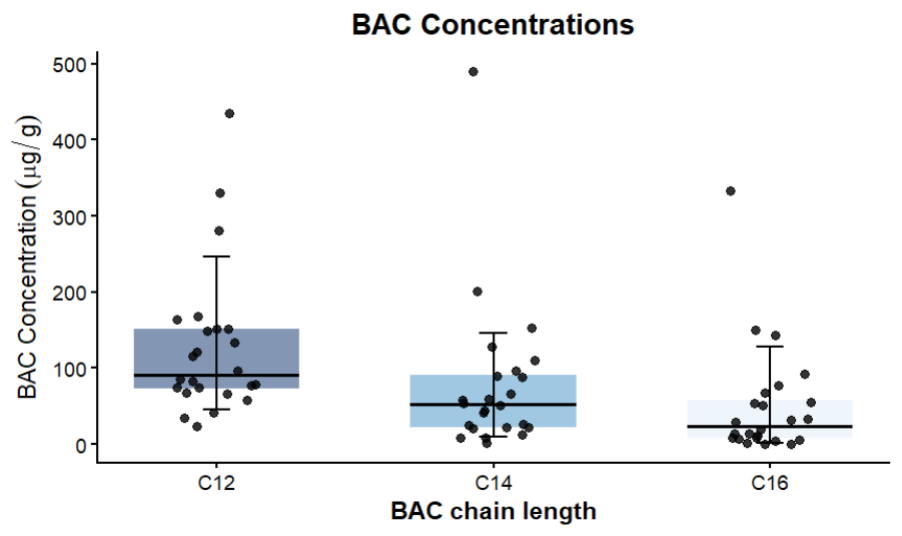
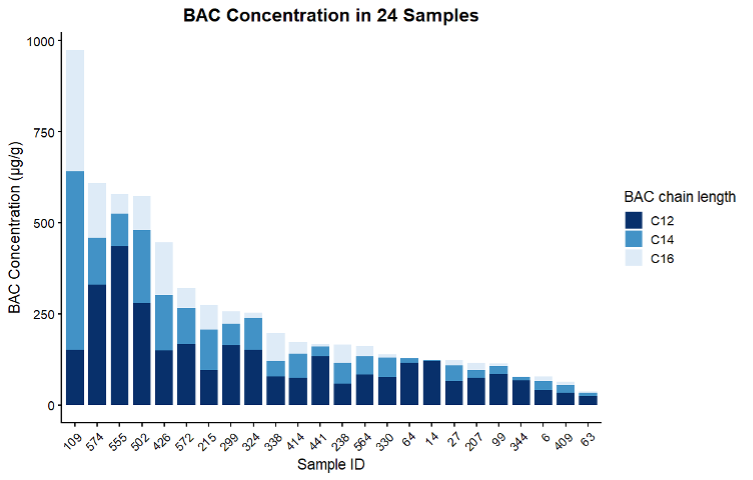
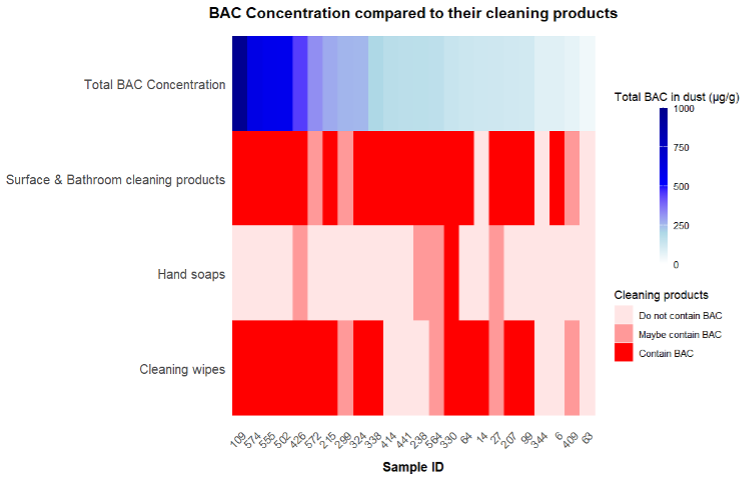
Background: Benzalkonium chloride (BAC) is a quaternary ammonium surfactant commonly found in consumer disinfectants. Household disinfectants are a major source of such exposure for pregnant people. BAC persists in indoor environments, and animal data suggest links to adverse reproductive and developmental impact. Few studies have quantified exposure using paired household dust samples and product-specific use data in pregnancy. Objective: To evaluate the relationship between household disinfectant use and BAC levels in household dust in a cohort of pregnant people. Design/Methods: We analyzed data from the prospective Chicago Perinatal Origins of Disease cohort of pregnant people with singleton gestations at two obstetric clinics in Chicago, IL. Household dust samples were collected between 20-36 weeks' gestation and analyzed by LC-MS for three common BAC homologues (C12, C14, and C16). Cleaning product surveys collected at the same time captured product type and BAC ingredient presence along with information about the household environment. Microorganisms cultured from dust were tested for BAC tolerance, and descriptive statistics for BAC concentrations were reported. Results: A subset of 24 participants were included in this analysis. Among them, 25% and 17% self-identified as non-White or Hispanic, respectively. Median age at enrollment was 33 years (IQR: 30-36) and median gestational age at dust collection was 19.4 weeks (IQR: 17-22). Our results show that BAC-C12 was most abundant, followed by BAC-C14, and BAC-C16, with median concentrations of 90.97 µg/g, 52.09 µg/g, and 23.61 µg/g, respectively (Fig. 1, 2). Higher BAC concentrations were observed among participants reporting use of BAC-containing cleaning solutions and wipes (Fig. 3). Bacterial isolates from dust exhibited tolerance to sub-inhibitory BAC concentrations, with minimum inhibitory concentrations ranging from 64-256 µg/mL.
Conclusion(s): BAC accumulation in household dust is measurable and may correlate with specific product types. These data suggest that household use of BAC-containing disinfectants may not only increase human chemical exposure in pregnancy but also enrich BAC-tolerant indoor microorganisms. Given the potential long-term fetal and childhood health implications of in utero BAC exposure, further research is needed to examine how product use/exposure influences accumulation, assess bioaccumulation in paired dust and biological specimens, and explore links to antimicrobial resistance.
BAC Concentrations
BAC Concentration in 24 Samples
BAC Concentration compared to their cleaning products