Session: Neonatal Less Than 25 Weeks 1: Physiology and Management
739 - Intraventricular Hemorrhage in Preterm Infants with Low Serum Choline
Saturday, April 25, 2026
3:30pm - 5:45pm ET
Publication Number: 2721.739
Pelli Mechnikov, Case Western Reserve University School of Medicine, Cleveland, OH, United States; Mrinaj Janampalli, Case Western Reserve University School of Medicine, Cleveland, OH, United States; Juliann Di Fiore, Case Western Reserve University School of Medicine, clevelaned, OH, United States; Thomas M. Raffay, UH Rainbow Babies & Children's Hospital, Cleveland, OH, United States; Deanne Wilson-Costello, Case Western Reserve University School of Medicine, Cleveland, OH, United States; Cynthia Bearer, UH Rainbow Babies & Children's Hospital, Cleveland, OH, United States; Gloria Liu, Northwestern University The Feinberg School of Medicine, Chicago, IL, United States
Medical Student Case Western Reserve University School of Medicine Cleveland, Ohio, United States
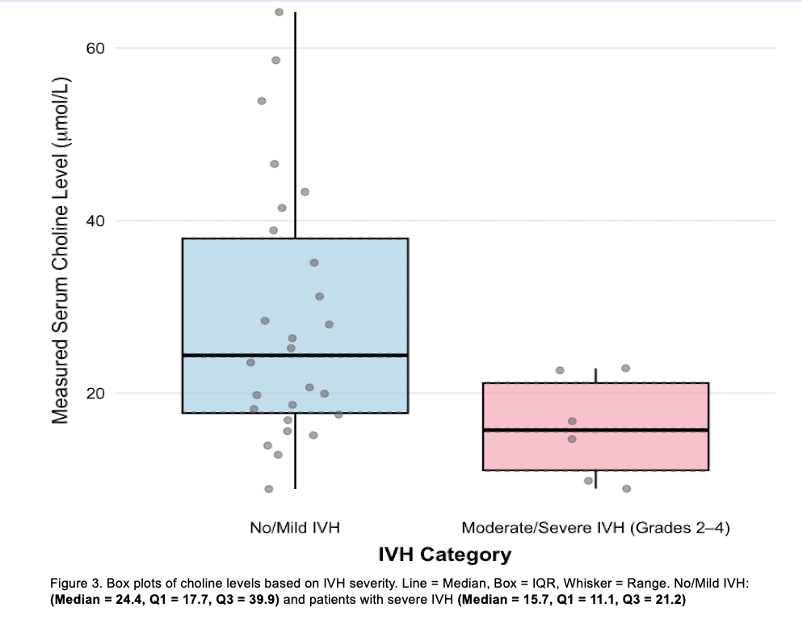
Background: Choline is recognized as an essential nutrient for neurodevelopment and is integral for the development of the myelin sheath, cell membranes, and acetylcholine. It also plays a role in angiogenesis. Preterm infant formulas do not supply enough choline to adequate daily intake. Additionally, preterm infants are susceptible to interventricular hemorrhage (IVH). Fragile vasculature with rapid angiogenesis and rapid fluctuations in cerebral blood flow are implicated in the pathogenesis of IVH. Objective: The aim of this study was to determine whether there is an association between serum choline levels in preterm infants and IVH. Design/Methods: This was a retrospective cohort study involving infants born at Rainbow Babies and Children's Hospital at a gestational age of 24-28 weeks. Premature infants born between 11/27/2023 - 8/25/2024 were screened. Patients with multisystem or congenital abnormalities, or infants not born at Rainbow Babies and Children's Hospital were excluded. Presence or absence of intraventricular hemorrhage (IVH), as well as grade of hemorrhage, was collected and stored in REDCap. Discarded patient blood samples from the first day of life were collected and assayed with the EnzyChrom Choline Assay Kit (BioAssay Systems, Hayward, CA, USA) to determine serum concentrations of choline. Unpaired t test or Mann Whitney rank sum test used for group mean or median comparisons, respectively. Results: We have analyzed serum and collected medical record data for 32 infants. No relationship was found between gestational age and serum choline (r2=0.0163, p=.43), so this was not included as a covariate in the analysis. Infants that had experienced IVH of Grades II, III or IV had a lower median serum choline (n = 6, Median = 15.7, Q1 = 11.1, Q3 = 21.2) than infants that had not experienced IVH or had Grade I IVH (n = 26, Median = 24.4, Q1 =17.7, Q3 = 39.9). The difference in choline concentrations between No IVH/Gr I versus Gr II/III/IV groups was found to be statistically significant with a p = 0.033.
Conclusion(s): Low choline levels may have an impact on development of IVH in premature infants. This may be due to choline's involvement in angiogenesis, cell membrane production, and acetylcholine biosynthesis. Further research should continue to explore the relationship between IVH and choline with a larger sample size.
Table 1. Demographics and Choline Levels
Figure 1. Choline Levels in Infants Based on IVH Category









.jpg)