494 - Efficacy of Rasburicase in the Management of Acute Kidney Injury with Associated Hyperuricemia
Saturday, April 25, 2026
3:30pm - 5:45pm ET
Publication Number: 2480.494
Stefan Raicevic, University of Alabama School of Medicine, Hoover, AL, United States; Amelia C. Pak, University of Alabama School of Medicine, Birmingham, AL, United States; Isaac Weintraub, University of Alabama School of Medicine, Birmingham, AL, United States; David Askenazi, University of Alabama at Birmingham, Birmingham, AL, United States
Resident University of Alabama Birmingham School of Medicine Hoover, Alabama, United States
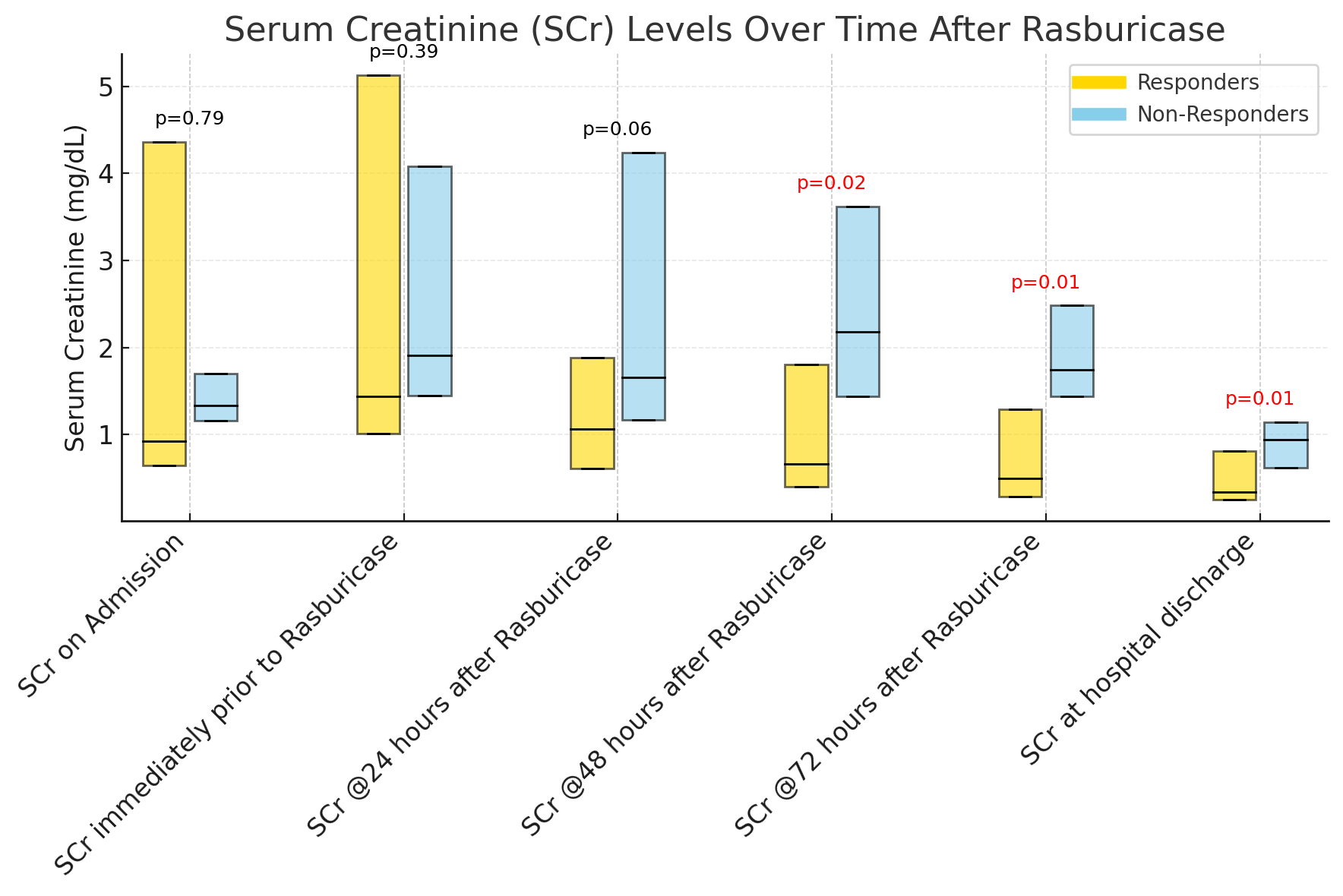
Background: Serum uric acid is associated with acute kidney injury (AKI) through crystal dependent (obstruction and inflammation) and crystal independent (renal vasoconstriction via inhibition of nitric oxide synthase and oxidative stress) pathways. Rasburicase is a recombinant urate oxidase which catalyzes the conversion of uric acid into a more soluble substance that can be excreted by the kidneys. Treatment in context of cancer and tumor lysis syndrome is efficacious and safe, but only limited data in non-cancer patients exists. Objective: To improve the understanding of the safety and efficacy of rasburicase for treatment of AKI in pediatric non-oncologic patients. We report the changes in SCr from admission, prior to rasburicase, at 24 hours, 48 hours, 72 hours and at hospital discharge. We will evaluate the factors associated with a response (decrease in SCr by >20% at 24 hours). Design/Methods: We performed a retrospective cohort study of 22 hospitalized patients under 22 years of age at Children's of Alabama between February 2024 and September 2025. Patients were included if they had a diagnosis of AKI, hyperuricemia (>7.5 mg/dL), negative G6PD screening, and received a dose of rasburicase. We excluded those with known cancer diagnoses. Results: Of the 22 subjects, 10 were female, 3 required dialysis, 10 received pressors, 12 had mechanical ventilation and 3 died prior to hospital discharge. The median (IQR) serum uric acid for all patients dropped significantly after a single dose of rasburicase (13.7 mg/dL (12.6 - 17.4) to 1.4 (1.0 - 3.4). The change in uric acid was not different between responders (n=11) and non-responders (n= 11); however, responders were younger [0.8 (0.6 - 3.0 vs. 7.0 (3.7 - 15.5) years; p< 0.02] and received a higher dose of rasburicase [0.17 (0.16 - 0.19) vs. 0.08 (0.07 - 0.15) p< 0.03]. No differences were observed by sex, ventilation, pressors, dialysis, or death. Figure 1 shows difference in SCr between groups at admission, prior to rasburicase, at 24, 48, 72 hours and discharge. No side effects were evident.
Conclusion(s): One dose of rasburicase significantly decreased uric acid values in non-cancer patients with AKI and hyperuricemia which attenuates a decrease in SCr. SCr response was associated with higher rasburicase dose and age. Rasburicase appears to be safe and efficacious in management of hyperuricemic AKI. Prospective intervention studies to better understand timing, dose and safety are warranted.