353 - Maternal and Neonatal Factors Associated with inhaled Nitric Oxide Use in Very Low Birthweight Infants
Saturday, April 25, 2026
3:30pm - 5:45pm ET
Publication Number: 2342.353
Savanah Gallegos, Los Angeles General Medical Center, Agoura Hills, CA, United States; Yu-Han Wang, Keck School of Medicine of the University of Southern California, Los Angeles, CA, United States; Lorayne Barton, Keck School of Medicine of USC/Los Angeles General Hospital, Los Angeles, CA, United States; Rangasamy Ramanathan, Cedars Sinai Guerin Children's, Cedars Sinai Medical Center, Los Angeles, CA, United States; Rowena Cayabyab, Los Angeles General Medical Center, Los Angeles, CA, United States
Resident Physician Los Angeles General Medical Center Agoura Hills, California, United States
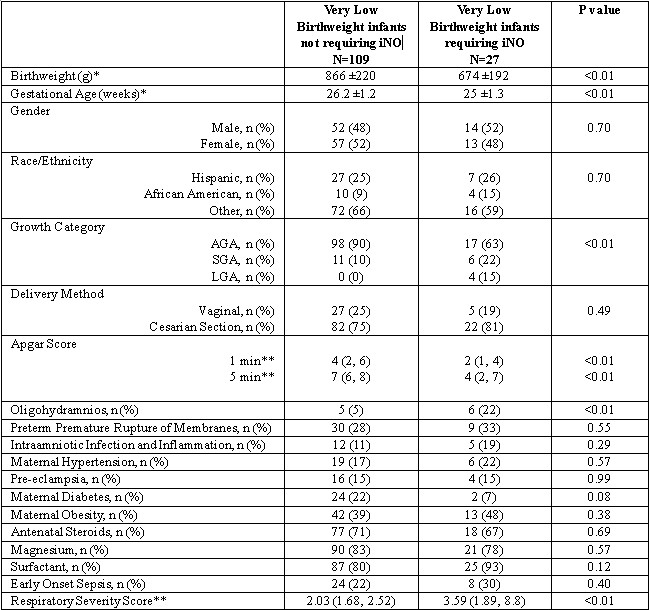
Background: Inhaled nitric oxide (iNO) is a well-studied medication used in the neonatal intensive care unit (NICU) for treatment of persistent pulmonary hypertension of the newborn (PH) in late preterm and term infants. Several studies have investigated the effects of iNO on infants with PH >34 weeks gestational age (GA), as well as explored maternal/neonatal characteristics to predict response to treatment. However, data is limited in preterm infants. Objective: The purpose of this study is to determine maternal and neonatal factors associated with use of iNO in very low birthweight (VLBW) infants during admission to the NICU. Design/Methods: This was a retrospective cohort study of all VLBW infants admitted to a Level III NICU at Los Angeles General Medical Center from 2015-2024. Maternal and neonatal demographics were collected from the electronic NICU database and electronic medical records. Respiratory severity scores (RSS) were calculated at ≤24 hours of life [FiO2 x Mean Airway Pressure]. Infants were grouped into those who received nitric oxide and those who did not during their NICU stay. Chi square test was used to determine differences in categorical risk factors, and Wilcoxon rank sum was used to analyze continuous variables. Multivariate logistic regression was used to determine factors associated with use of iNO. Results: There were 136 infants included in this study; 27 (20%) infants required iNO, and 109 did not. Infants requiring iNO were exposed to maternal oligohydramnios, had significantly lower birthweight, gestational age, Apgar scores, and higher RSS compared to those who did not. Most infants were appropriate for gestational age in both groups. There were no significant differences in gender, race/ethnicity, or maternal illness between the two groups (Table). 74% of infants who received iNO had a diagnosis of pulmonary hypertension by clinical or echocardiographic criteria (p < 0.01). On regression analysis, use of iNO was associated with oligohydramnios [OR 4.9, 95%CI (1, 26), p=0.03] and gestational age [OR 0.48, 95%CI (0.32, 0.71), p< 0.01].
Conclusion(s): VLBW infants exposed to maternal oligohydramnios are nearly 5 times more likely to require iNO use especially in the setting of lower gestational age, likely, due to pulmonary hypoplasia. These infants should be delivered, if possible, in centers where this intervention is available.
Demographics and maternal/neonatal characteristics of the study population *Mean ±Standard Deviation **Median (25th, 75th percentile)









 *Mean ±Standard Deviation