8 - From Metaphor to Precision: Are Food Eponyms Losing Their Flavor?
Saturday, April 25, 2026
3:30pm - 5:45pm ET
Publication Number: 2007.8
Apthi C. Muralidhar, Baylor College of Medicine, Bellaire, TX, United States; Hariharan Gokulakrishnan, Baylor College of Medicine, Houston, TX, United States; Muralidhar H. Premkumar, Baylor College of Medicine, Houston, TX, United States
Undergraduate Researcher Baylor College of Medicine Bellaire, Texas, United States
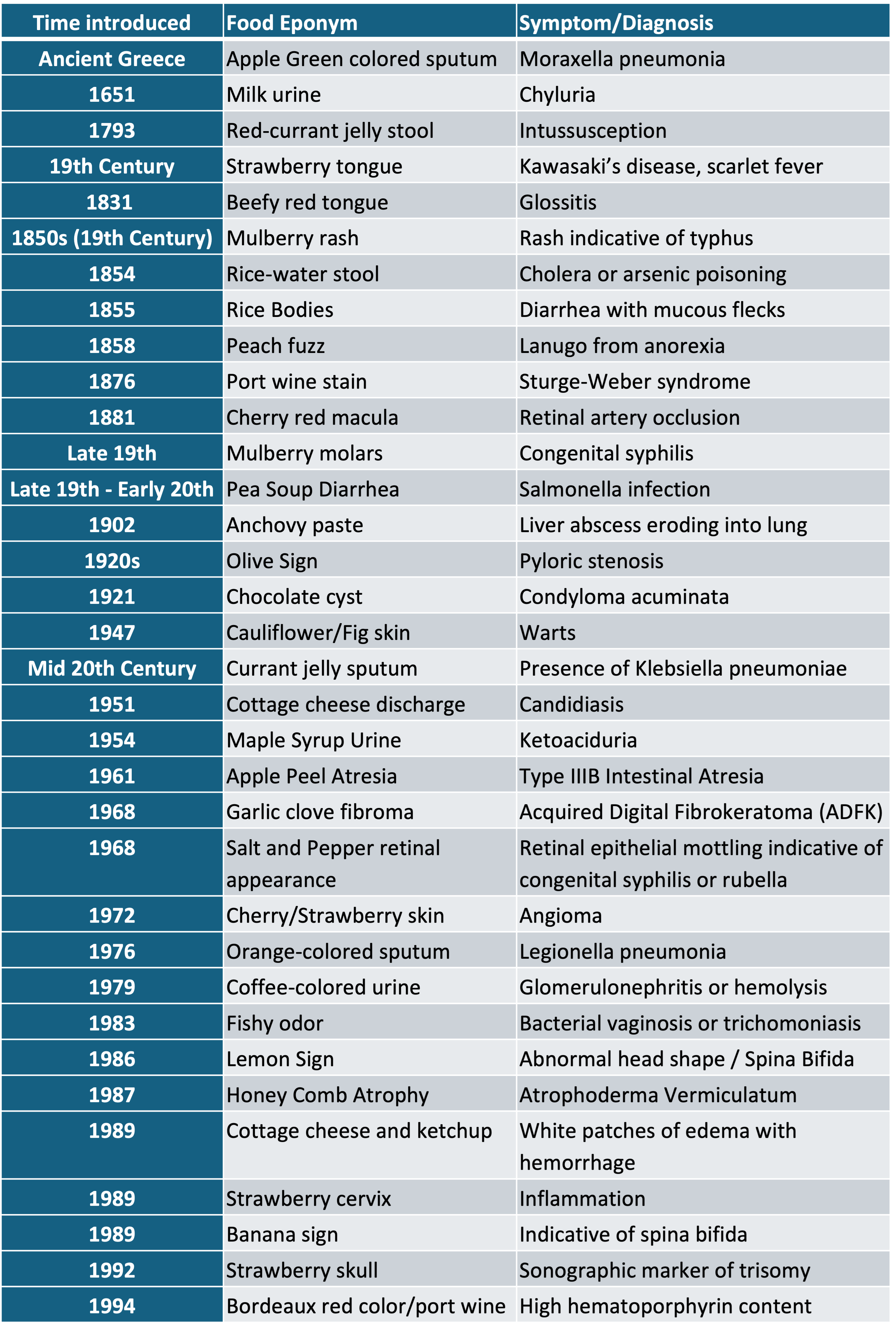
Background: Food eponyms are terms that use food or food-related language to describe a condition or characteristic. They are employed across various medical specialties to aid in the description and identification of diseases and pathologies. Food eponyms enhance communication among healthcare professionals and enrich the educational experience for learners. However, most originate from Western foods or concepts. Objective: To describe the use of food eponyms in medicine, examine the cultural implications, and explore strategies to improve inclusivity while preserving their educational value. Design/Methods: Electronic databases (PubMed, MEDLINE, EMBASE, and Google Scholar) were searched for descriptions of food eponyms in medicine and their impact on education and clinical practice. Results: The use of food as a descriptive tool has been present throughout medical history, dating back to Ancient Greece, when physicians created connections between food textures and symptoms of diseases and diagnoses (Table 1). During the mid-20th century, there was a peak in the use of sensory descriptions in medical terminology, which expanded significantly and began to incorporate food terms, primarily from Western or European contexts. Currently, the creation of sensory descriptions in medical terms is diminishing, with a greater emphasis on the use of precise terminology.
The use of food eponyms can also create cultural barriers when used outside of European or Western contexts. The physicians should strive to balance cultural barriers with universally comprehensible language and education. The World Health Organization recommends that disease descriptions use words relating to pathology, be concise, and include only additional details as needed. Disease descriptions containing geographical terms, names of people and animal species, and cultural references are advised against. For those food terminologies that are retained, educators should clarify and present visuals to help students understand the diagnostic relevance, especially for students from non-Western backgrounds.
Conclusion(s): Food eponyms have long enriched medical language through vivid and memorable descriptions, but their continued use must be balanced against cultural inclusivity and scientific precision. As medicine becomes increasingly global, adopting clear, descriptive, and culturally neutral terminology ensures effective communication and equitable education across diverse contexts.
Figure 1. Description of food eponyms, their origin, names, and the diseases or pathologies they represent.









.jpeg.jpg "Apthi C. Muralidhar (she/her/hers) photo")