97 - Hypertension Prevalence and Correlates Among 8-Year-Old Hispanic Children in the Starting Early Program (StEP) Cohort
Saturday, April 25, 2026
3:30pm - 5:45pm ET
Publication Number: 2092.97
Dabir Siddiqi, New York University Grossman School of Medicine, Brooklyn, NY, United States; Christina N. Kim, New York University Grossman School of Medicine, New York, NY, United States; Rachel S. Gross, New York University Grossman School of Medicine, New York, NY, United States; Rebecca Campos. Ribeiro, New York University Grossman School of Medicine, Everett, MA, United States; Mary Jo Messito, New York University Grossman School of Medicine, New York, NY, United States
Pediatric General Academic Fellow New York University Grossman School of Medicine Brooklyn, New York, United States
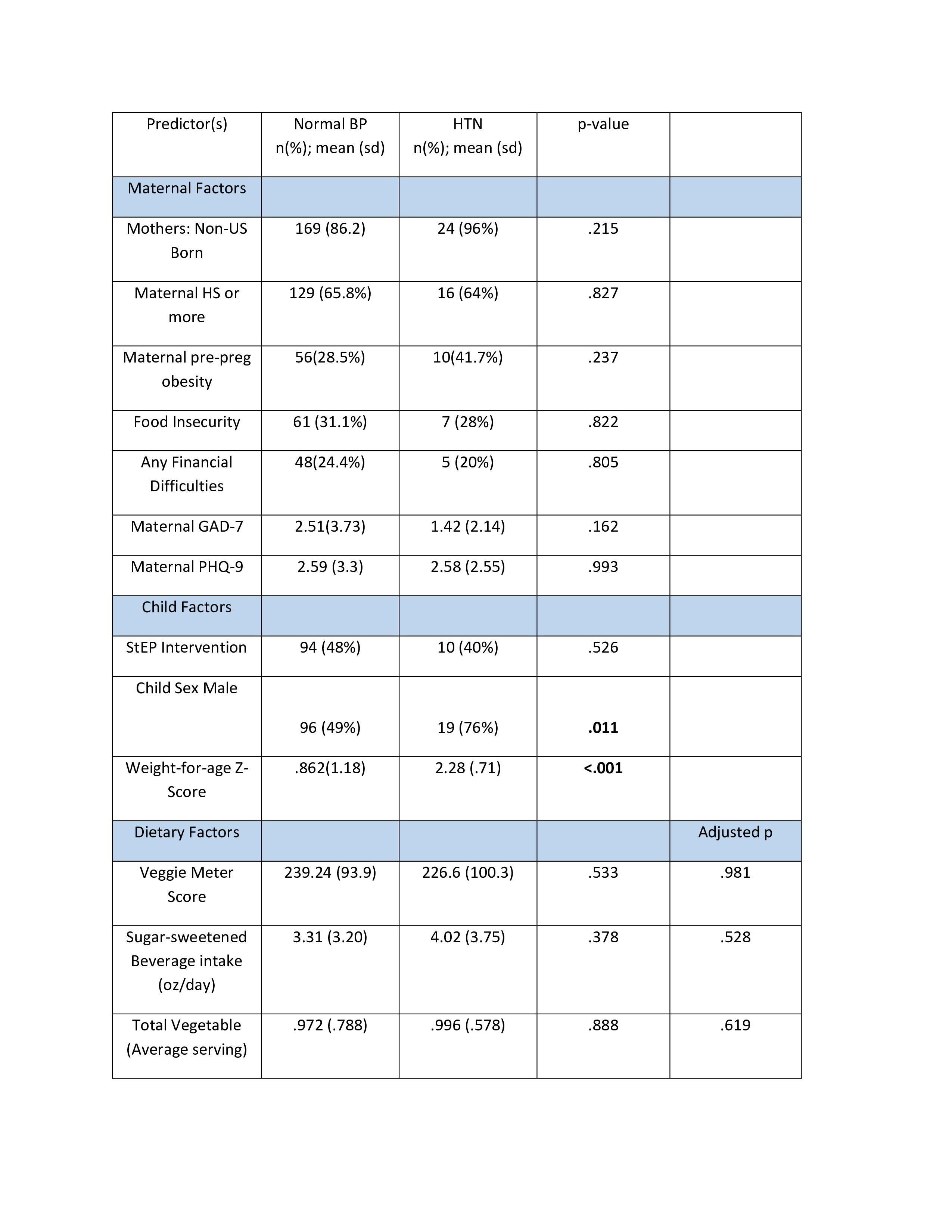
Background: High blood pressure (BP) in childhood leads to increased risk for hypertension and cardiovascular disease in adulthood. Research shows that psychosocial stressors such as food insecurity (FI), high weight and dietary factors such as fruit and vegetable intake (FVI) can be associated with BP in children and adults. Less research as examined these factors in Hispanic children and those with living with lower income, and few have included alternate measures of FVI such as skin carotenoid levels measured using the Veggie Meter (VM). Objective: To determine the prevalence of hypertension 8-year-olds from the Starting Early Program (StEP) cohort and examine associations with maternal psychosocial factors, child weight and VM and survey measures of dietary intake. Design/Methods: Cross-sectional analysis including 221 mother-child dyads from the StEP randomized controlled trial of a primary-care based child obesity prevention intervention. StEP was developed for low-income, Hispanic mother-child pairs, beginning in the third trimester of pregnancy and continuing to child age 3 years. Child blood pressure was measured in triplicate and averaged; percentiles were calculated using 2017 AAP guidelines. Hypertension was defined as BP ≥ 95th percentile for age, sex, and height. Maternal psychosocial factors included country of birth, education (≥HS vs < HS), food insecurity, depression and anxiety symptoms. Child factors included sex, weight-for-age z-score (WAZ) and FVI assessed by survey and using the Veggimeter. The VM score was obtained as an average of 3 skin β-carotene measurements giving a continuous score of 0-800 where higher scores indicate higher FVC consumption. Between-group differences were assessed using t-tests and χ² tests. Multivariable logistic regression adjusted for sex, height, and intervention arm. Results: Among 221 children, 25 (11.3%) met criteria for hypertension. Male sex and higher WAZ were significantly associated with HTN (Table 1). Maternal psychosocial factors, dietary intake, intervention arm, and other demographic variables were not significantly associated with hypertension in this sample.
Conclusion(s): In this cohort of Hispanic mother-child dyads from low-income families, the prevalence of hypertension at age 8 remained nearly double national estimates. Male sex and higher weight were the only significant correlates. Though diet and maternal psychosocial factors were not significant in this analysis, limited power may have masked their effects. Studies with larger sample sizes are needed to assess the FVI with hypertension.