232 - When it comes to child health information, who do you trust?
Saturday, April 25, 2026
3:30pm - 5:45pm ET
Publication Number: 2223.232
Kathryn (Callie) C. Kaplan, Ann & Robert H. Lurie Children's Hospital of Chicago, Chicago, IL, United States; Laiba Bajwa, Ann & Robert H. Lurie Children's Hospital of Chicago, Chicago IL, IL, United States; Emily Golbeck, Ann & Robert H. Lurie Children's Hospital of Chicago, Chicago, IL, United States; Marie Heffernan, Ann & Robert H. Lurie Children's Hospital of Chicago, Chicago, IL, United States; MIchelle Macy, Ann & Robert H. Lurie Children's Hospital of Chicago, Chicago, IL, United States; Adam B. Becker, Northwestern University The Feinberg School of Medicine, Chicago, IL, United States
Senior Research Scientist Ann & Robert H. Lurie Children's Hospital of Chicago Chicago, Illinois, United States
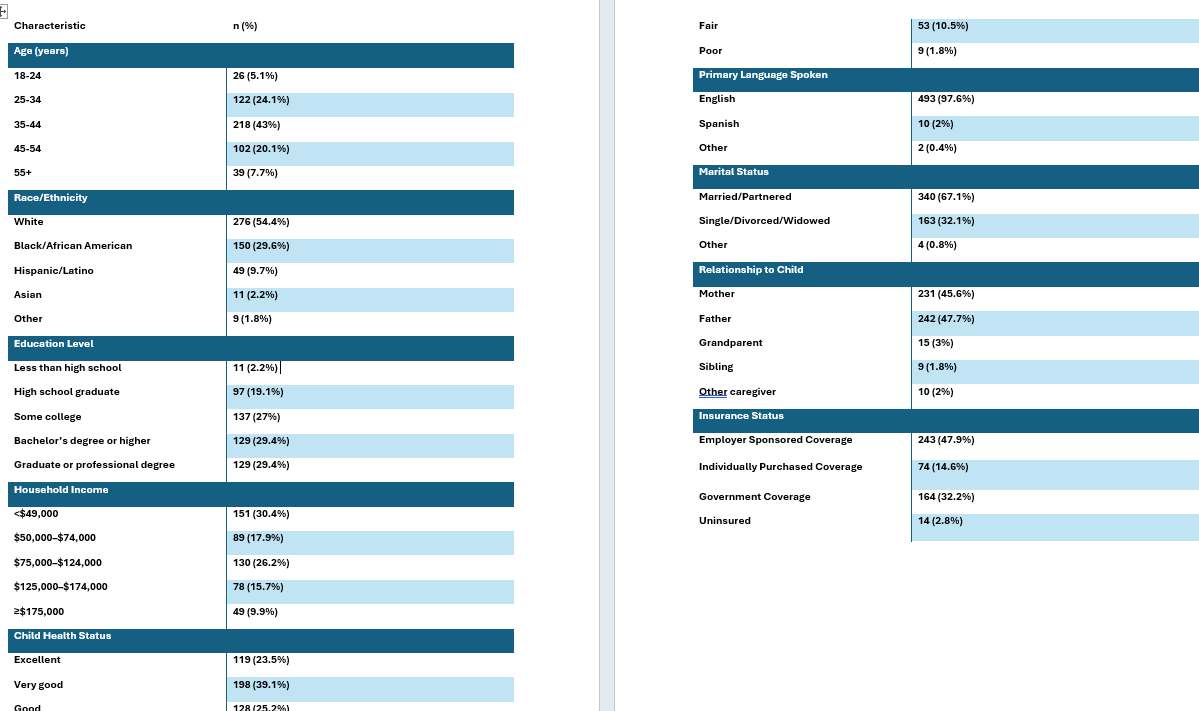
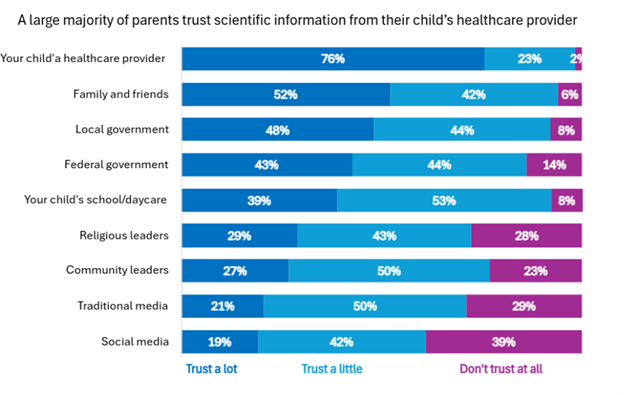
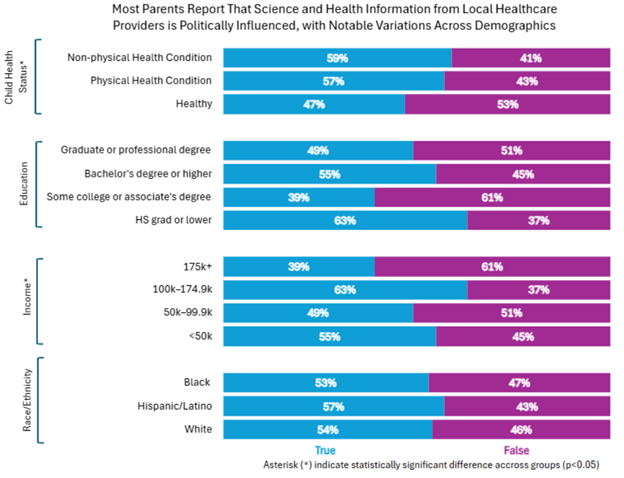
Background: Various health information sources shape parental perspectives on general pediatric health care-seeking, vaccine safety, and research participation safety. Parental trust or distrust in sources of health information may modify health behaviors and result in different child health outcomes. Assessing parental trust in scientific and health-related information among various sources is critical for effective engagement and tailored pediatric public health and clinical messaging. Objective: To explore parental perspectives of trust in scientific sources among a sample of parents within Lurie Children's Hospital's Catchment area. Design/Methods: We distributed a cross-sectional online survey using QualtricsXM to parents of children < 18 years, residing in Lurie Children's primary service catchment area, largely made up of metropolitan Chicago, with parts of southern Wisconsin and northwest Indiana. Participants were recruited by Qualtrics Panels using demographic quotas to reflect the region's racial, ethnic, linguistic, and socioeconomic diversity. We calculated descriptive and chi-square statistics to compare responses across race and ethnicity, language, income, and child health status. Results: We received responses from 536 parents and included 507 complete and high-quality cases in our analysis (Table 1). While parents reported receiving information from a variety of sources, parents most often reported receiving scientific information from their healthcare provider (86%). A large majority of parents trust scientific information from their child's healthcare provider (76%), followed by friends and family (52%) Across sources, parents most frequently reported that they did not trust social media at all (39%). (Figure 2). Despite this, most respondents indicated they believed information about science and health from healthcare providers in their community is driven more by politics than by truth (54%), with significant differences across parent demographics and characteristics (Figure 3). A majority of parents reported that they would trust healthcare providers more if they looked like them (64%) and if they knew they were receiving input from the community (73%).
Conclusion(s): Parents receive information from their healthcare providers and trust that information. At the same time, many parents also believe that health-related information from healthcare providers in their community is driven by politics. Better understanding this nuance, and ways to improve community trust may be critical to improving health messaging from healthcare providers.
Demographics and Child Health Characteristics among a sample of parents in the Lurie Children's Catchment Area (n=507)
Parental trust of scientific information among various sources
Demographic and Child Health Differences in Parental Trust in Political Influence of Local Health Care Providers









.jpg "Callie C. Kaplan, MPH, DrPH Candidate (she/her/hers) photo")