7 - Enhancing Recruitment and Retention by Diversifying Research Staff to Include Marginalized Populations for Studies on Sensitive Topics
Sunday, April 26, 2026
9:30am - 11:30am ET
Publication Number: 3006.7
Maria P. Gomez, Boston Medical Center, Boston, MA, United States; Samuel Francois, Boston University School of Medicine, Milford, MA, United States; Sahar A. Choudhry, Boston Medical Center, Boston, MA, United States; Rachel S. Sagor, Boston University School of Medicine, Chestnut Hill, MA, United States; Michelle Stransky, Boston University School of Medicine, Boston, MA, United States; Miriam Bremer-Kamens, Boston Medical Center, Boston, MA, United States; Lucy Marcil, Boston University School of Medicine, Alexandria, VA, United States
Clinical Research Coordinator Boston Medical Center Boston, Massachusetts, United States
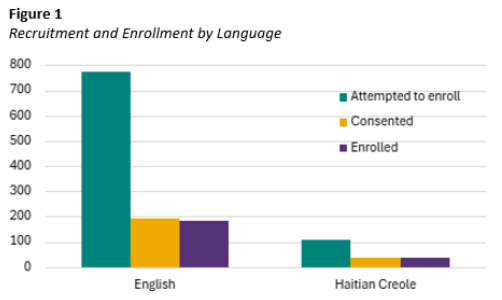
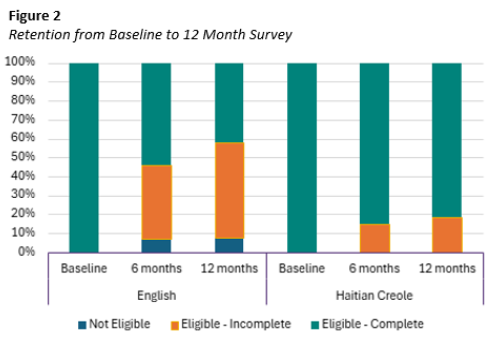
Background: High-quality research evidence necessitates the inclusion of participants from diverse racial, economic, and ethnic backgrounds. However, traditional medical research institutions are limited by mostly serving English-speaking populations and may lack the resources and staff to translate, recruit, and administer research protocols to other languages. Biased search perceptions that individuals from non-English speaking or low-income groups will not be willing to participate or complete studies further reduces opportunities to include all potentially eligible persons. We addressed concerns about recruitment and retention in an ongoing study of publicly funded program enrollment among families receiving pediatric primary care at Boston Medical Center (BMC). BMC is an ideal site for research regarding historically marginalized groups, given that most patients have Medicaid insurance and approximately 40% speak languages other than English. Objective: We describe and evaluate the enrollment and retention of low-income English and non-English speaking patient populations in a study. Design/Methods: We recruited English- and Haitian Creole-speaking families receiving primary care for an infant at BMC. Enrolled families were asked to complete a 20-minute survey every 6 months until their child reached 24 months of age. We compared enrollment and retention at each time point. Results: We attempted to recruit 773 English and 110 Haitian Creole speakers eligible for the study (Figure 1). Of those recruited, 25% (n=192) English and 32% (n=35) Haitian Creole speakers completed the consent process (p=0.130) and 88% (n=169) and 94% (n=33) completed the baseline survey (p=0.385), respectively. All families who completed the baseline survey were eligible to complete the 6-month survey; nearly all English (99%) and all Haitian Creole speaking families were eligible to complete the 12-month survey. Haitian Creole-speaking families were more likely to complete the 6- and 12-month follow-up surveys than their English-speaking peers (6 months: 85% vs. 58%, p=0.005; 12 months: 82% vs. 46%, p< 0.001) (Figure 2).
Conclusion(s): Contrary to the belief that recruiting and retaining historically marginalized, non-English-speaking populations is difficult, we found that Haitian Creole speakers were more likely to agree to participate, consent, and complete surveys at baseline and at 6- and 12-month follow-ups. The effort required to ensure our study team could communicate directly in Haitian Creole with potential participants was well rewarded.