692 - Correlation of Bladder Wall Thickness and Bladder Debris on Ultrasonography with Urine Culture in Pediatric Patients presenting to a Single-Center, Academic Children’s Hospital Emergency Department
Sunday, April 26, 2026
9:30am - 11:30am ET
Publication Number: 3669.692
Emily Jonker, Connecticut Children's Medical Center, Hartford, CT, United States; Alexandra Bahgat, Connecticut Children's Medical Center, Hartford, CT, United States; Amirul Anuar, Connecticut Children's Medical Center, Hartford, CT, United States; Andrew Heggland, Connecticut Children's Medical Center, Hartford, CT, United States; Douglas Moote, Connecticut Children's Medical Center, Hartford, CT, United States; Henry Chicaiza, Connecticut Children's, Suffield, CT, United States
Pediatric Emergency Medicine Fellow Connecticut Children's Hartford, Connecticut, United States
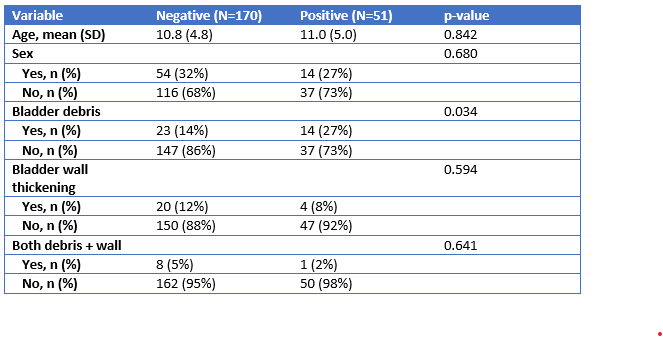
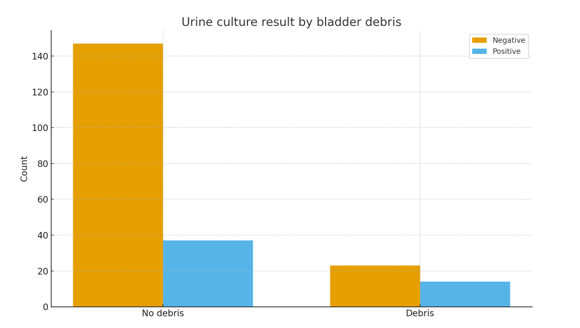
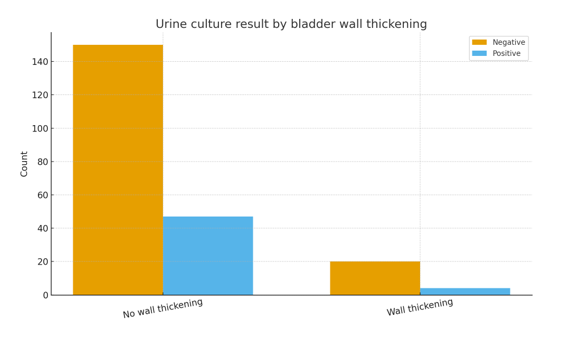
Background: Ultrasound (US) evaluation of the bladder is commonly performed on pediatric patients undergoing work-up for renal and/or bladder pathology. While a correlation between urinary tract infection (UTI) and bladder debris on US has been previously described, whether bladder wall thickness is also associated with UTI in pediatric patients is unknown. Objective: To evaluate for correlation of bladder wall thickness and/or bladder debris on US with urinary tract infection. Design/Methods: We performed a retrospective chart review of pediatric patients presenting to a pediatric emergency department (PED) for possible UTI between May 1, 2023 and May 1, 2024 and who underwent bladder US and had urine cultures. The primary outcome was a positive urine culture. Independent variables included the presence of bladder debris, bladder wall thickening, and patient demographics. Descriptive statistics were used to compare demographic and US findings between patients with positive and negative urine cultures. Continuous variables were analyzed using t-tests; categorical variables were analyzed using chi-square tests. We performed logistic regression to assess the association between bladder ultrasound findings and urine culture positivity. A multivariable model additionally adjusted for age and sex. Odds ratios (OR) with 95% confidence intervals (CI) are reported. Statistical significance was defined as p < 0.05. Results: Among 221 patients, 51 (23%) had a positive urine culture. Mean age and sex did not differ significantly between the groups (see table). Bladder debris was seen more frequently in patients with positive cultures than those with negative cultures (27% vs 14%, respectively, p = 0.034). Bladder wall thickening was not significantly different between the groups. In the unadjusted logistic regression, bladder debris was associated with positive urine culture (adjusted OR 2.71, 95% CI 1.24-5.94, p = 0.012); bladder wall thickening was not significant. Results were similar after adjusting for age and sex in the multivariable model.
Conclusion(s): These findings suggest an association between bladder debris on ultrasound and a positive urine culture but not for bladder wall thickening. Further prospective study is needed to validate these findings.
Table 1. Demographics.
Figure 1. Distribution of urine culture results by presence of bladder debris.
Figure 2. Distribution of urine culture results by presence of bladder wall thickening,