9 - Spanish-Speaking Caregiver Experience in Pediatric Care Management: A Qualitative Study from North Carolina Integrated Care for Kids (NC InCK)
Sunday, April 26, 2026
9:30am - 11:30am ET
Publication Number: 3008.9
Yasamin E. Sanii, University of North Carolina at Chapel Hill School of Medicine, Hillsborough, NC, United States; Kori Flower, University of North Carolina at Chapel Hill School of Medicine, Chapel Hill, NC, United States; Jennifer P. McBride, University of North Carolina at Chapel Hill School of Medicine, Durham, NC, United States; Eleanor A.. Wertman, UNC Health, Durham, NC, United States; Josie Hatley, Duke University School of Medicine, Winston-Salem, NC, United States; Carolyn Avery, Duke University School of Medicine, Durham, NC, United States; Michael J. Steiner, Oklahoma Childrens Hospital at OU Health, Chapel Hill, NC, United States; Alexander Acosta, University of North Carolina at Chapel Hill School of Medicine, Hendersonville, NC, United States; Chelsea Swanson, Duke-Margolis Institute for Health Policy, Durham, NC, United States; Hartlee Lidsky, University of Michigan, Ann Arbor, MI, United States; Rushina Cholera, Duke University School of Medicine, Durham, NC, United States
Fellow University of North Carolina at Chapel Hill School of Medicine Hillsborough, North Carolina, United States
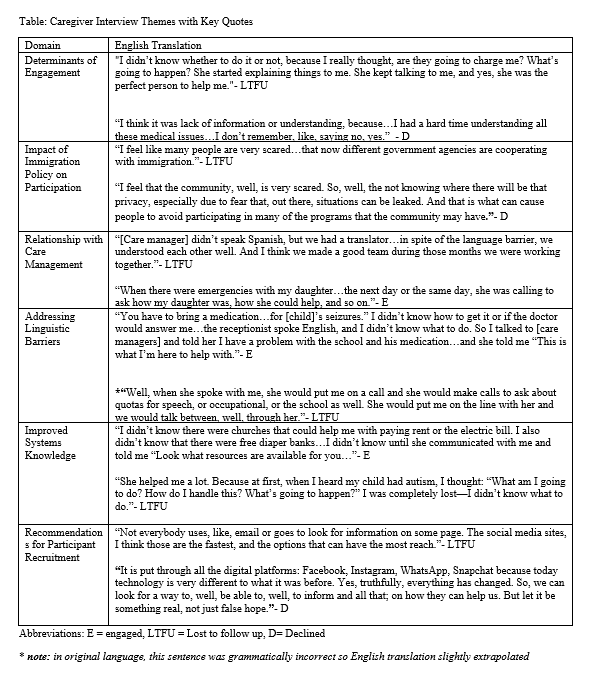
Background: Spanish-speaking families face unique barriers to accessing healthcare and community resources. Care management is widely used to improve access to services, but it is unclear how to best tailor care management for Spanish-speaking families. Objective: NC InCK is a CMS Innovation Center pediatric care delivery and demonstration model that provides care management services to Medicaid-insured children with medical and social risk factors. We assessed Spanish-speaking caregivers' experiences with NC InCK care management. Design/Methods: Caregivers were chosen randomly from 3 groups with varied care management participation: engaged, lost to follow-up (LTFU), and declined. Bilingual researchers interviewed Spanish-speaking caregivers using an interview guide with questions about care management recruitment, engagement, and recommendations for improvement. LTFU and declined families were asked about immigration policy's impact on program participation. Interviews continued until thematic saturation was reached. Themes were summarized into domain matrices and analyzed using rapid qualitative analysis. Results: Caregivers were primarily mothers who engaged (n=6), were LTFU (n=6), or declined services (n=5). Interviewees described barriers and facilitators to engagement. Engaged and LTFU participants were unfamiliar with care management and concerned about privacy, but encouraged by care managers' genuine and effective support for their children. Most caregivers who declined participation did not remember initial outreach, with several noting privacy concerns; however, most requested connection to care management after further explanation of care manager role. LTFU and declined caregivers highlighted immigration policy as a community-level deterrent to enrollment. Engaged and LTFU caregivers reported strong and trusting care manager relationships, with most LTFU caregivers reporting that they had unintentionally discontinued participation. Care managers addressed language barriers, increased resource and systems awareness, and facilitated benefits to children like improved medication adherence, connections to healthcare and school performance. Caregivers reported increased household-level access to material resources like diapers and food, as well as reduced stress.
Conclusion(s): Spanish-speaking families report specific benefits from care management including addressing language barriers and improving resource awareness. Education about care management, with clear explanations of program scope and privacy safeguards, may increase Spanish-speaking caregivers' engagement.