497 - Effect Of Exposure To Intrauterine Blood Transfusions On T-cell Subsets In Fetuses And Neonates With Rh Iso-immunization- A Cohort Study
Sunday, April 26, 2026
9:30am - 11:30am ET
Publication Number: 3478.497
Anita Yadav, PGIMER Chandigarh, Gurugram, Haryana, India; Sourabh Dutta, Post Graduate Institute of Medical Education and Research, Chandigarh, Chandigarh, India; Amit Rawat, PGIMER Chandigarh, Chandigarh, Chandigarh, India; Lakhvinder Singh, Post Graduate Institute of Medical Eduacation and Research, Chandigarh, Chandigarh, Punjab, India; Subhas Chandra. Saha, Post graduate institute if medical education and research, Chandigarh, Chandigarh, India
DM senior resident PGIMER Chandigarh Gurugram, Haryana, India
Background: Scant published data on T-cell subsets in neonatal blood suggest that-owing to limited antigenic stimuli- the memory T-cell subset (CD45RO+) constitutes a small fraction (~2-5%) of both CD4+ (helper) and CD8+ (cytotoxic) T-cells, whereas the naïve T-cell subset (CD45RA+) forms the dominant fraction. Intrauterine blood transfusions (IUT) prematurely expose the fetal immune system to foreign antigens providing an opportunity to study the effect on the memory and naïve subsets of CD4+ and CD8+ cells. Objective: Prospective observational cohort Design/Methods: We compared 3 groups (Figure 1) until 3 months postnatal age: Group I (n=29): fetuses with Rh-iso-immunization [maternal Indirect Coomb's Test >1:16] who underwent IUTs for significant fetal anemia, Group II-A (n=25): neonates with Rh-iso-immunization without IUT, Group II-B (n=25): non-Rh-iso-immunized neonates. In group I, we compared T-cell subset percentages in pre-IUT fetal, birth, and three-month blood samples and also compared them between groups at birth and 3 months. Percentages were calculated using FlowJo software after flow cytometry analysis (with positive controls). Primary outcome: memory CD4+ subset (% of all CD4+ T-cells). Secondary outcomes: CD3+ (pan-T-cell) (% of all lymphocytes), CD4+ and CD8+ subsets (% of CD3+), memory (CD45RO+) subset (% of CD8+ T-cells), and naïve (CD45RA+) subsets (% of both CD4+ and CD8+ T-cells). Results: Group I neonates had indicators of severe isoimmunization. (Table 1) Groups I, II-A and II-B had similar median (Q1, Q3)% CD4+ memory T-cells at birth [0.22 (0.08, 0.39) vs. 0.29 (0.07, 0.83) vs. 0.14 (0.09, 0.34), respectively, p=0.5] and at three months [0.47 (0.09, 1.79) vs 0.30 (0.05, 1.36) vs 0.80 (0.00, 6.83), respectively, p=0.6]. The percentage of CD3+ T-cells (of all lymphocytes) was similar at birth between the groups but was significantly higher in Group I at 3 months (p= 0.03). The percentage of CD8+ memory T-cells (of all CD8+ cells) and T-cells (of all of CD4+ and CD8+ cells) were similar between Groups at birth and three months (Table 2). In Group I, median (Q1, Q3) % CD4+ memory T-cells were less in utero compared to birth and 3 months [0.09 (0.00, 0.33) vs 0.22 (0.08, 0.39) vs 0.47 (0.09, 1.79), respectively, p= 0.5]. However, a mixed linear model did not find statistically significant relationships between CD4+ memory T-cell % and age at sampling or number of IUTs, or with the interaction term of age and number of IUTs.
Conclusion(s): IUT in fetuses with Rh-iso-immunization does not significantly affect cell-mediated immunity. Memory CD4+ subset (%) was lower than earlier reported.
Study flow Daigram Figure 1
Baseline maternal, fetal and neonatal characteristics between the three groups Table 1
Comparison of T cell subsets between the three Groups Table 2









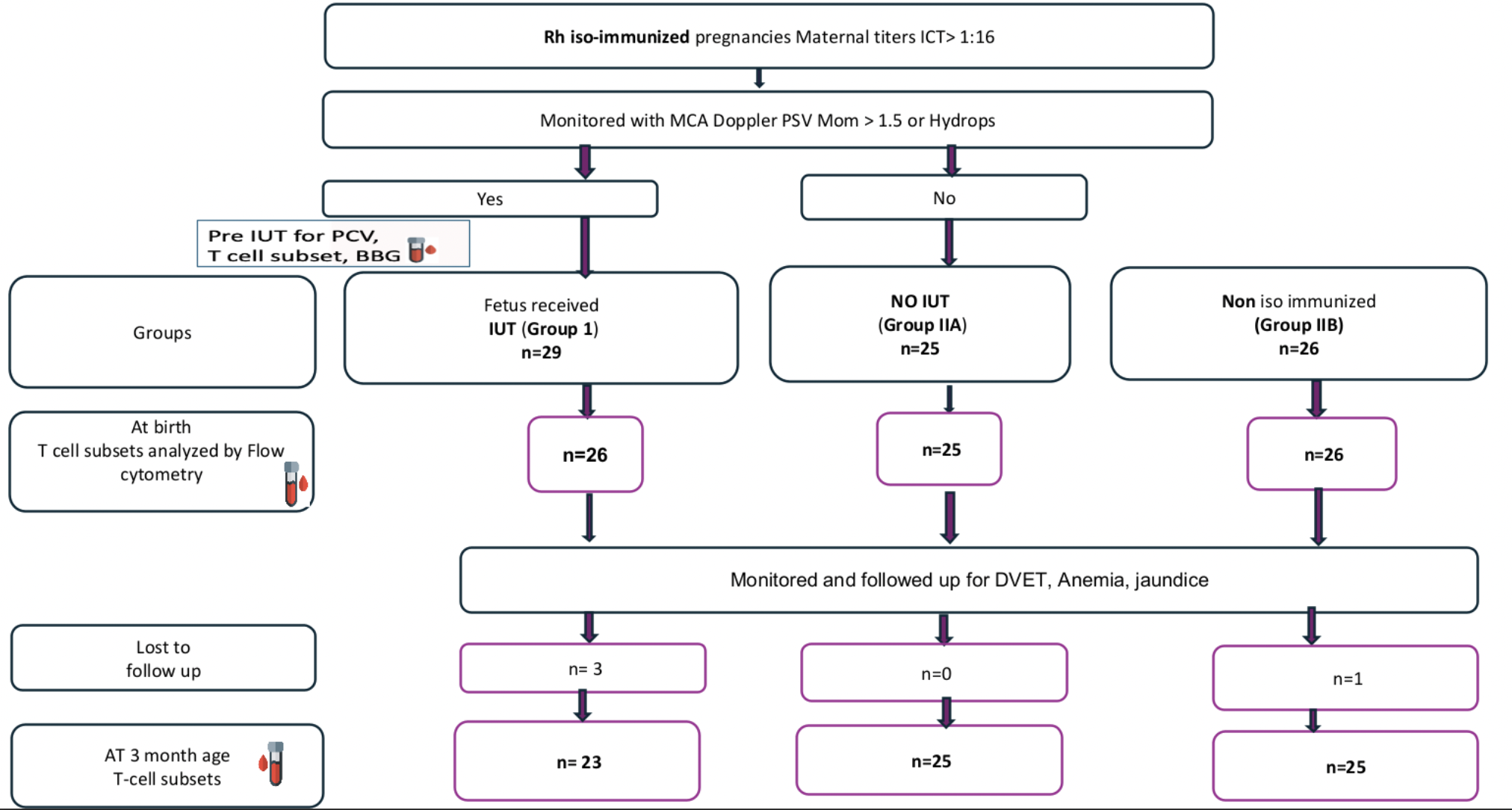 Figure 1
.png) Table 1
Table 1.png) Table 2
Table 2