Session: Neonatal Hemodynamics and Cardiovascular Medicine 2
466 - CaRD tool: A Cardiovascular-Respiratory-Demographic Scoring system for early prediction of bronchopulmonary dysplasia in extreme preterm neonates
Sunday, April 26, 2026
9:30am - 11:30am ET
Publication Number: 3451.466
Renjini Lalitha, University of Western Ontario, London, ON, Canada; Lisiane Hoff Calegari, The University of Western Ontario - Schulich School of Medicine & Dentistry, London, ON, Canada; Andrea C. De La Hoz, London Health Sciences Center Research Institute, London, ON, Canada; Clara I. McNair MacNeil, The University of Western Ontario - Arthur Labatt Family School of Nursing, London, ON, Canada; Michael Miller, The University of Western Ontario - Schulich School of Medicine & Dentistry, London, ON, Canada; Tamara I. Jahmani, Yarmouk University, Irbid, Irbid, Jordan; Matthew Hicks, University of Alberta Faculty of Medicine and Dentistry, Edmonton, AB, Canada; Kumar Kumaran, University of Alberta, Edmonton, AB, Canada; Soume Bhattacharya, Western University, London, ON, Canada
Assistant Professor University of Western Ontario London, Ontario, Canada
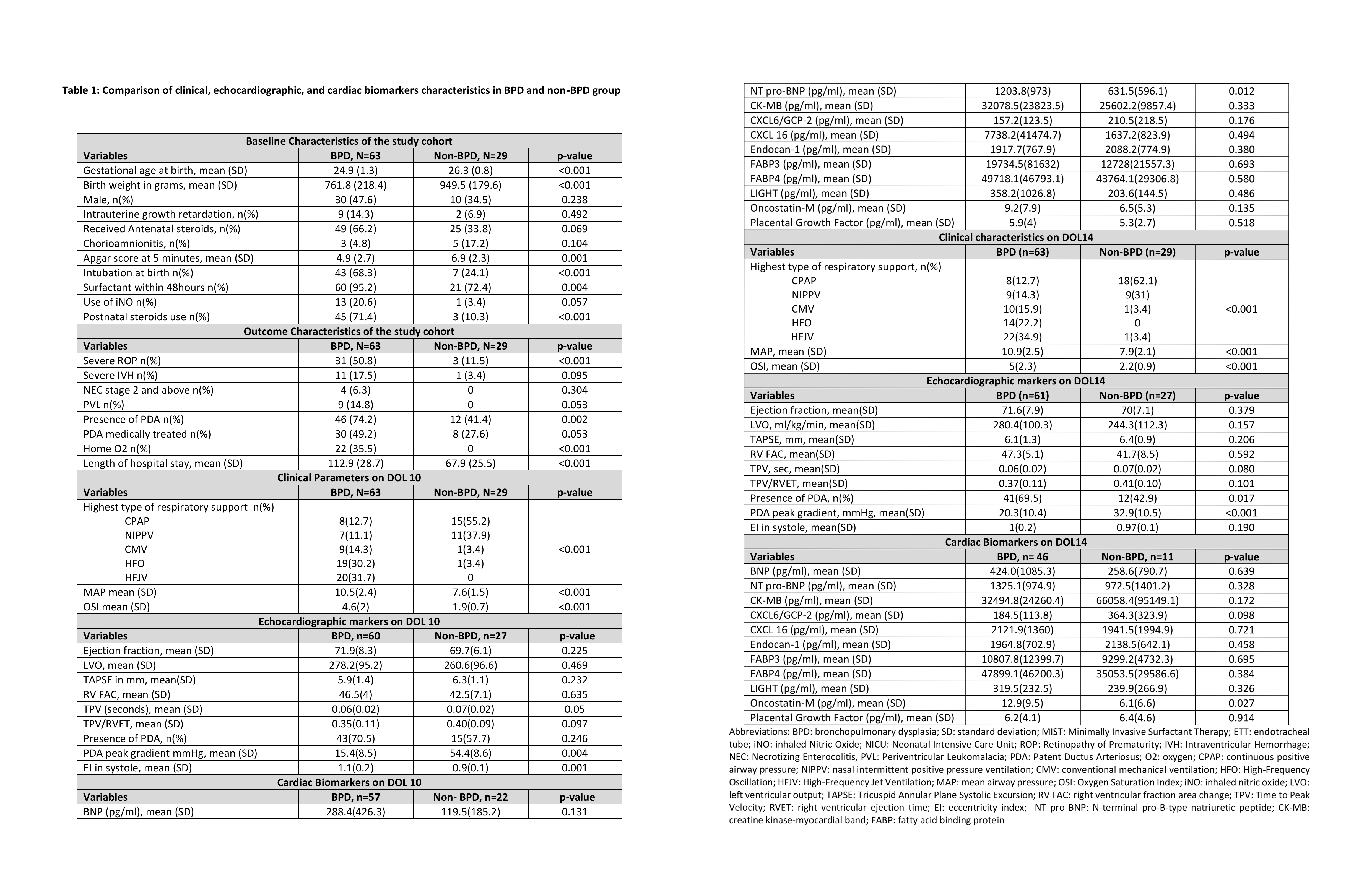
Background: Bronchopulmonary dysplasia (BPD) remains the most common respiratory morbidity among extreme preterm neonates. In recent years, researchers have identified early cardiovascular factors associated with BPD development. Incorporation of these cardiovascular markers within current BPD prediction models that rely on clinical and demographic data is an unexplored area. Objective: To generate a scoring system incorporating cardiovascular, respiratory and demographic parameters for early BPD prediction in neonates born less than 28weeks. Design/Methods: Prospective cohort study involving neonates born < 28weeks gestational age(GA), in a Canadian tertiary care center between Dec 2021 and May 2025. Eligible neonates had echocardiograms on day 10 and 14 of life along with 12 cardiovascular biomarkers [MILLIPLEX MAP Human Cardiovascular Disease (CVD) Magnetic Bead Panel 1]. Demographic data, cardiorespiratory parameters on day 10 and 14 of life and major morbidity outcomes were collected. Univariate and bivariate analyses were performed between BPD and no BPD group. Cardiovascular-Respiratory-Demographic (CaRD) scoring tool was developed based on variables with p-value < 0.1 amongst the 10 a priori variables. Receiver operator characteristics (ROC) curves analyzed its predictive ability. Results: Of 92 neonates, 68.4% (63/92) had BPD. Clinical and demographic characteristics of the cohort are summarized in Table 1. Table2 shows the respiratory, echocardiographic and cardiac biomarkers on DOL10 and 14 respectively. CaRD scoring tool (Table3) was generated based on cardiorespiratory variables on day 10 given that more neonates had biomarkers assessed then. The mean day10 CaRD scores (SD) were 9.3(3.9) Vs 3.7(2.6), p< 0.001 in the BPD group; mean day14 CaRD scores were 8.8(3.7) Vs 3.1(2.1) in the non-BPD groups respectively. The ROC curve showed AUC of 0.87(95%CI 0.79-0.94) for day 10 CaRD score cut off ≥7; every unit increase in the score was associated with 1.52(95%CI 1.28-1.82, p< 0.001) increased odds of BPD. Day 14 CaRD, ROC curve showed AUC of 0.90(95%CI 0.83-0.96) for CaRD score cut off ≥6; every unit increase in the score was associated with 1.76(95%CI 1.39-2.24, p< 0.001) increased odds of BPD.
Conclusion(s): This study generated a novel BPD predictive tool based on cardiovascular, respiratory and demographic data. The study showed CaRD score≥7at Day 10 accurately predicted BPD; this may potentially help identify who may benefit from early preventive strategies. Future studies comparing CaRD tool with other BPD predictive tools could be interesting.
Table 1: Baseline, clinical, echocardiographic and cardiac biomarkers for the study cohort
Table 2- Cardiovascular-Respiratory-Demographic (CaRD) scoring system for BPD