488 - Cytokine profile in QuantiFERON®-CMV supernatants in neonates with congenital Cytomegalovirus Infection
Sunday, April 26, 2026
9:30am - 11:30am ET
Publication Number: 3470.488
Chrysanthi Eleni Loizou, Third Department of Pediatrics, National and Kapodistrian University of Athens, Attikon University Hospital, Athens, Attiki, Greece; Sofia Karagiannidou, 3rd Department of Pediatrics, "Attikon" University Hospital, National and Kapodistrian University of Athens, Greece, Pefki, Attiki, Greece; Sofia Grammenoudi, BSRC Alexander Fleming, Vari, Attiki, Greece; Garyfallia Syridou, Third Department of Pediatrics, National and Kapodistrian University of Athens, University General Hospital “Attikon”, Athens, Greece, Athens, Attiki, Greece; Evangelia Farmaki, Aristotle University of Thessaloniki, Thessaloniki, Thessaloniki, Greece; Vassiliki Papaevangelou, National and Kapodistrian University of Athens, ATHENS, Attiki, Greece
Professor National and Kapodistrian University of Athens ATHENS, Attiki, Greece
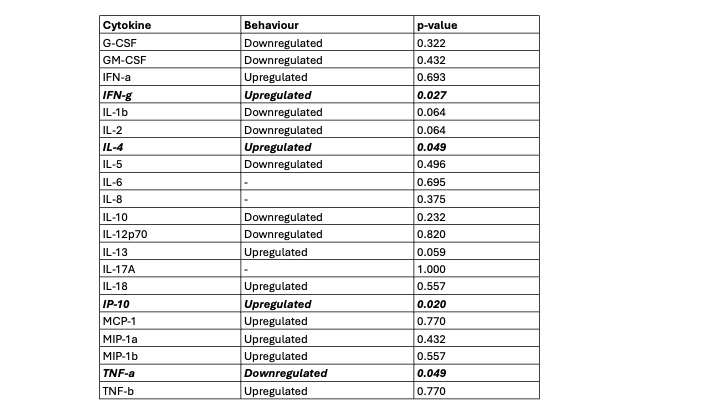
Background: Congenital Cytomegalovirus infection (cCMV) is associated with long-term sequelae, mainly sensorineural hearing loss and neurodevelopmental impairment. QuantiFERON®-CMV (QF-CMV) is a commercial assay assessing CMV-specific T cell immunity and a potentially useful prognostic marker especially among cCMV infected newborns with Clinically Inapparent CMV (CICMV). Preliminary unpublished data from our group has previously shown a correlation between a reactive QF-CMV result at birth and CICMV infection as well as absence of long-term sequelae at 12 months of life. Objective: To investigate the cytokine profile in QF-CMV supernatants. Design/Methods: A prospective cohort study (September 2023 - June 2025) including all cCMV-infected neonates referred to our center with a QF-CMV sample during the first 28 days of life was conducted. Post assessment of the qualitative result of IFN-γ production by QF-CMV test, supernatants were collected and stored in -80oC. Infants were clinically assessed at birth, at 6 and 12 months of age. In a pilot sample of 20 neonates with cCMV infection, cytokines in QF-CMV supernatants were quantified using the Invitrogen™ ProcartaPlex™ 21-plex Human Cytokine Storm Panel (Thermo Fisher Scientific, Waltham, MA) in a Luminex xMAP analyzer. The induced cytokine profile was calculated as the cytokine value in the CMV-stimulated supernatant ("CMV tube") minus the value in the unstimulated one ("nil tube"). Differences between groups were evaluated using the Wilcoxon signed ranks test. Results: No significant stimulation of cytokines was detected in the supernatants from neonates with Clinically Apparent CMV (CACMV, n=10) (Table 1). However, in the samples from newborns with CICMV (n=10), a significant upregulation of IFN-γ, IP-10 and IL-4 and downregulation of TNF-α was detected (Table 2). Moreover, irrespectively to clinical presentation, a similar pattern was observed in neonates with a reactive QF-CMV (n=10) (Figure).
Conclusion(s): The results from this pilot study indicate that further study of cytokine profile in the QF-CMV supernatants of cCMV-infected newborns may reveal pathways associated with early viral control. It might be postulated that CICMV newborns present with a balanced Th1:Th2 immune response. Such data may provide prognostic markers associated with long term outcome among newborns with CICMV.
Table 1. Cytokine difference between CMV-stimulated (CMV-tube) and unstimulated (nil tube) in CACMV infants at birth
Table 2. Cytokine difference between CMV-stimulated (CMV-tube) and unstimulated (nil tube) in CICMV infants at birth









.jpg)
.jpg)
