Assistant Professor University of Minnesota Medical School Minneapolis, Minnesota, United States
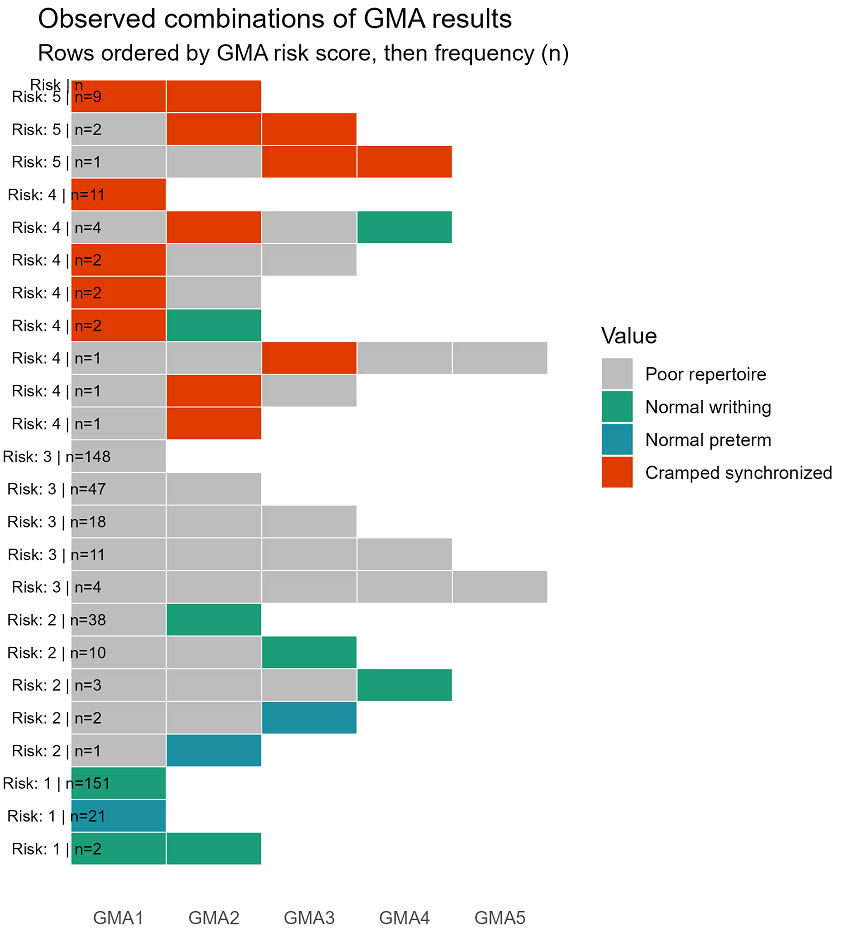
Background: The General Movements Assessment (GMA) is a widely used neonatal neurodevelopmental screening tool for risk of movement disorders (i.e. cerebral palsy). While some results among neonates less than 48 weeks corrected gestational age (CGA) can indicate low or high risk of cerebral palsy, it is unknown how combinations of serial GMA examinations on the same patient correlate with movement development later in early infancy. Objective: To determine whether a risk score based on the combination of GMA scores during the writhing period (before 48 weeks CGA) could predict high risk of low (<= 10th percentile for age) Alberta Infant Motor Scale (AIMS) at 3-5 months CGA. Design/Methods: Retrospective data from a Level 4 NICU and associated neonatal follow-up clinic was used after IRB approval. A writhing period GMA risk score with 5 levels was created with the lowest risk attributed to neonates who had normal writhing or normal preterm general movements on their first assessment. Highest risk was attributed to neonates with 2 sequential exams with predominantly cramped-synchronized movements. See Figure 1 for risk scores attributed to GMA result combinations. Relative risk regression with penalized confidence intervals was applied. Covariates were selected using a modified directed acyclic graph approach with the aim to improve estimate precision. Results: 477 infants had complete data and were included in the analysis. After controlling for sex, maternal age, history of bacteremia in the neonatal period, gestational age and birth year, compared to neonates in the low-risk group, those in the low moderate group had RR of 2.79 (95% confidence interval (CI) -0.13, 5.71) of 3-5 month CGA AIMS score less than or equal to the 10th percentile. The moderate risk group had a RR of 3.51 (95% CI 0.82, 6.20) and the high and very high groups had RR of 4.11 (95% CI 1.33, 6.90) and 4.55 (95% CI 1.47, 7.72) respectively. See Table 1.
Conclusion(s): Current guidelines for establishing high risk for movement disorder before 48 weeks CGA suggests that 2 cramped-synchronized GMA results are needed. These data suggest that one cramped-synchronized GMA result may carry similar risk for movement delay as 2 sequential cramped-synchronized assessments.
Table 1. Main regression results
Figure 1. GMA exam sequence combinations and risk scores









.png)