581 - Changes over time in parent attitudes toward obesity treatment in teens
Monday, April 27, 2026
8:00am - 10:00am ET
Publication Number: 4569.581
Susan Woolford, University of Michigan Medical School, Ann Arbor, MI, United States; Acham Gebremariam, University of Michigan Medical School, Ann Arbor, MI, United States; Sarah J. Clark, University of Michigan, Ann Arbor, MI, United States
Associate Professor University of Michigan Medical School Ann Arbor, Michigan, United States
Background: Treatment for adolescent obesity typically achieves only modest results. Bariatric surgery is an exception which has demonstrated significant efficacy since pediatric recommendations were published in the early 2000s. Recent studies have revealed the efficacy of anti-obesity medications (AOMs), and new pediatric guidelines recommend their use in teens. Parents play a key role in teens accessing these treatments, yet little is known about parental views of these interventions. Objective: To examine parental attitudes about bariatric surgery and AOMs after guidelines recommend their use for teens. Design/Methods: Cross-sectional online surveys of parents of teens 13-17 fielded through a nationally representative panel; the survey vendor provided response data, demographic characteristics, and Census-based sampling weights. The 2011 survey asked 657 parents about bariatric surgery for teens; the 2025 survey asked 966 parents about AOMs for teens. Weighted data were used to conduct multivariable logistic regression analysis assessing the relationship between parent attitudes and sociodemographic characteristics. Odds ratios and 95% confidence intervals were calculated. Results: In 2011, 47.8% of parents expressed general approval of bariatric surgery for teens (95% CI 43.0, 52.7); 39.8% of parents indicated bariatric surgery should be delayed until age 18 (95% CI 35.2, 44.6); and 12.4% said it should never be done (95% CI 9.3, 16.4). In 2025, 52.2% of parents expressed general approval regarding AOMs for teens (95% CI 48.9, 55.6); 18.9% indicated AOMs should be delayed until age 18 (95% CI 16.3, 21.7); and 28.9% said AOMs should never be used (95% CI 25.9, 32.1).
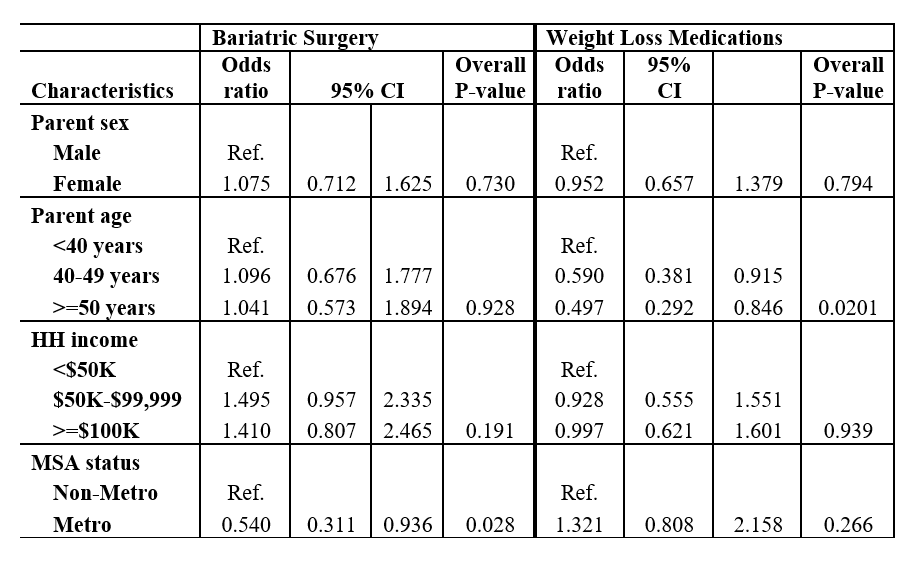
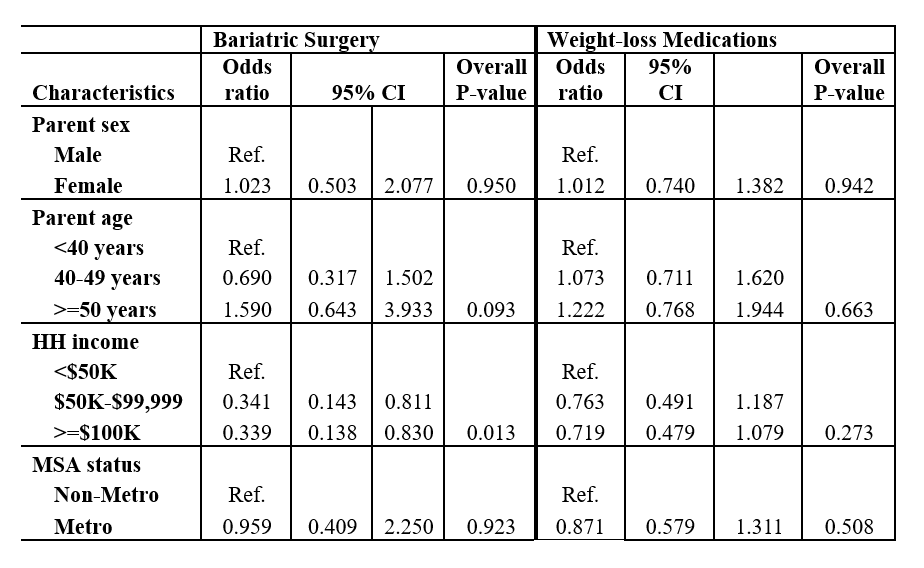
Multivariate analysis showed no consistent relationships between parent attitudes about obesity treatment and parent characteristics. Parents in non-metro areas were less likely to believe bariatric surgery should be limited to adults, and older parents were less likely to believe AOMs should be limited to adults (Table 1). Higher income parents were less likely to believe that bariatric surgery should never be done, and the belief that AOMs should never be used did not differ by parent characteristics (Table 2).
Conclusion(s): Parent support for using AOMs in adolescents is limited and mirrors the level of support for bariatric surgery almost a generation ago. This may reflect concern about safety when interventions are new to pediatrics. Though, counterintuitively, twice as many parents indicated that AOMs, vs surgery, should not ever be used for weight loss. Further work should explore why parents may not support using these effective treatments.
Table 1: Multivariate Analysis: Outcome = "Only when adult"