582 - How much is enough? Re-thinking the dosage of pediatric weight management interventions
Monday, April 27, 2026
8:00am - 10:00am ET
Publication Number: 4570.582
Grace W. Ryan, University of Massachusetts Chan Medical School, Worcester, MA, United States; Melissa Goulding, University of Massachusetts Medical School, Worcester, MA, United States; Jamie M. Faro, UMass Chan Medical School, Worcester, MA, United States; Meagan J. Sabatino, UMass Chan Medical School, Worcester, MA, MA, United States; Christine Frisard, University of Massachusetts Chan Medical School, Worcester, MA, United States; Sybil L. Crawford, University of Massachusetts Medical School, Worcester, MA, United States; Michelle Trivedi, UMass Memorial, Worcester, MA, United States; Alan Geller, Harvard TH Chan School of Public Health, Boston, MA, United States; Lori Pbert, University of Massachusetts Medical School, Harvard, MA, United States
Assistant Professor University of Massachusetts Chan Medical School Worcester, Massachusetts, United States
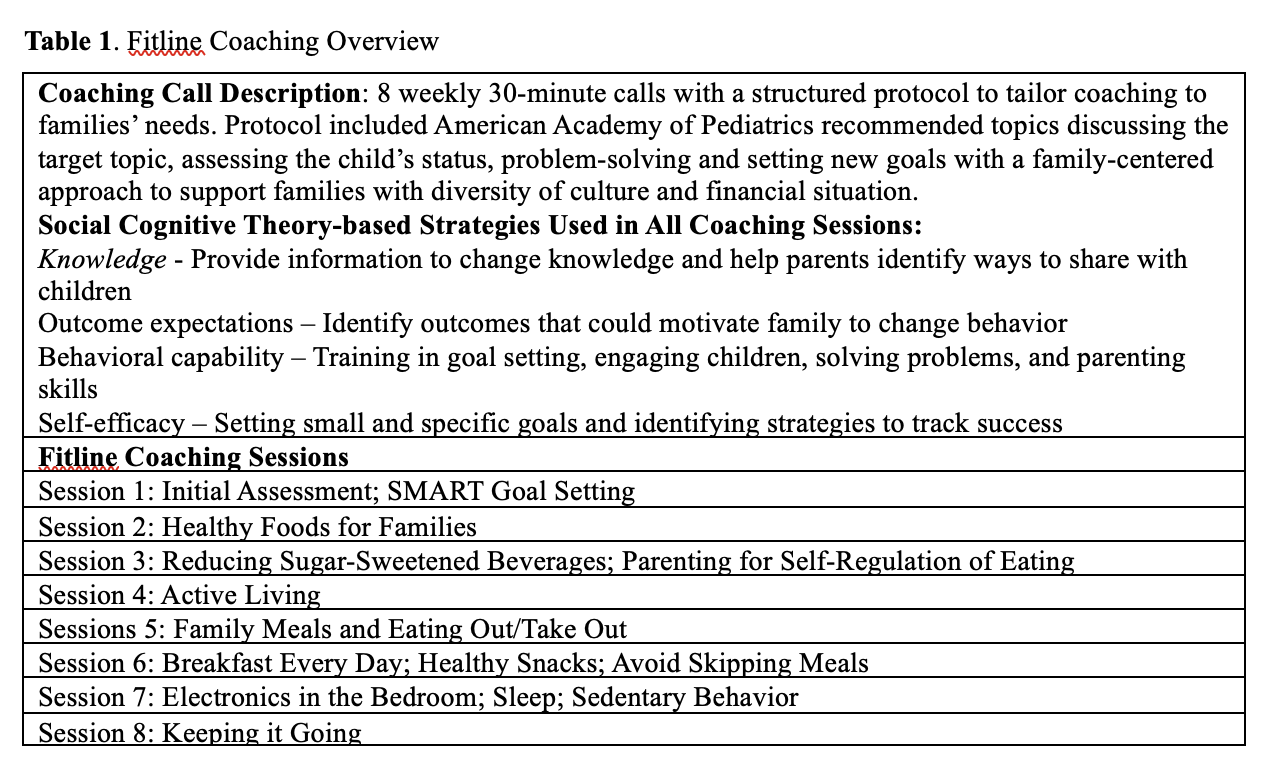
Background: Guidelines for weight management programs in pediatric populations recommend at least 26 in-person contact hours in intensive lifestyle behavior change programs, which can be difficult for families to attend. We designed Fitline with Coaching as a brief, remote alternative to these high-intensity programs, building from Social Cognitive Theory, to help families of children with overweight and obesity make sustainable lifestyle changes. This program consists of 8 30-minute coaching sessions for parents with an accompanying workbook. In our primary analysis, 21% of children enrolled in Fitline made a clinically meaningful reduction (≥0.25) in their BMI z-score at 12 months post-intervention compared to baseline. Objective: We assessed the relationship between dosage, defined as number of coaching sessions completed and BMI z-score outcomes. Design/Methods: Fitline consists of a brief provider intervention involving BMI assessment, a short questionnaire on diet and physical activity, and referral to remote parent nutrition coaching for eight sessions. A total of 243 children, ages 8-12, enrolled in Fitline in our cluster RCT, representing patients from 10 pediatric practices in Central Massachusetts. Descriptive statistics were generated from study logs and surveys, and regression models were used to examine the associations between coaching call completion and BMI z-scores. Results: At baseline, children's mean BMI percentile was 96.3 (SD: 3.4) and the majority (n=138, 56.8%) were classified as having obesity. Among the 243 families, 82.7% (n=201) completed all 8 counseling calls, while 11.1 % (n=27) completed four or fewer. There was no relationship between number of calls and change in BMI z-score at 12 months (p=.65), or percentage of children achieving a clinically meaningful BMI z-score decrease of 25% (p=0.08) or 50% (p=0.81). Nearly 60% of parents reported that the amount of coaching was sufficient; among those desiring more support, 18.8% preferred access via text messaging.
Conclusion(s): This sub-analysis of our trial data, though limited by sample size, raises two related questions that merit further research, potentially using causal inference methods. First, what is the minimum effective dose of weight management interventions needed to produce clinically meaningful change? Secondly, which families would be most responsive to lower-dose interventions? Answers to these questions could help clinicians offer families more accessible and less burdensome interventions that produce clinically meaningful improvements.
Table 1. Fitline Coaching Overview
Table 2. Modeling association of number of counseling calls completed with BMI z-score outcomes









.png)
