Session: Technology 3: Telemedicine and Virtual Health
182 - Impact of Telehealth vs In-person Care on Shared Decision Making about Chronic Conditions
Monday, April 27, 2026
8:00am - 10:00am ET
Publication Number: 4179.182
Ellen Lipstein, Cincinnati Children's Hospital Medical Center, Cincinnati, OH, United States; Andrew F. Beck, Cincinnati Children's Hospital Medical Center, Cincinnati, OH, United States; William Brinkman, Cincinnati Children's Hospital Medical Center, Cincinnati, OH, United States; Maria T. Britto, Cincinnati Children's Hospital Medical Center - James M. Anderson Center Health Systems Excellence, Cincinnati, OH, United States; Ruby Hyland-Brown, Cincinnati Children's Hospital Medical Center, Cincinnati, OH, United States; Chunyan Liu, Cincinnati Children's Hospital, Cincinnati, OH, United States; Ken Tegtmeyer, Cincinnati Children's Hospital Medical Center, Cincinnati, OH, United States; Nanhua Zhang, Cincinnati Children's Hospital Medical Center, Cincinnati, Ohio, US, OH, United States; Kristin Ray, University of Pittsburgh School of Medicine, Pittsburgh, PA, United States
Professor Cincinnati Children's Hospital Medical Center Cincinnati, Ohio, United States
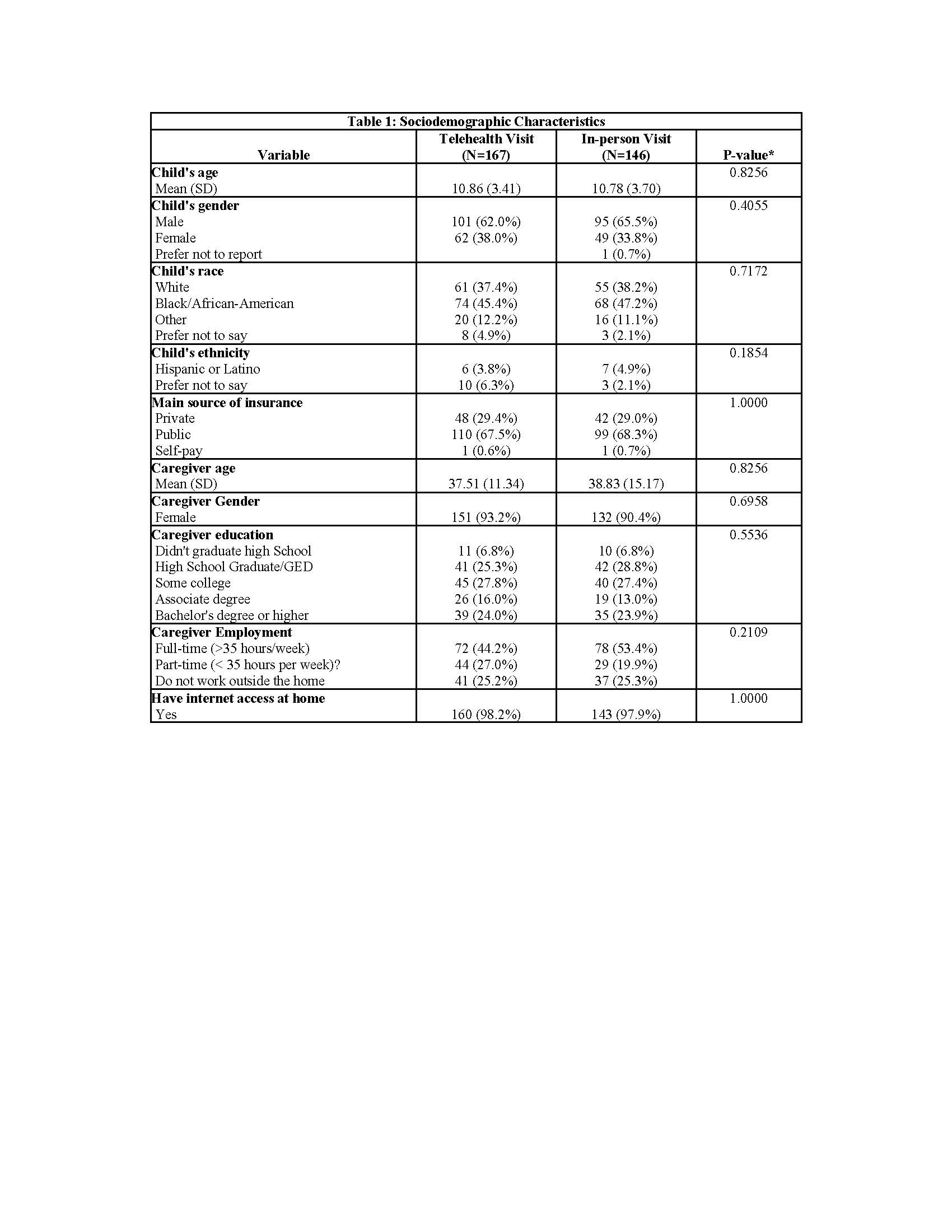
Background: Telehealth was rapidly expanded during the COVID-19 pandemic with little opportunity to consider its impact on the quality of health communication, including shared decision making (SDM). A change in quality may be particularly important for higher frequency healthcare users, such as families of children and adolescents with chronic conditions. Objective: To compare the decision engagement of parents of children and adolescents with chronic conditions (ADHD, asthma, eczema) who attended in-person versus telehealth appointments. Design/Methods: Across 3 academic and 3 community pediatric primary care offices, we recruited parents of patients age 5-17 years with ADHD, asthma or eczema seen between January 2023 and May 2025. Patients seen in-person were matched to those seen via telehealth based on age, date and chronic condition. Parents were invited to complete an on-line survey that included measures of decision making, family-physician relationship, barriers to care and sociodemographic characteristics. Our primary outcome, SDM, was measured using the Pediatric Caregiver Version of the SDM Process Scale. Descriptive analyses were conducted for all outcomes and covariates, by visit modality. We developed a linear mixed-effects model that assessed the impact of visit modality while accounting for condition, race and patient clustering within physician. Results: 313 parents (146 in-person, 167 telehealth) completed surveys. 91.9% of parents were female. The average age of their child was 10.8 (SD 3.5). 63.6% of patients were male and 46.3% were Black (Table 1). Most (78.9%) were seen for ADHD. Visit diagnosis and sociodemographic characteristics did not vary significantly by mode of care. For telehealth visits, the total SDM Process Scale score, out of 4, was 2.80 (SD 1.12) which was not significantly different than that for in-person visits [2.67 (SD 1.18)]. In our mixed-effects model which included mode of care, chronic condition and race, only chronic condition was significantly associated with SDM. Asthma (OR -0.67; 95%CI -1.04, -0.31) and eczema (OR -0.97; 95%CI -1.51, -0.44) were associated with less SDM than ADHD.
Conclusion(s): Overall parents reported a high-level of SDM that was not impacted by the mode of care, suggesting that telehealth communication is of similar quality to that of in-person care. As in other settings, this was higher than shown in direct observation of telehealth and in-person visits. Unexpectedly, the degree of SDM varied with the child's chronic condition. Future work should explore reasons for this difference, such as the types of decisions or context of care.