100 - Preserving Tiny Guts: A QI Journey to Optimize NEC Antibiotic Stewardship
Monday, April 27, 2026
8:00am - 10:00am ET
Publication Number: 4098.100
Rupashree R. Mandala, Jacobs School of Medicine and Biomedical Sciences at the University at Buffalo, Depew, NY, United States; Kavya Rao, Jacobs School of Medicine and Biomedical Sciences at the University at Buffalo, Buffalo, NY, United States; Louis L. Bystrak, Kaleida Health, Buffalo, NY, United States; Valerie Elberson, John R. Oishei Children's Hospital, Buffalo, NY, United States
NICU Fellow Jacobs School of Medicine and Biomedical Sciences at the University at Buffalo Depew, New York, United States
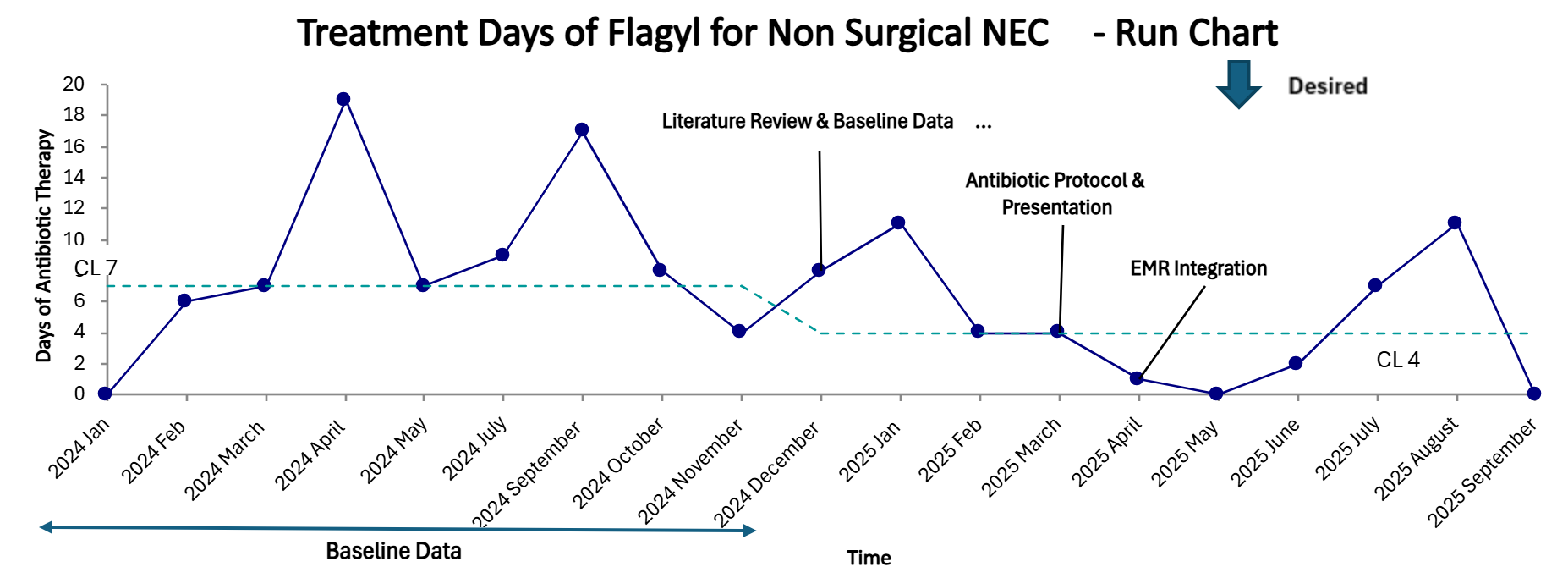
Background: Prolonged broad spectrum antibiotic use have been associated with decreased microbiota and increased morbidity and mortality in preterm infants. Evidence shows that metronidazole does not prevent progression from Stage II to III necrotizing enterocolitis (NEC). Diagnosis and management of NEC can be challenging and often vary by provider. A NEC Protocol was developed in order to standardize NEC management in our Level IV NICU. Objective: To reduce unnecessary antibiotic use in infants diagnosed with NEC through implementation of an evidence-based guideline. Our aim is to achieve ≥60% adherence to the new guideline and reduce metronidazole use by 20%. Design/Methods: A multidisciplinary quality improvement (QI) team was formed using direct observation, key driver diagram, and unit process. The guideline was created based on literature review, to standardize antibiotic choice and duration based on Modified Bell's criteria and clinical evaluation of the patient (Figure 1). Baseline data from 2024 were collected via electronic medical record (EMR) review of infants evaluated for NEC. Data was collected on both surgical and non-surgical patients to assess compliance and days of therapy. Non-surgical cases were analyzed since metronidazole use in surgical cases were deemed appropriate. Interventions included provider education, EMR integration, and unit-based infographics. Our primary outcome measure was adherence to the protocol and our process measure was to reduce unnecessary metronidazole use in non-surgical patients. Balancing measures included overall NEC rates and progression from Stage II to III NEC. Results: Upon retrospective review, baseline adherence was 48% to the protocol and initial center line for metronidazole use was 7 days of therapy among non-surgical patients. Six months after implementation, protocol adherence improved to 79% (Table 1) and the new center line for metronidazole use shifted to 4 days of therapy in non-surgical patients (Chart 1).
Conclusion(s): Through our quality initiative in promoting antibiotic stewardship, adherence to a standardized NEC protocol improved, and reduced unnecessary metronidazole use in management of suspected and confirmed non-surgical NEC without increasing mortality or disease progression. This highlights the impact of multidisciplinary QI initiatives on promoting antimicrobial stewardship in the NICU.