101 - Feeding practice in extremely low gestational age neonates (ELGANs)
Monday, April 27, 2026
8:00am - 10:00am ET
Publication Number: 4099.101
muppala Prasanth raju, Baylor Scott White McLane Children's Medical Center, Temple, TX, United States; Suleiman N. Essoh, Baylor Scott White McLane Children's Medical Center, Temple, TX, United States; Ram R.. Kalagiri, Baylor Scott White McLane Children's Medical Center, Temple, TX, United States; raza Bajwa, Baylor Scott and White, Temple, TX, United States; Venkata Raju, Baylor Scott White McLane Children's Medical Center, Temple, TX, United States; Vinayak Govande, Baylor Scott White McLane Children's Medical Center, Temple, TX, United States; madhava (. Beeram, Baylor Scott and White Health, Temple, TX, United States; Ashith Shetty, Baylor Scott White McLane Children's Medical Center, Temple, TX, United States; Sanket Shah, University of Florida College of Medicine, Jacksonville, FL, United States; Niraj Vora, Baylor Scott White McLane Children's Medical Center, Leander, TX, United States
Fellow Baylor Scott & White McLane Children's Medical Center Temple, Texas, United States
Background: Extremely low gestational age neonates (ELGANs; < 28 weeks) face elevated risks of growth restriction and necrotizing enterocolitis (NEC). Standardized enteral feeding protocols are essential, yet contemporary U.S. practice patterns remain incompletely characterized. Objective: To describe current U.S. NICU practices regarding timing of enteral feed initiation, advancement, fortification thresholds, and fortifier. Design/Methods: An anonymous online survey was distributed via email to neonatologists and NICU providers in the United States between July 2023 and July 2025 using REDCap. The survey targeted practices for 22-24 week and 25-27 week gestational age infants. Descriptive statistics were used to analyze responses. Results: Of 122 respondents (76% from academic institutions, 56% Level IV NICUs, 43% Level III, 1% Level II), 94% reported having a standardized feeding protocol, with 51% based on gestational age and 98% on birth weight. For 22-24 week infants, 50% initiated enteral feeds at 24-48 hours, 70% maintained trophic feeds for 1-3 days, and 63% advanced by 20 cc/kg/day. Fortification typically began at 60-100 cc/kg/day (76%). For 25-27 week infants, feeds started earlier (47% within 12 hours), with similar advancement patterns. Bovine-based fortifiers were used by 39%, human milk-derived by 58%; among users of human milk-derived fortifiers, 51% continued until 34 weeks. Routine gastric residual checks were uncommon (12%).
Conclusion(s): This survey highlights predominant practices in ELGAN feeding, with most NICUs using standardized protocols and initiating feeds within 48 hours. Variability exists in fortification timing and fortifier type, suggesting opportunities for consensus guidelines to optimize outcomes.
Feeding Practices in ELGANs- Survey Descriptive Statistics










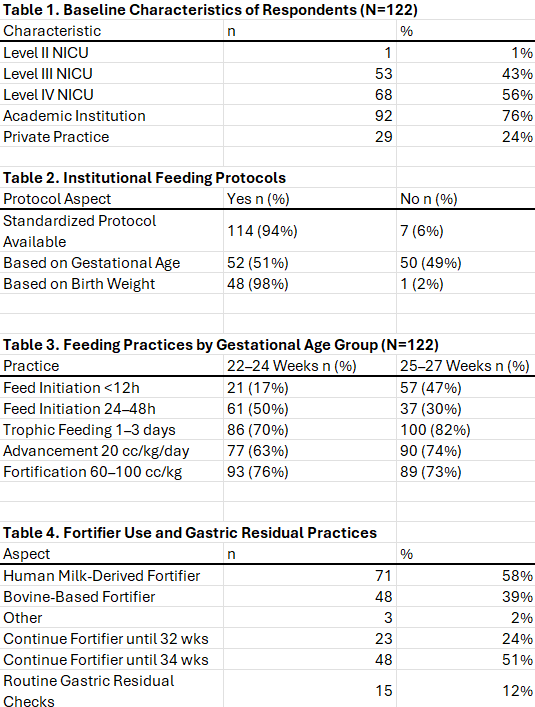 Descriptive Statistics