544 - Metabolomic signals of dietary plant protein intake in children receiving chronic hemodialysis
Monday, April 27, 2026
8:00am - 10:00am ET
Publication Number: 4532.544
Cynthia X. Dong, Childrens Hospital of Philadelphia, Shoreview, MN, United States; Erin Cass, Childrens Hospital of Philadelphia, Philadelphia, PA, United States; Christine Burke, Childrens Hospital of Philadelphia, Morton, PA, United States; Lawrence Copelovitch, The Children's Hospital of Philadelphia, Philadelphia, PA, United States; Michelle Denburg, Children's Hospital of Philadelphia, Philadelphia, PA, United States; Arthur Lee, Children's Hospital of Philadelphia, Philadelphia, PA, United States
Undergraduate Researcher Childrens Hospital of Philadelphia Shoreview, Minnesota, United States
Background: Emerging adult data suggest increased dietary plant protein intake is associated with improved uremic toxin profiles in patients receiving chronic dialysis. There is limited data on how dietary plant protein intake may affect toxin profiles in children. Objective: We investigated if plant protein intake was associated with toxin or metabolic differences in children receiving chronic hemodialysis (HD). Design/Methods: The Paired pre/post-Dialysis Investigation of Global Metabolomics (P/paraDIGM) study recruited children receiving chronic HD at a single large children's hospital who were at least 1-year-old, weighed >10kg, HD vintage >1-month, and most recent hemoglobin >8g/dL.
Pre-HD plasma samples were collected for global metabolomics profiling at the first and second HD treatments during the week routine clinical labs were collected. In the same week, three 24-hour dietary recall interviews were conducted. Sample and data collection was repeated for up to 3 months. We analyzed the data for which pre-HD plasma metabolomic profiles could be paired with dietary data collected in the 24-hours preceding sample collection.
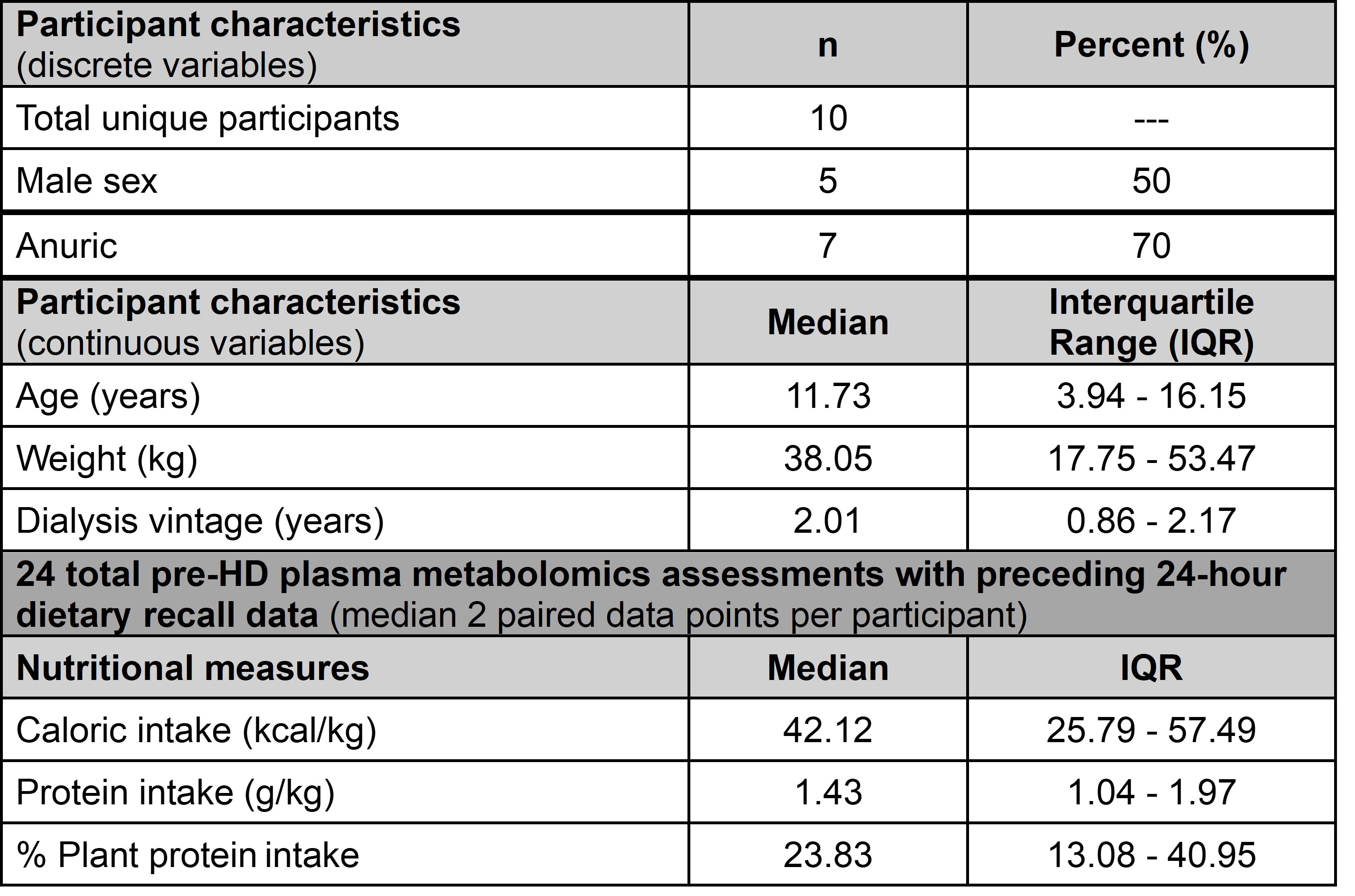
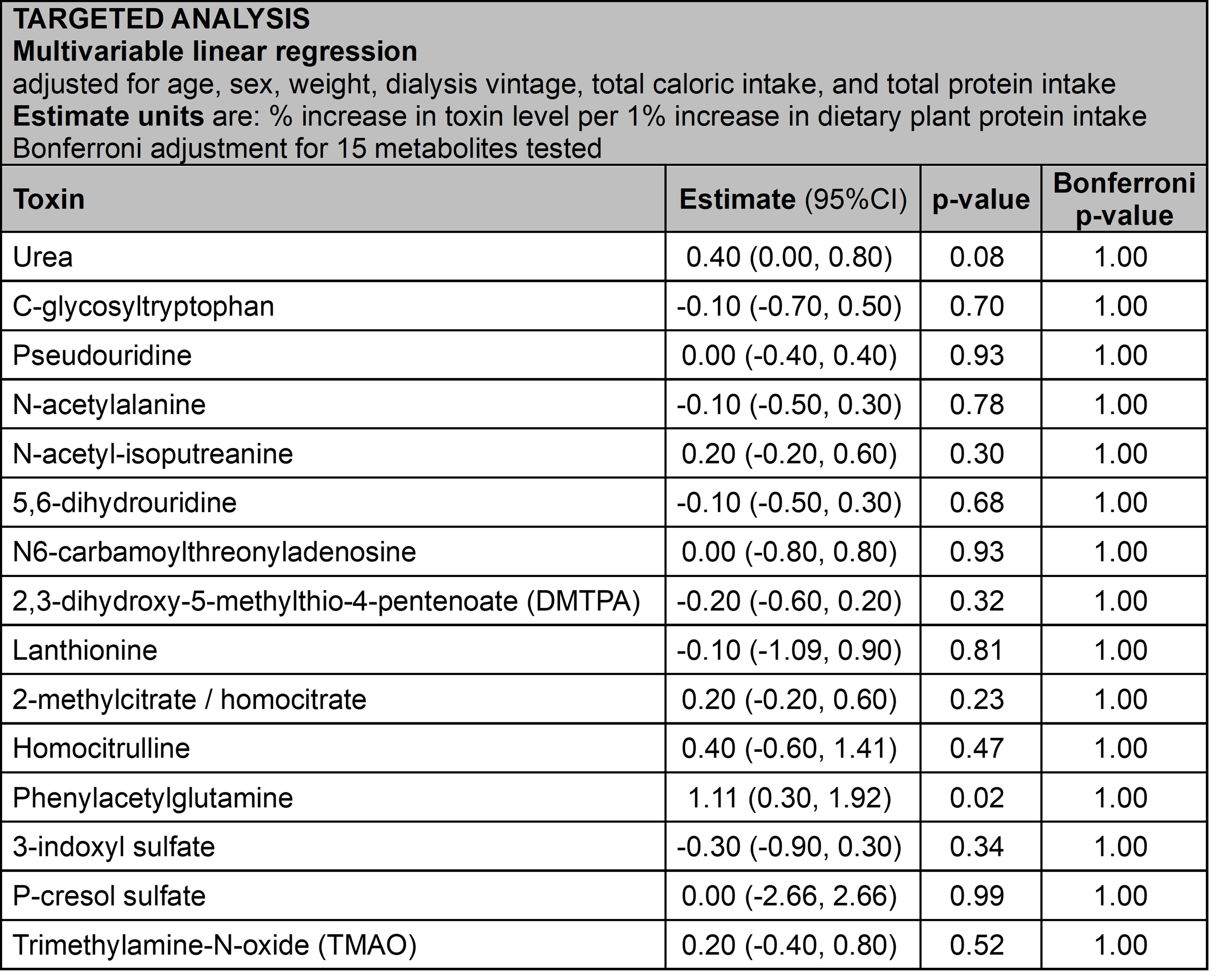
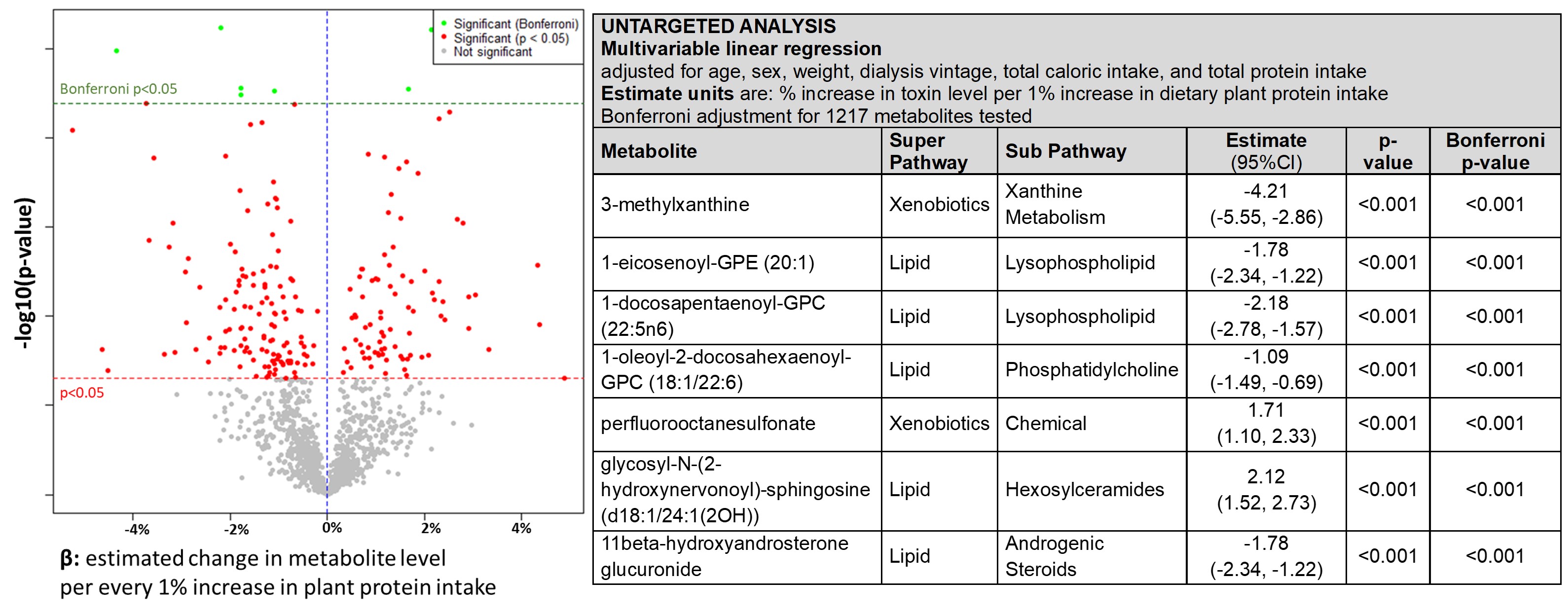
The association between metabolite levels versus dietary plant protein intake (% of total protein intake) were assessed with linear regression adjusted for age, sex, dialysis vintage, weight, total caloric intake (Cal/kg), and total protein intake (g/kg). We performed a targeted analysis of 14 selected known or putative uremic toxins. We performed an untargeted analysis with all named metabolites assayed. Significance was based on the Bonferroni threshold. Results: 10 participants had 24 paired dietary and metabolomic assessments (characteristics in Table 1). Targeted analysis: there were no associations between the 14 selected uremic toxins and plant protein intake (Table 2). Untargeted analysis: 1217 total metabolites were analyzed. 7 metabolites associated with dietary plant protein intake at the Bonferroni threshold (Figure 1).
Conclusion(s): In this small pilot sample of children on chronic HD, we did not replicate the adult observation of increased dietary plant protein intake associating with improved uremic toxin profiles. We identified several metabolites associated with plant protein intake. Higher plant protein intake associated with lower lysophospholipid metabolites, which may be mediators of inflammation. P/paraDIGM is ongoing and analyses with increasing power will be required to further characterize how plant protein intake affects the circulating metabolome.
Table 1: Participant characteristics
Table 2: Targeted analysis of dietary plant protein intake and uremic toxins
Figure 1: Untargeted analysis of dietary plant protein intake and the metabolome