470 - A Retrospective Chart Review of Factors Affecting Post-Discharge Weight Gain and Growth Faltering of Infants with Gastrostomy Tubes from the NICU
Monday, April 27, 2026
8:00am - 10:00am ET
Publication Number: 4461.470
Michael Evers, Louisiana State University School of Medicine in New Orleans, New Orleans, LA, United States; Meghan McCord, Louisiana State University School of Medicine in New Orleans, New Orleans, LA, United States; Caroline T. Moreau, Louisiana State University School of Medicine in New Orleans, Louisiana, LA, United States; Emily Langsam, Tulane University School of Medicine, New Orleans, LA, United States; Michelle Knecht, Louisiana State University School of Medicine in New Orleans, Metairie, LA, United States
Fellow Louisiana State University School of Medicine in New Orleans New Orleans, Louisiana, United States
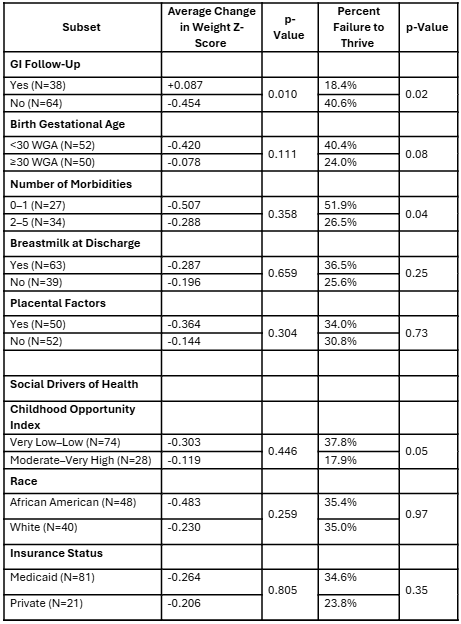
Background: Infants discharged with enteral tube feedings frequently experience poor growth and growth faltering post-discharge, typically defined as a negative change in weight Z-scores greater than 0.8 on the appropriate growth chart. There are numerous factors that may affect post-discharge growth of infants including early access to subspecialty services like GI, birth gestational age, number of neonatal morbidities (BPD, sepsis, IVH, ROP, surgical NEC), the Childhood Opportunity Index (a measure of 3 important domains: education, health and environment, and socioeconomic factors), diets including mother's own milk, and history of placental insufficiency during pregnancy (pre-eclampsia, hypertension, diabetes, maternal drug use). Objective: We performed a retrospective chart review of 102 infants discharged with gastrostomy tubes over a five year period to observe which factors affected patients' growth within 3-4 months of discharge from our level IV regional NICU. Design/Methods: Statistical analysis was performed using T-tests of unequal variances and Chi-square tests of independence. Results: Table 1 details the results of how each factor affected growth for our infants. We found that infants who followed up with GI had statistically significant better weight gain and less growth faltering. Infants who were born less than 30 WGA had trends towards worse growth and more growth faltering compared to infants born greater than 30 WGA. Infants with 2 or greater neonatal morbidities trended towards better growth and had statistically significant less growth faltering compared to infants with less than 2 neonatal morbidities. Infants of Very Low-Low COI trended towards worse growth and had statistically significant more growth faltering compared to infants of Moderate-Very High COI. Race and insurance status did not affect post-discharge growth. Infants receiving mother's own breastmilk at discharge had trends towards worse growth and more growth faltering compared to infants only receiving formula. Infants with factors of placental insufficiency had trends towards worse growth and more growth faltering compared to infants that had normal placental blood flow.
Conclusion(s): Post-discharge growth of NICU infants with gastrostomy tubes is a complex subject that can be affected by many factors. Since there are numerous factors affecting growth, it may be best monitored by a multi-disciplinary team with experience in these factors. It may also be beneficial to standardize home feeding regimens to empower families to improve ownership of their infant's care.