








Genomics/Epigenomics
Session: Genomics/Epigenomics 1
Ryohei Matsuoka, MD, PhD (he/him/his)
Assistant Professor
Kyushu University
Fukuoka, Fukuoka, Japan
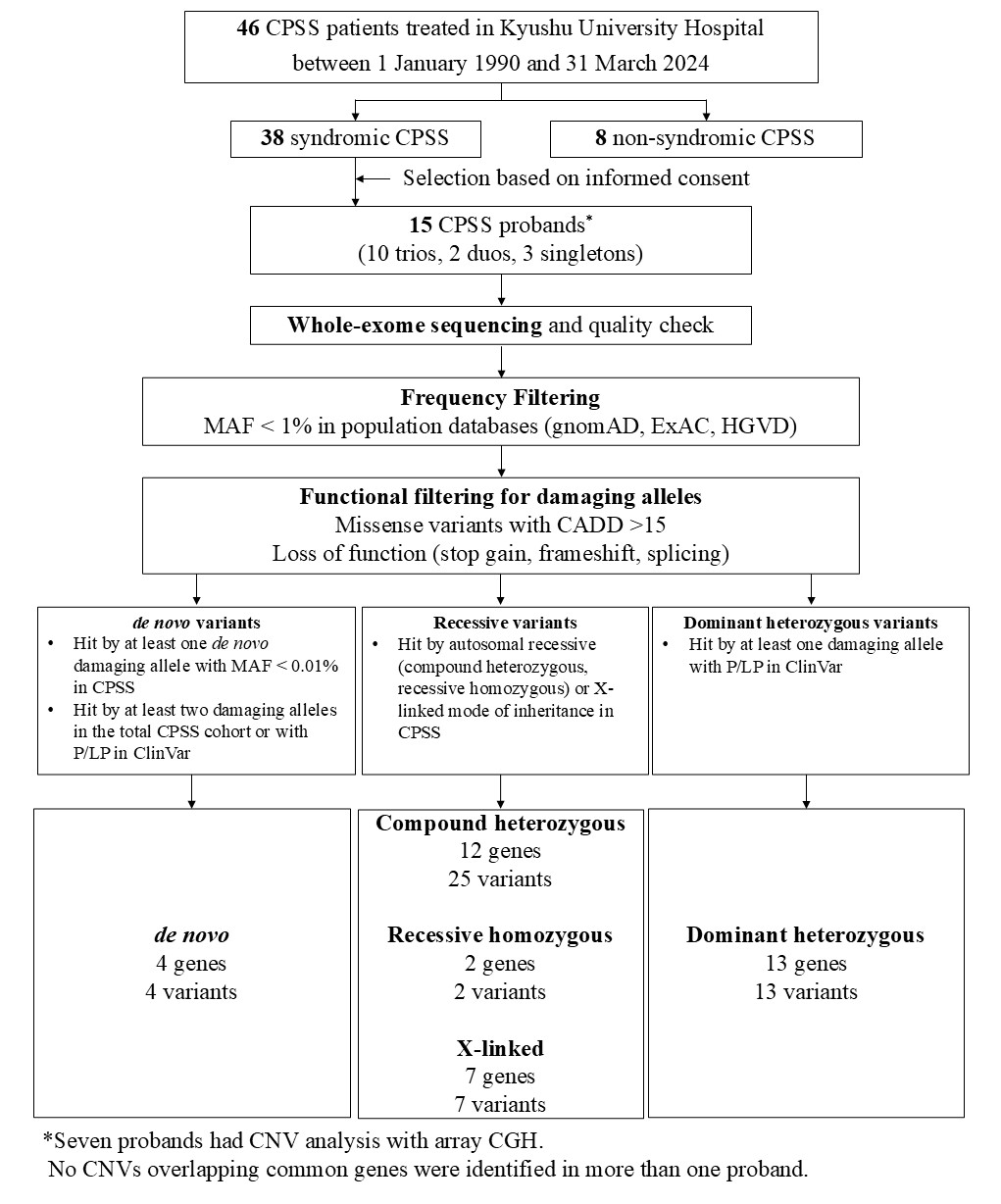 Schematic overview of the filtering strategy used to identify candidate gene variants for congenital portosystemic shunt (CPSS) from whole-exome sequencing data of 15 probands. CPSS, congenital portosystemic shunt; MAF, minor allele frequency; CADD, combined annotation-dependent depletion; P, pathogenic; LP, likely pathogenic; CNV, copy number variant; CGH, comparative genomic hybridization.
.jpg) Values are expressed as No. (%) or median (range). CPSS, Congenital portosystemic shunt; WES, Whole-exome sequencing.
Values are expressed as No. (%) or median (range). CPSS, Congenital portosystemic shunt; WES, Whole-exome sequencing..jpg) Clinical characteristics and candidate gene variants identified in each of the 15 probands who underwent WES are summarized. Probands 1-12 (above the dashed line) had parental data available, allowing for family-based analysis (or duo-based analysis as specified in Figure 1) in addition to recurrent variant analysis. Probands 13-15 (below the dashed line) were singletons, and thus only recurrent variant analysis was performed for candidate gene identification. The heatmap section illustrates the number of specific abnormalities within each affected organ system, as indicated by the key at the bottom. Candidate genes identified through family-based analysis and recurrent variant analysis are listed for each proband. Genes highlighted in bold are those classified as cilia-related according to our defined criteria. *Age at diagnosis. ESPC, end-to-side portocaval shunt; EHPS, extrahepatic portosystemic shunt; SSPC, side-to-side portocaval shunt; PDV, patent ductus venosus; PAH, pulmonary arterial hypertension; CNS, central nervous system; ORL, otorhinolaryngological; NA, not applicable.
Clinical characteristics and candidate gene variants identified in each of the 15 probands who underwent WES are summarized. Probands 1-12 (above the dashed line) had parental data available, allowing for family-based analysis (or duo-based analysis as specified in Figure 1) in addition to recurrent variant analysis. Probands 13-15 (below the dashed line) were singletons, and thus only recurrent variant analysis was performed for candidate gene identification. The heatmap section illustrates the number of specific abnormalities within each affected organ system, as indicated by the key at the bottom. Candidate genes identified through family-based analysis and recurrent variant analysis are listed for each proband. Genes highlighted in bold are those classified as cilia-related according to our defined criteria. *Age at diagnosis. ESPC, end-to-side portocaval shunt; EHPS, extrahepatic portosystemic shunt; SSPC, side-to-side portocaval shunt; PDV, patent ductus venosus; PAH, pulmonary arterial hypertension; CNS, central nervous system; ORL, otorhinolaryngological; NA, not applicable.