399 - Incidence of Bacteremia in Patients With Fever and Sickle Cell Disease Who Present to the Emergency Department
Monday, April 27, 2026
8:00am - 10:00am ET
Publication Number: 4391.399
Gabrielle Jasmin, Children's National Health System, Silver Spring, MD, United States; Joe Wu, Children's Hospital of Philadelphia, Phildelphia, PA, United States; Angela Ellison, Childrens Hospital of Philadelphia, Philadelphia, PA, United States
Fellow Children's National Health System Silver Spring, Maryland, United States
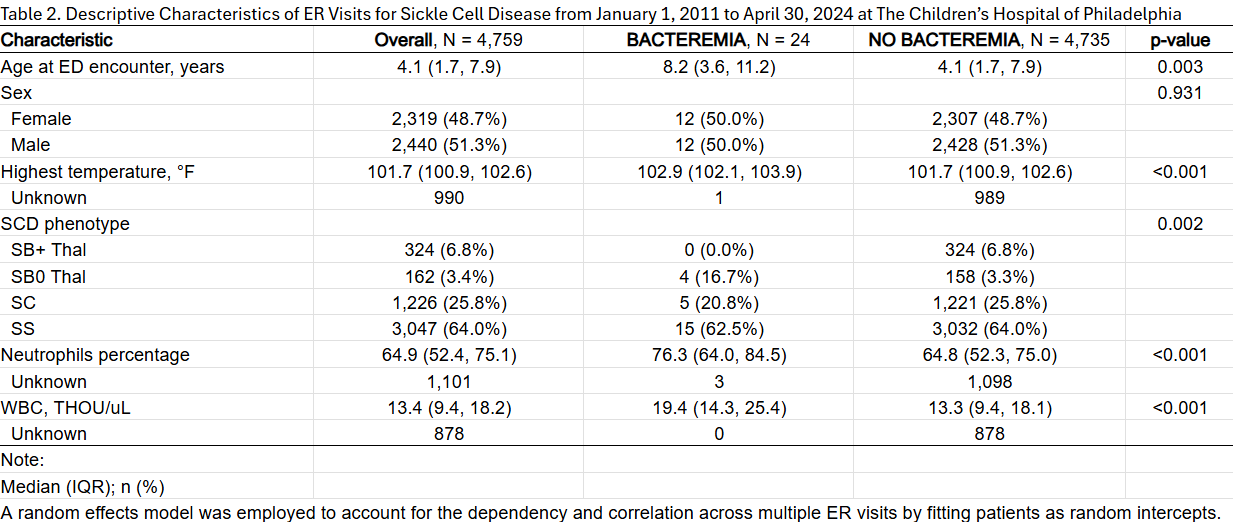
Background: Children with sickle cell disease (SCD) are at high risk for serious bacterial infections secondary to functional asplenia, impaired complement activation, and immature response to virulent polysaccharide agents. There is limited data available in the post pneumococcal 13-valent conjugate vaccine (PCV-13) era on the incidence of bacteremia, and organisms responsible for bacteremia in febrile patients with SCD presenting to the pediatric emergency department (ED). Objective: 1) To determine the incidence of bacteremia among febrile patients with SCD presenting to the ED between 2011-2024 and 2) To determine clinical outcomes and organisms responsible for bacteremia in this patient population in the post PCV-13 vaccine era. Design/Methods: We conducted a single center retrospective cohort study of patients with SCD who were evaluated in the emergency department at Children's Hospital of Philadelphia (CHOP) from January 1, 2011- April 30, 2024. Inclusion criteria were: 1) age 3 months to 21 years and 2) Temperature >/= 38.3 C on presentation. Patients transferred from an outside institution, received antibiotics for preceding infections within the last 7 days, or had history of stem cell transplantation were excluded. Repeated ED encounters for fever within 7 days were also excluded. Medical records for speciated positive blood cultures were reviewed to determine isolates and clinical outcomes, along with vaccination status and compliance with prophylactic antibiotics. Descriptive statistics were used to compare encounters with and without bacteremia. Results: Of 4759 SCD-related ED visits, 24 (0.5%) were diagnosed with bacteremia including 1 death and 1 requiring critical care. Salmonella was the causative organism for the majority of bacteremia cases (n=9), followed by S. pneumoniae (n=8). All S. pneumoniae cases had received at least 1 pneumococcal vaccine dose, and none had central line access. Among the 8 S. pneumoniae cases, 5 serotypes were reported with 3 being covered by PPSV23 (Table 1) and all but 2 reported compliance with antibiotic prophylaxis. Bacteremia was significantly associated with older age, higher maximum temperature, white blood cell and neutrophil counts (Table 2, p < .05).
Conclusion(s): Bacteremia is a rare occurrence in febrile patients with SCD, and Salmonella is the causative organism for most bacteremia events in our population. Although NHLBI guidelines recommend empiric treatment with broad-spectrum parenteral antibiotics such as Ceftriaxone, this data suggests that enteral narrow spectrum antibiotics in low risk, well appearing patients may be an acceptable alternative.
Descriptive Characteristics of Patients with S. pneumoniae Bacteremia
Descriptive Characteristics of ER Visits for Sickle Cell Disease from January 1, 2011 to April 30, 2024 at The Children's Hospital of Philadelphia










.png)