








Genomics/Epigenomics
Session: Genomics/Epigenomics 2

Barbara Chaiyachati, MD/PhD (she/her/hers)
Assistant Professor
Children's Hospital of Philadelphia
Philadelphia, Pennsylvania, United States
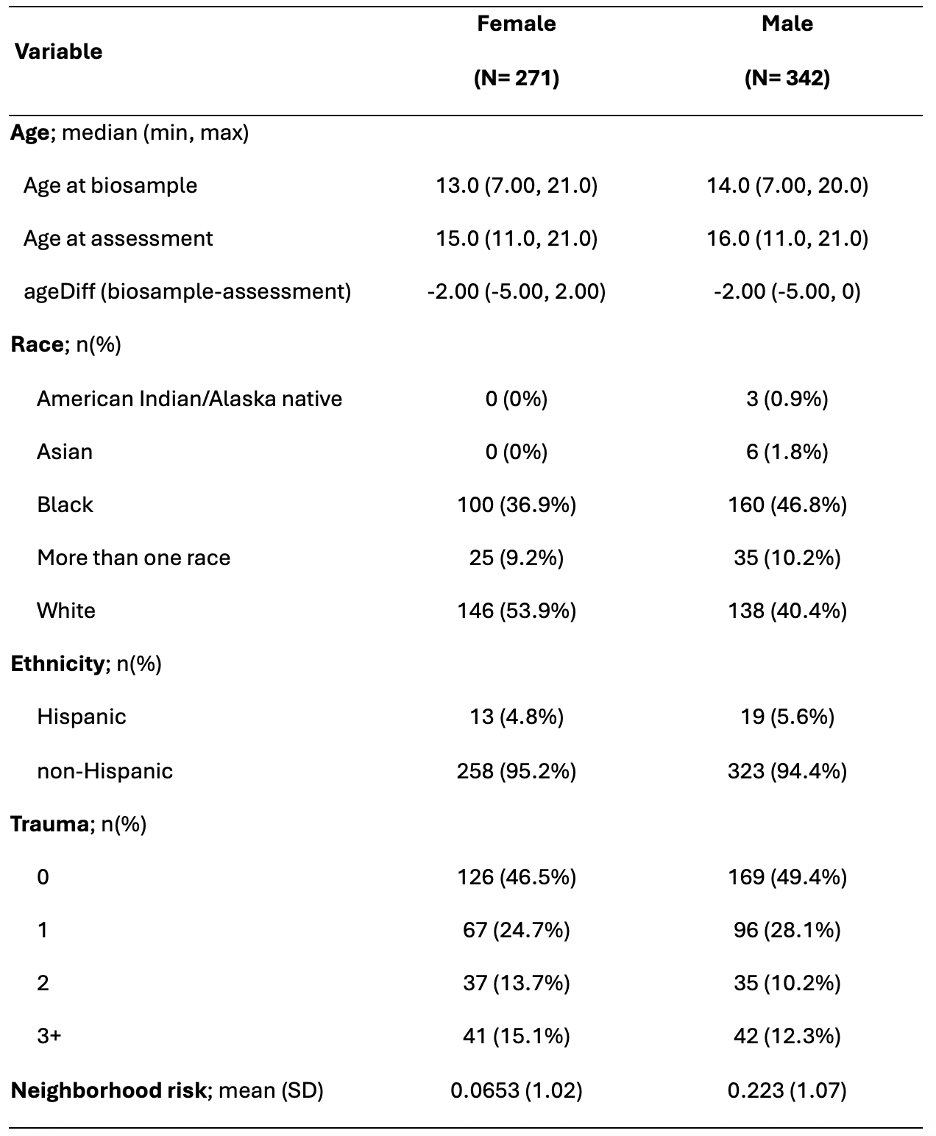 AgeDiff reflects quantification of difference in age between biosample collection and PNC assessment. Race and ethnicity collected within study procedures. Trauma experiences were self-reported DSM PTSD criterion A experiences with maximum of 8. Neighbhorhood risk comprised of census block factors including factors such as unemployment and vacant lots; normed to zero with higher values reflecting higher risk.
.png) Linear regression lines illustrating the unadjusted relationships between (a) trauma exposure and (b) neighborhood risk with epigenetic aging across five DNA methylation clocks (Horvath pan-tissue, Horvath S&B, Pheno, Grim, and DunedinPACE). Shaded regions indicate 95% confidence intervals, and panels are stratified by sex. DunedinPace output recentered to zero for comparison.
Linear regression lines illustrating the unadjusted relationships between (a) trauma exposure and (b) neighborhood risk with epigenetic aging across five DNA methylation clocks (Horvath pan-tissue, Horvath S&B, Pheno, Grim, and DunedinPACE). Shaded regions indicate 95% confidence intervals, and panels are stratified by sex. DunedinPace output recentered to zero for comparison. 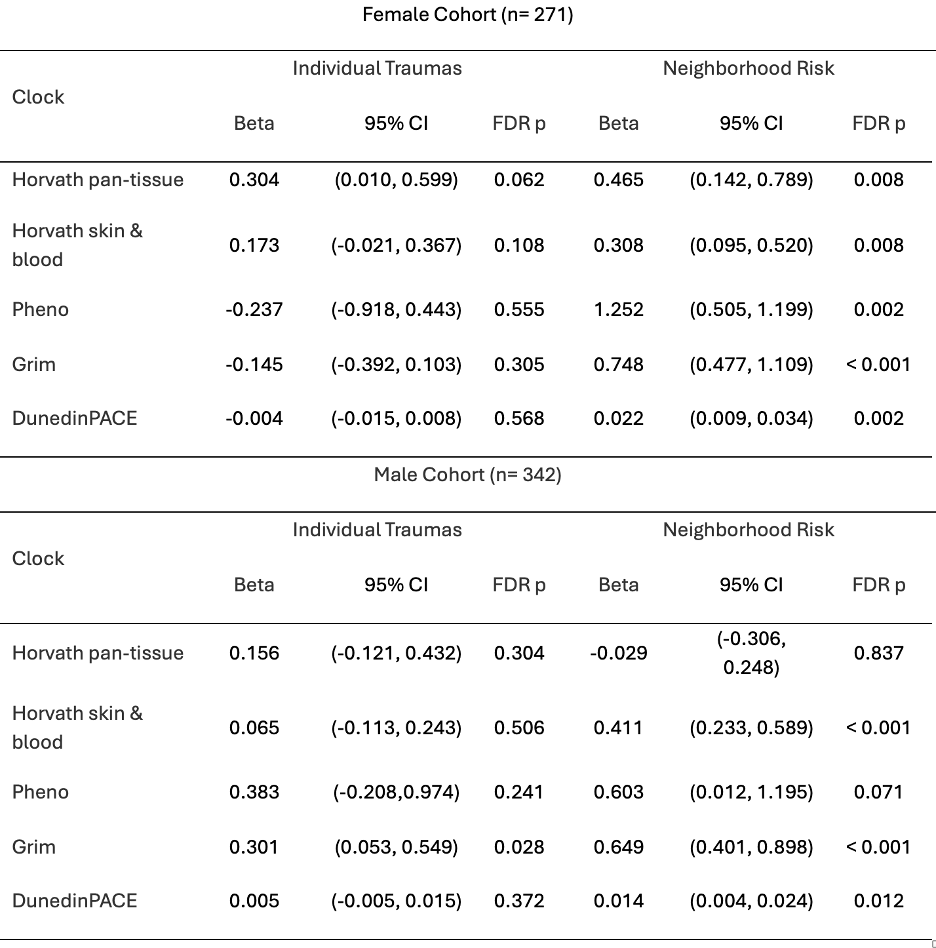 Beta coefficients, 95% confidence intervals, and FDR-adjusted p-values from sex-stratified linear regressions of five DNA methylation clocks (Horvath pan-tissue, Horvath skin & blood, Pheno, Grim, DunedinPACE) on trauma (self-reported, DSM criterion A; ordinally binned) and neighborhood risk (block-group-level indicators; higher values = higher risk). Models adjusted for estimated cell counts (CD4, CD8, Bcell, NK, Mono, granulocytes) and ageDiff. Global FDR correction applied across clocks for each cohort.