200 - Beyond Bedroom Devices: Problematic Internet Use and Daytime Sleepiness in Adolescents
Monday, April 27, 2026
8:00am - 10:00am ET
Publication Number: 4197.200
Libby Milkovich, Children's Mercy, Kansas City, MO, United States; Jordan Carlson, Children's Mercy Hospitals and Clinics, KANSAS CITY, MO, United States; Meredith J. Scafe, Children's Mercy Hospitals and Clinics, Kansas City, MO, United States; Theodore C. Brisimitzakis, Children's Mercy Hospital, Kansas City, MO, United States; Emily Cramer, Children's Mercy Kansas City, Kansas City, MO, United States; Emily Law, University of Kansas School of Medicine, Kansas City, KS, United States
Associate Professor of Pediatrics Children's Mercy Kansas City, Missouri, United States
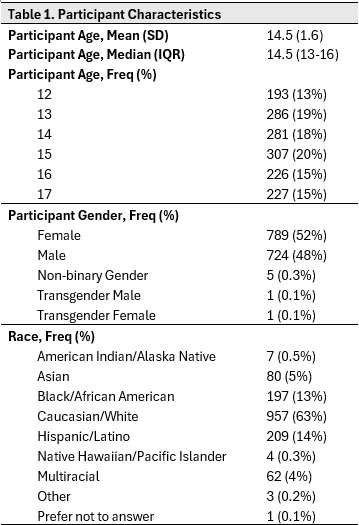
Background: Problematic internet use (PIU), marked by compulsive online behavior and withdrawal-like symptoms, affects 11% of adolescents. There is a need to better understand both the contributors to and impacts of PIU among adolescents to inform interventions and policy. This study investigated associations between PIU symptoms, digital devices in the bedroom, and daytime sleepiness in national study of U.S. adolescents. Objective: 1) determine the prevalence of digital devices in U.S. adolescent bedrooms; 2) examine the association between device count and PIU symptom severity, controlling for demographic and clinical factors; and 3) evaluate PIU severity and device count as predictors of daytime sleepiness. Design/Methods: We conducted a secondary analysis of a 2019 cross-sectional survey of adolescents aged 12–17 recruited via Qualtrics panels. Adolescents completed validated measures of PIU (PRIUSS-18; scores >25 indicate problematic symptoms) and daytime sleepiness (PDSS; scores >15 indicate problematic sleepiness) and reported the number of digital devices in their bedroom. Covariates included age, gender, race, and physical activity (Physical Activity Scale; scores >8.5 classified as active). Two multivariate linear regression models were used: Model 1 assessed device count as a predictor of PIU severity score; Model 2 examined device count and PIU severity as predictors of daytime sleepiness scale score. Both models controlled for demographic and clinical covariates. Results: Among 1,250 adolescents (mean age 14.5, 52% female, 63% white, 52% physically active) in Table 1, 96% had at least one device in their bedroom (mean=3, range=0-9, SD=1.7). PIU symptoms and daytime sleepiness were prevalent (reported by 92% and 91% of participants, respectively). Model 1 showed a significant association between device count and PIU severity (β=.88, p< 0.01, CI=0.39-1.37). Model 2 revealed a strong association between PIU severity and daytime sleepiness (β=.19, p< 0.01, CI=0.18-0.21) but no significant link between device count and sleepiness (β=.12, p=.60, CI=-0.34-0.58).
Conclusion(s): Digital devices are nearly universal in adolescent bedrooms. More devices are linked to greater PIU severity. Higher PIU severity is associated with increased daytime sleepiness; however, device count alone does not predict sleepiness. PIU is likely to have negative impacts on multiple aspects of adolescents’ health, including sleep. Future longitudinal studies should explore the interplay between PIU, sleep, and other health behaviors to inform complementary multi-behavior interventions.