388 - Professional Identity Formation: Linking Identity with Moral Resilience and Burnout Among Pediatric Trainees
Monday, April 27, 2026
8:00am - 10:00am ET
Publication Number: 4380.388
Chinyere V. O'Connor, UT Health Houston at McGovern Medical School, Texas, Houston, TX, United States; Syed Shahrukh Hashmi, McGovern Medical School at the University of Texas Health Science Center at Houston, Houston, TX, United States; Lindsey R. Cortes, The University of Texas Health Science Center at San Antonio Joe R. and Teresa Lozano Long School of Medicine, San Antonio, TX, United States; Darian C. Stewart, McGovern Medical School at the University of Texas Health Science Center at Houston, Houston, TX, United States; Yesh Dhruva, Saint Louis University School of Medicine, St. Louis, MO, United States; Elizabeth Rodriguez Lien, University of Texas Medical Branch School of Medicine, Galveston, TX, United States; Terri Major-Kincade, Department of Pediarics, McGovern Medical School, UTHealth Houston, Richardson, TX, United States
Assistant Professor of Pediatrics UT Health Houston at McGovern Medical School, Texas Houston, Texas, United States
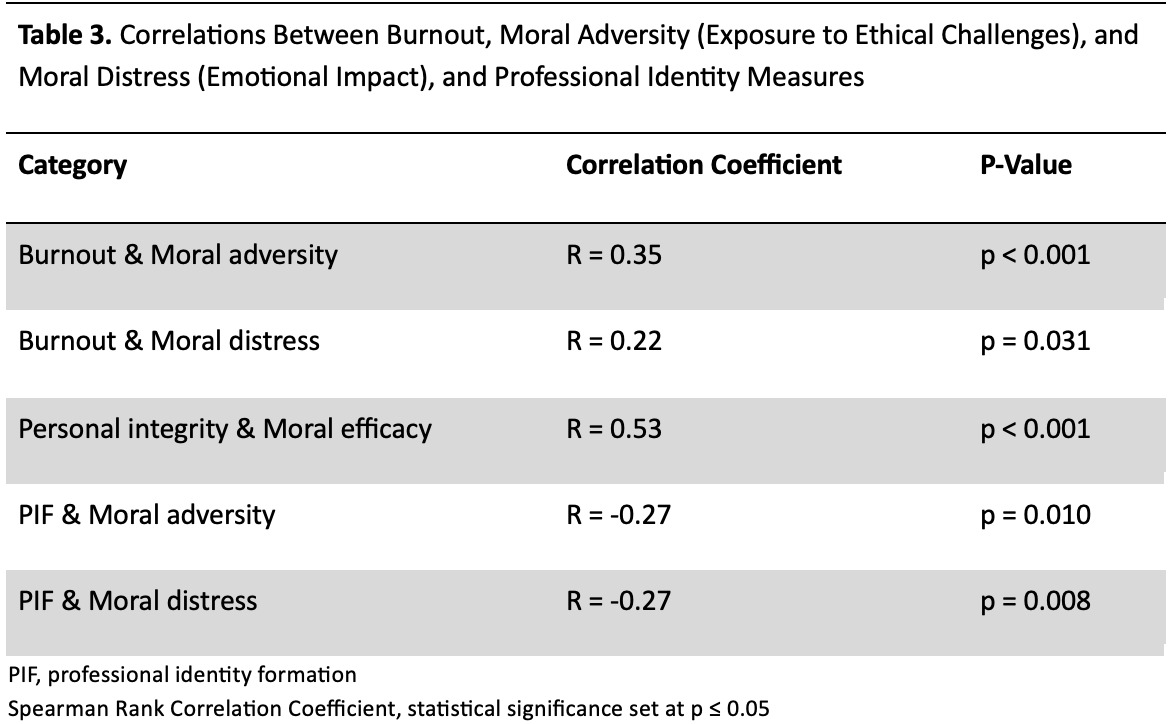
Background: Professional identity formation (PIF), the process by which trainees internalize the values, norms, and responsibilities of the medical profession, is fundamental to developing a sense of self and purpose as a physician. Competing clinical, institutional, and moral pressures may disrupt this process, contributing to moral distress, depersonalization, and burnout. While these phenomena have been extensively examined in nursing and other health professions, empirical research linking PIF with moral resilience, moral distress, and burnout among physician trainees remains limited. Objective: This study aims to examine baseline associations between PIF, moral distress, moral resilience, and burnout in pediatric residents across three academic institutions. Design/Methods: Validated psychometric instruments were administered to assess PIF and related constructs across postgraduate years (PGY1-PGY3). Instruments included a PIF scale, the revised Rushton Moral Resilience Scale (subscales: moral adversity, personal integrity, and moral efficacy), the 2-item Maslach Burnout Inventory, and the Moral Distress Thermometer. Baseline analyses compared demographic variables across instruments. Pre- and post-intervention comparisons were conducted on burnout and PIF after an educational intervention specifically exploring personal and professional values and the experience of burnout. Data was analyzed using Mann Whitney U tests and Spearman rank correlation coefficients. Results: Of 103 eligible residents, 84 completed paired assessments (Table 1). Burnout scores were significantly higher among female residents (Table 2). Following the educational session, mean burnout scores decreased from 2.99 (SD = 1.42) to 2.69 (SD = 1.55) (p = 0.002), while PIF scores remained unchanged. No significant correlations were observed between PIF subscales and burnout; additional correlations are presented in Table 3.
Conclusion(s): Even a brief didactic intervention may help reduce burnout among pediatric residents. Exposure to moral adversity was modestly associated with higher burnout and slightly lower PIF, indicating that ethical strain contributes to resident well-being. The lack of correlation between burnout and PIF suggests that strengthening identity alone may not protect against burnout. This highlights the need to address both emotional and professional domains in training to promote PIF and well-being. Future analyses with longitudinal data is necessary and underway to better define relationships and to inform the design of interventions that promote resilience, reduce moral distress, and strengthen professional identity.
Demographics
Comparison of Burnout, Professional Identity Formation, and Moral Constructs by Program, Gender, and Training Level
Correlations Between Burnout, Moral Adversity (Exposure to Ethical Challenges), and Moral Distress (Emotional Impact), and Professional Identity Measures









.jpg)
.jpg)