586 - Parents’ Perspectives on Weight Discussions in Pediatric Primary Care: Non-Stigmatizing but Room for Improvement
Monday, April 27, 2026
8:00am - 10:00am ET
Publication Number: 4574.586
Emily B. Finn, Yale School of Medicine, New Haven, CT, United States; Carlin F. Aloe, Yale School of Medicine, New Haven, CT, United States; Victoria Cueto Vilorio, Yale School of Medicine, New Haven, CT, United States; Julie Flom, Yale School of Medicine, New Haven, CT, United States; Hollyce Tyrrell, Academic Pediatric Association, McLean, VA, United States; Jeremy Michel, Childrens Hospital of Philadelphia, Philadeelphia, PA, United States; Randall Grout, Indiana University School of Medicine, Indianapolis, IN, United States; Charles T. Wood, Duke University School of Medicine, Durham, NC, United States; Eliana M.. Perrin, Johns Hopkins University School of Medicine, Baltimore, MD, United States; Mona Sharifi, Yale School of Medicine, New Haven, CT, United States
Program Manager Yale School of Medicine New Haven, Connecticut, United States
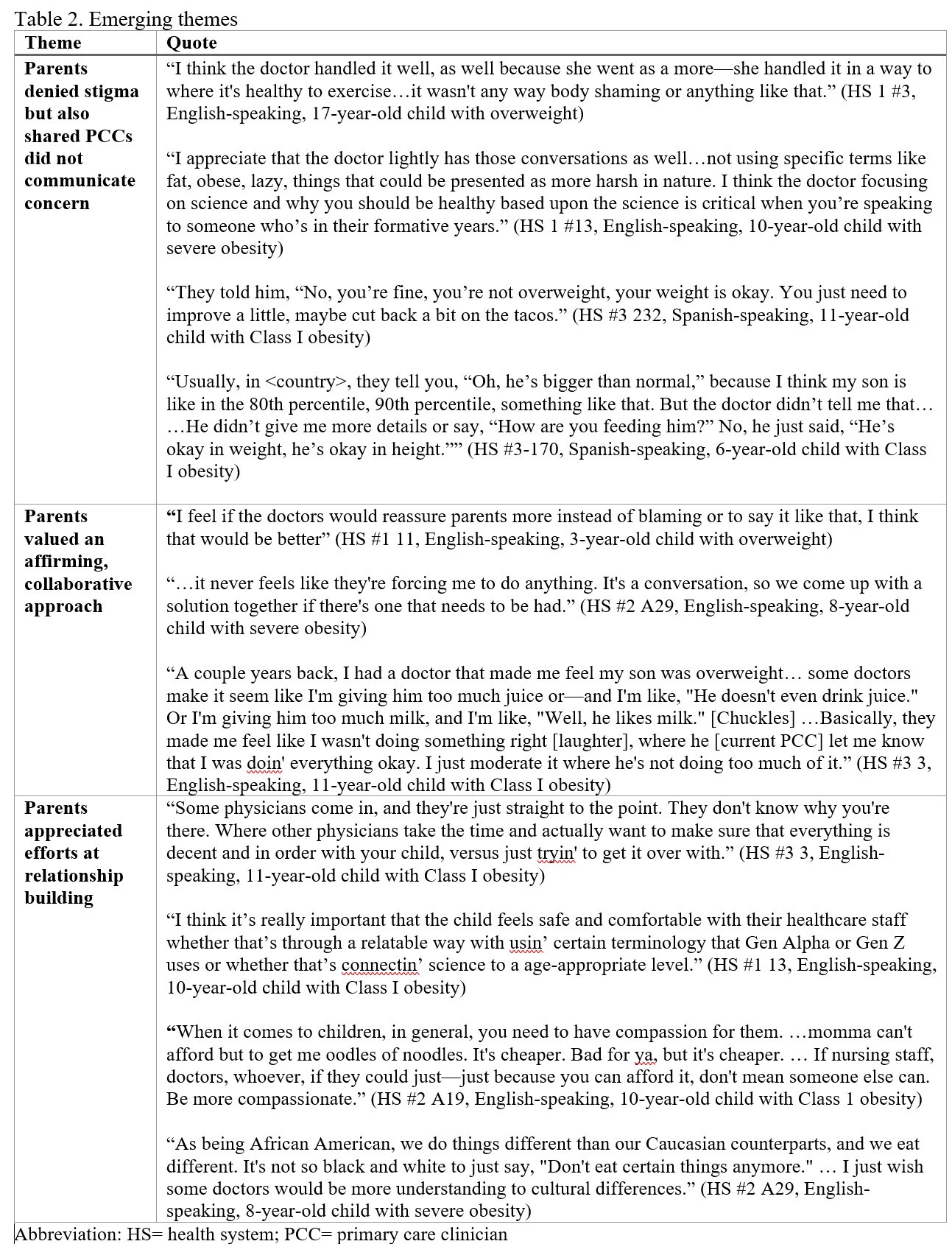
Background: Weight bias in healthcare negatively impacts patients and families, yet little is known about how it is experienced by families in pediatric primary care. Objective: To explore family perceptions of weight bias/stigma experienced in pediatric primary care and preferences around discussing weight. Design/Methods: As part of the Improving Pediatric Obesity Practice Using Prompts (IPOP-UP) trial at three US health systems (Northeast, South, and Midwest), we identified English- or Spanish-speaking parents of 2-17-year-olds with high BMI seen for well visits within the prior 14 days. Using purposive sampling, parents were recruited for interviews to ensure variation by language, race and ethnicity, child age, sex, BMI classification, insurance status, and primary care clinic. The semi-structured interview guide included questions exploring weight/growth-related conversations at the recent visit, cognitive interviewing of two adapted, validated instruments on family-centered care and stigmatizing care, and a "magic-wand" question to evoke preferences for improving weight discussions in primary care. We analyzed transcribed recordings using a framework analysis approach. Results: We reached thematic saturation after 59 interviews (59.3% English, mean duration 28 min) with parents whose children were 47.5% female, 67.8% publicly insured, 60.2% age < 10 years, 35.6% with overweight, and 28.8% with severe (Class II/III) obesity (Table 1). Three salient themes have emerged (Table 2): 1) Parents denied stigma but also shared PCCs did not communicate concern: all parents denied stigma/bias in how their child's PCC discussed weight, yet many reported that the PCC communicated the child's weight was of low concern or required no active changes. 2) Parents valued an affirming, collaborative approach: many shared they appreciated that discussions focused on actions they could control, rather than shame/blame. 3) Parents appreciated efforts at relationship-building: parents appreciated efforts to make personal connections and create a welcoming/inclusive clinical environment but expressed a desire for greater cultural humility and compassion in PCCs' communication.
Conclusion(s): Our findings support the ability for PCCs to engage with patients in constructive, connecting, empowering, and collaborative ways without bias but highlight potential missed opportunities for communicating concern and counseling about high BMI during well visits. Further research is needed to develop ways to preserve those positive approaches while both conveying medical concern about weight to families and improving cultural humility and compassion.
Table 1. Characteristics of interview participants, n=59.
Table 2. Emerging themes Abbreviation: HS= health system; PCC= primary care clinician









.jpg)
 Abbreviation: HS= health system; PCC= primary care clinician