122 - Protecting Tiny Eyes: Histogram Monitoring in the Neonatal ICU for Prevention of ROP
Monday, April 27, 2026
8:00am - 10:00am ET
Publication Number: 4120.122
Raghav Taneja, University of Texas Southwestern Medical School, Dallas, TX, United States; Melissa Kemp, Parkland Hospital, Dallas, TX, United States; Tara Best, University of Texas Southwestern Medical School, Plano, TX, United States; Cari Brown, Parkland Hospital, Dallas, TX, United States; Leslie A. Pate, Parkland Health, Corinth, TX, United States; Katherine Stumpf, UTSW, Dallas, TX, United States; Venkatakrishna Kakkilaya, UT Southwestern Medical Center, Dallas, TX, United States; Vishal Kapadia, University of Texas Southwestern Medical School, Dallas, TX, United States
Fellow University of Texas Southwestern Medical School Dallas, Texas, United States
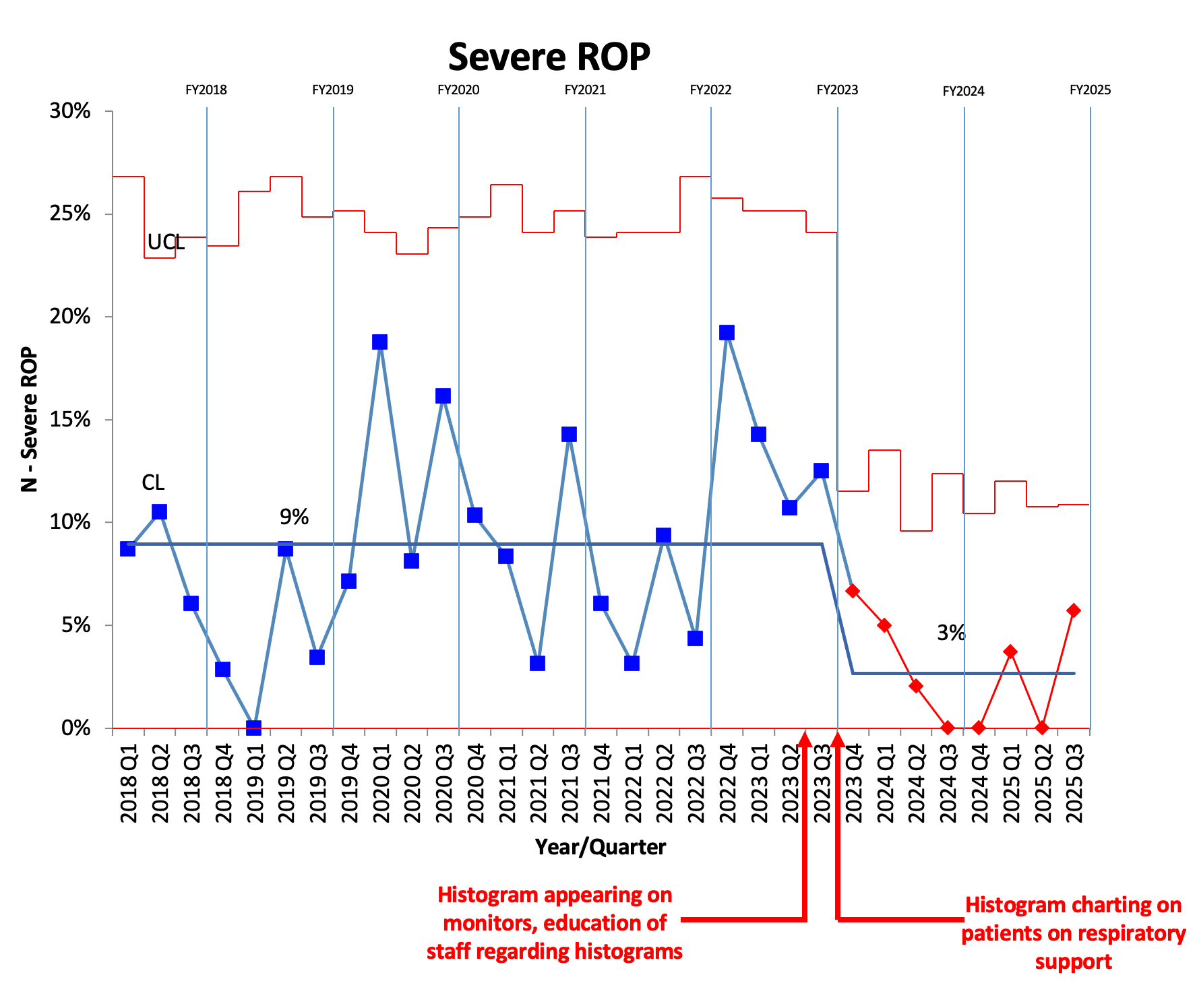
Background: Retinopathy of Prematurity (ROP) can cause multiple life-long problems for neonates, including peripheral or total blindness. Supplemental oxygen, hyperoxia, and hypoxia can all greatly increase the risk for the development of ROP. Increased awareness of judicious oxygen use and appropriate changes to respiratory support can help reduce exposure to unnecessary and damaging oxygen levels. Objective: According to the Vermont Oxford Network (VON), when compared with similar NICUs, our NICU had the highest rate of ROP. ROP incidence had increased from 6.8% in FY2022 to 15.2% in FY2023. Our objective was to implement a histogram-based education to guide bedside titration of oxygen. We aimed to decrease the rate of severe ROP by 10% over the year in our unit. Design/Methods: We implemented a PDSA cycle involving the presence of signage on all monitors with clearly stated oxygen saturation goals. Interval audits of set alarm parameters were undertaken. The staff was educated on the judicious use of oxygen supplementation and how to view histograms on all monitors. Bedside RNs documented histogram results in Epic flowsheets, and providers could view auto-populated histogram results in their daily notes. Results: Severe ROP rates dropped from a peak of 15.2% in FY2023 to just 2.7% in FY2025 after implementation of the oxygen histogram.
Conclusion(s): The use of an oxygen histogram visible to bedside RNs and providers can successfully alter the rate of severe ROP in a busy neonatal ICU. Future directions include: increase rate of documentation of histograms to every 6 hours and development of an algorithm to guide respiratory interventions.