435 - Characterizing Psychosocial Determinants of Caregiver Health in the Pediatric Emergency Department
Monday, April 27, 2026
8:00am - 10:00am ET
Publication Number: 4426.435
Meenakshi Awasthi, McGovern Medical School at the University of Texas Health Science Center at Houston, Houston, TX, United States; Jacqueline Furbacher, McGovern Medical School at the University of Texas Health Science Center at Houston, Houston, TX, United States; Renee C. Johnson, McGovern Medical School at the University of Texas Health Science Center at Houston, Houston, TX, United States; Jessica R. Dunn, McGovern Medical School at the University of Texas Health Science Center at Houston, Houston, TX, United States; Jason Phan, McGovern Medical School at the University of Texas Health Science Center at Houston, Houston, TX, United States; Madison Horn, McGovern Medical School at the University of Texas Health Science Center at Houston, Houston, TX, United States; Ashley Okoye, McGovern Medical School at the University of Texas Health Science Center at Houston, Houston, TX, United States; Donovan Calvert, McGovern Medical School at the University of Texas Health Science Center at Houston, Houston, TX, United States
McGovern Medical School at the University of Texas Health Science Center at Houston Houston, Texas, United States
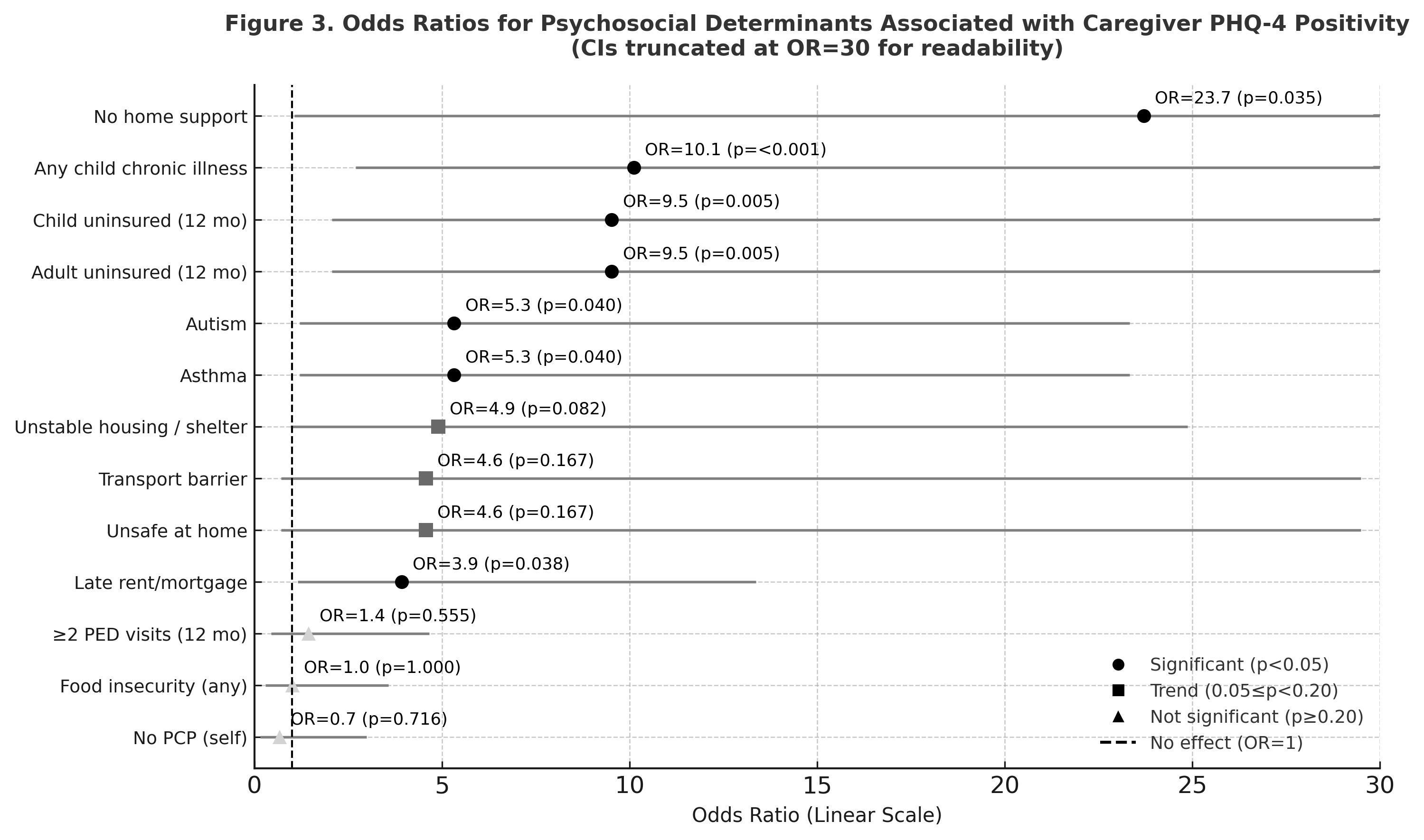
Background: Psychosocial determinants of health (PSDH), including housing stability, insurance coverage, and social support, significantly affect patient outcomes. In pediatric emergency medicine (PEM), caregiver well-being is closely tied to child health. Within the context of the maternal mental health crisis, the pediatric emergency department (PED) offers a critical point of access to identify and address caregiver distress. We hypothesized that presence of negative PSDH among caregivers presenting to the PED would be associated with higher rates of anxiety, depression, and ED utilization. Objective: To characterize PSDH among caregivers presenting to a PED, evaluate associations between negative PSDH and caregiver anxiety/depression, and identify factors linked to increased ED utilization. Design/Methods: A 21-question REDCap survey was offered in English and Spanish to caregivers in a tertiary PED. Items assessed 5 domains: Material (food insecurity, housing, literacy), Resource (insurance, primary care, transport), Psychological (support, safety, prior diagnosis), Family (caregivers, dependents), and Child Health (chronic illness). The PHQ-4 screened for anxiety and depression, with positivity defined as ≥3 on either subscale. Fisher's exact tests and odds ratios (95% CI) examined associations between PSDH and PHQ-4 positivity. Results: Among 67 responses (80% mothers, 76% English-speaking), 19.4% screened positive on the PHQ-4. Positivity was significantly associated with any child chronic illness (50% vs 8%; OR 10.1, p< 0.001), particularly asthma and autism spectrum disorder (OR 5.3, p=0.04). Adult or child uninsurance was strongly linked to caregiver anxiety/depression (OR 9.5, p=0.005). Housing strain was also significant (OR 3.9, p=0.038), as was reporting no household support (OR 23.7, p=0.035). Trends were observed for food insecurity (OR≈2.1, p≈0.18), unstable housing (OR 4.9, p=0.082), feeling unsafe at home (OR 2.8, p=0.11), transportation barriers (OR 4.6, p=0.167), and higher ED utilization (≥ 2 visits; OR 1.4, p =0.56). Domain-level analysis showed increasing PHQ-4 positivity across Material, Resource, and Psychological indices.
Conclusion(s): Nearly 1 in 5 caregivers presenting to the PED screened positive for anxiety or depression, far exceeding community baselines. Caregiver distress was most strongly linked to uninsurance, housing insecurity, and lack of support, with directional trends across multiple PSDH domains. Integrating PSDH screening into PED workflows and connecting families to real-time resources could mitigate stress, reduce preventable visits, and improve overall well-being.
Odds Ratios for Psychosocial Determinants Associated with Caregiver PHQ-4 Positivity
Associations Between Individual and Domain-Level Psychosocial Determinants of Health and Caregiver PHQ-4 Positivity psdh table pas OR p.pdf