








Neonatal Neurology
Session: Neonatal Neurology 10: Pre-Clinical 2
Gabriele Simonti
Research Student
Children's National Health System
Washington, District of Columbia, United States
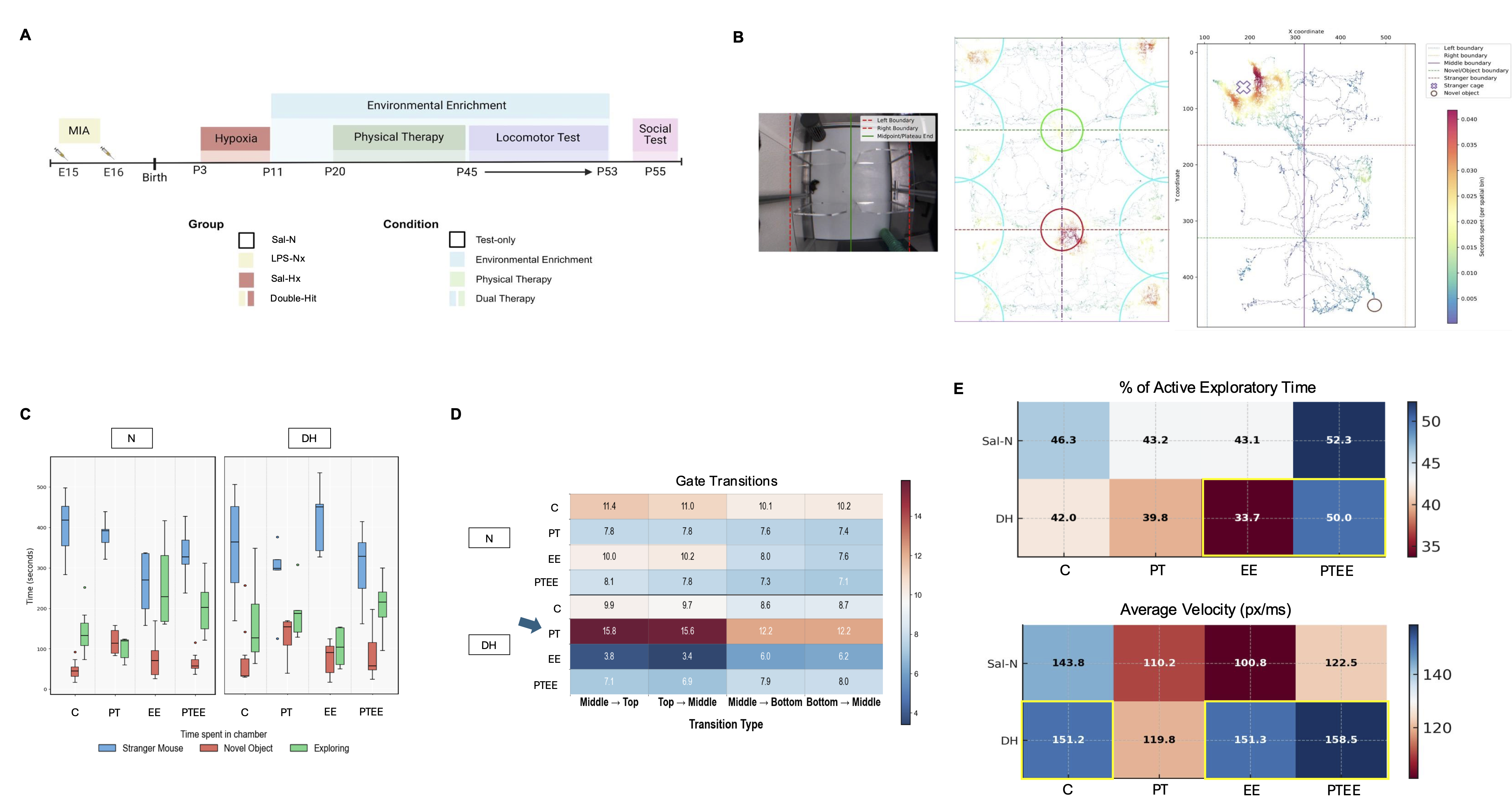 (A) Experimental design showing timing of maternal immune activation (MIA), postnatal hypoxia (Hx), and subsequent exposure to physical therapy (PT), environmental enrichment (EE), or their combination (PT+EE). (B) Schematic of the three-chamber sociability test with spatial heatmaps illustrating exploratory trajectories. (C) Time spent interacting with a stranger mouse, a novel object, or exploring indicates reduced social engagement and increased variability in double-hit (DH) animals, normalized by PT but not EE. (D) Heatmap of chamber transitions showing reduced exploratory movement in DH mice and partial restoration following PT. (E) Quantification of active exploratory time and average velocity during open-field exploration reveals that PT restores balanced locomotor behavior, whereas dual PT+EE exposure induces hyperactivity, suggesting overstimulation effects on motor regulation.
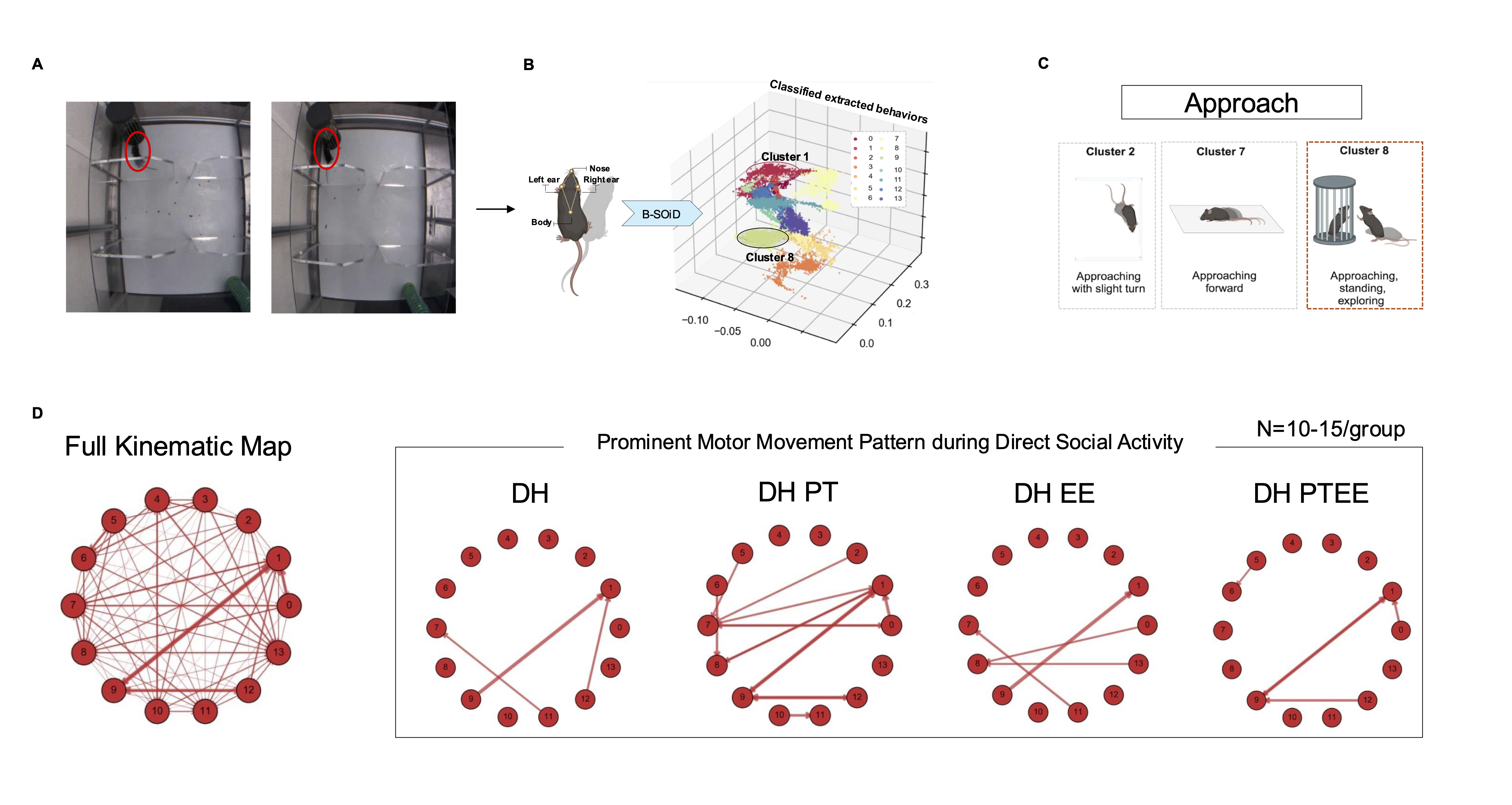 (A) Representative frames from the three-chamber social assay during direct social contact. (B) Schematic of pose estimation and B-SOiD-based clustering used to extract and classify fine-grained movement motifs. (C) Example of approach-related clusters capturing distinct social engagement kinematics, including forward approach, turning, and exploration. (D) Kinematic transition networks depicting the temporal organization of motor motifs during direct social behavior. Double-hit (DH) mice show reduced and fragmented transitions, whereas physiotherapy (PT) restores motor diversity and coordination. Environmental enrichment (EE) alone minimally improves motor organization, while dual PT+EE exposure further reduces connectivity, indicating overstimulation-induced restriction of interactive movement patterns.