422 - Clinical Features of Salmonella Bacteremia at Children’s National Hospital
Saturday, April 25, 2026
3:30pm - 5:45pm ET
Publication Number: 2410.422
Shamily Jadhav, George Washington University School of Medicine and Health Sciences, Washington, DC, United States; Shreya Doshi, Children's National Health System, Washington DC, DC, United States; Joseph Campos, George Washington University Medical Center, Washington, DC, United States; Rana F. Hamdy, Children's National Health System, Washington, DC, United States
Medical Student George Washington University School of Medicine and Health Sciences Washington, District of Columbia, United States
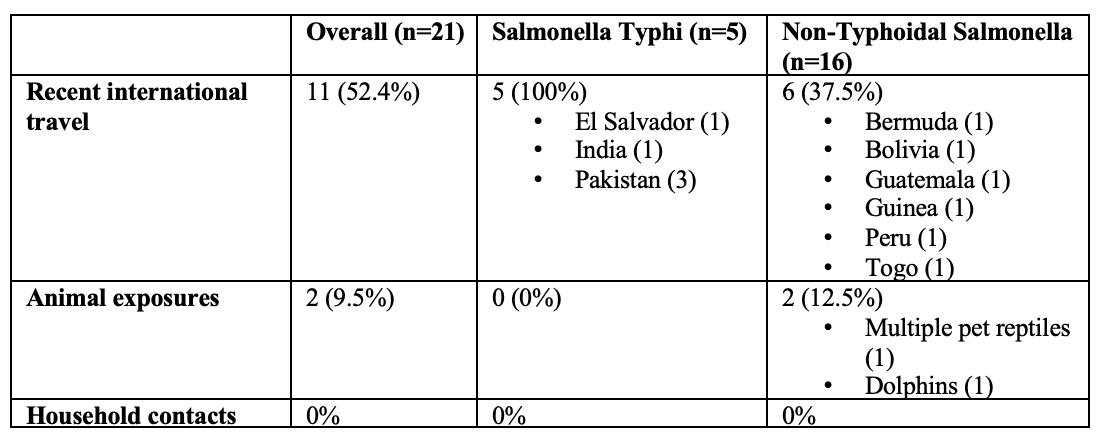
Background: Invasive infections due to Salmonella enterica, typhoidal and non-typhoidal strains, are a global concern. Rising antimicrobial resistance and international travel complicate management, highlighting the need to better understand risk factors, clinical features, outcomes, and resistance patterns to help guide diagnosis, management, and treatment. Objective: This study aims to characterize the clinical profiles, antibiotic resistance patterns, and outcomes of pediatric patients with Salmonella typhi and non-typhoidal Salmonella bacteremia. Design/Methods: We conducted a retrospective case series of patients under 21 years treated at Children's National Hospital from 01/2021 to 12/2023. Blood cultures positive for Salmonella typhi (ST) or non-typhoidal Salmonella (NTS) were included. Clinical and laboratory data were extracted from electronic medical records, and descriptive analyses summarized demographics, clinical course, treatment, and outcomes. Results: 21 patients were included: 5 with ST and 16 with NTS. Average ages were 8.1 (ST) and 5.8 years (NTS). Recent international travel was the most common risk factor [Table 1]. Fever and diarrhea were the most frequent symptoms. One ST patient was readmitted for recurrent bacteremia; no NTS patients required readmission. There were no deaths. All ST patients were previously healthy, whereas 5 NTS patients had sickle cell disease, 1 had sickle cell trait, and 1 had recent cardiac surgery. ST patients had longer antibiotic courses, while NTS patients had longer hospital stays, largely driven by one patient with prolonged surgical recovery despite earlier bacteremia resolution [Table 3]. Antibiotics were adjusted per susceptibility results, with one patient in each group requiring escalation to carbapenem therapy [Table 4]. Follow-up blood cultures were obtained in all patients: 3/5 ST and 1/16 NTS were positive. NTS serogroups included A (18.75%), B (25%), C (12.5%), E/G (12.5%), and unknown (5%).
Conclusion(s): Both ST and NTS bacteremia presented similarly, with fever and diarrhea. In this single center case series, travel to Southeastern Asia, particularly Pakistan, was a common finding among patients with ST. Outcomes were favorable, with no deaths and few readmissions. Early diagnosis and targeted antibiotic therapy were critical to effective management.










.png)
.png)
