Session: Health Equity/Social Determinants of Health 3
219 - Racial, Ethnic, and Socioeconomic Disparities in Acne Management In An Urban Pediatric Primary Care Clinic: A Retrospective Cohort Study
Friday, April 24, 2026
5:30pm - 8:00pm ET
Publication Number: 1208.219
Akshaya Sekar, Connecticut Children's Medical Center, Hartford, CT, United States; natania muriel, Connecticut Children's Medical Center, Shelton, CT, United States; Sharon Smith, University of Connecticut School of Medicine, Hartford, CT, United States
Connecticut Children's Medical Center Hartford, Connecticut, United States
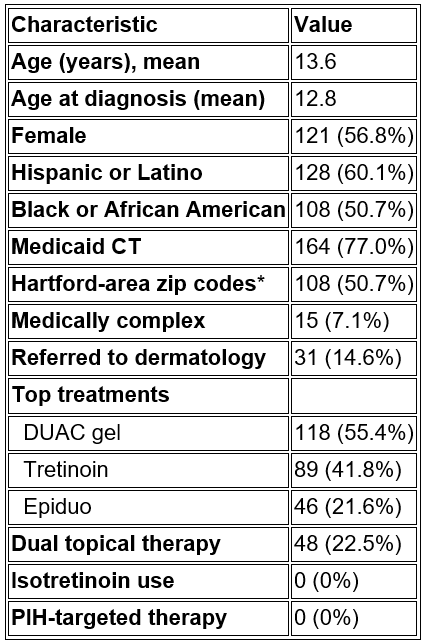
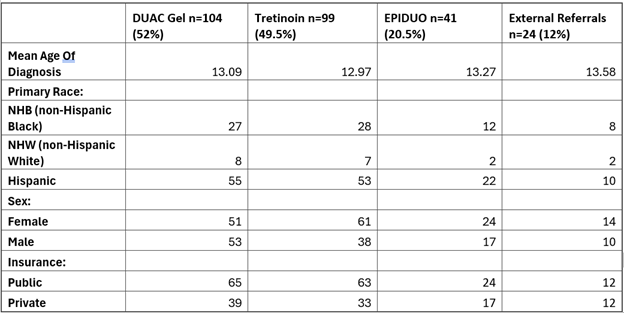
Background: Acne Vulgaris is a prevalent and multifactorial disorder of the skin. There have been racial, ethnic, and sex-based disparities associated with the treatment of acne in the United States though studies involving disparities in the pediatric population are lacking. Objective: To evaluate the association between race/ethnicity, sex, and socioeconomic status of patients in an urban pediatric primary care clinic with moderate to severe acne and dermatology referral. Design/Methods: This is a single-center retrospective cohort study. Eligible subjects were identified using ICD-10 codes, and data abstracted from electronic health record. Patients up to 18 years of age with moderate-to-severe acne were identified via ICD-10 codes (L70.0-L70.9). Excluded were patients who were greater than 18 years of age or those who were pregnant. Age of diagnosis, sex, race/ethnicity, insurance status, external dermatology referrals, and prescribed medications were collected. Multi-variable regression model used to quantify associations between patient demographics, socioeconomic characteristics, and outcomes. Results: Among the 200 children who met the inclusion criteria (mean age 13.6 years, 56.8% female), 60.1% were Hispanic and 50.7% identified as Black, with 77.0% insured by Medicaid CT. The most common treatments were DUAC (benzoyl peroxide 3% and clindamycin 1%) gel (55.4%), tretinoin (41.8%), and adapalene-benzoyl peroxide gel (21.6%), with 22.5% receiving combination topical retinoid and benzoyl peroxide-clindamycin therapy. Mean age at diagnosis was 12.8 years; 7.1% were medically complex and 14.6% were referred. Hispanic patients made up 41.7% of referrals despite being 51.1% of non-referred (proportionally similar). Black patients were 33.3% of referrals vs. 38.1% not referred. No significant differences were found in sex with regards to referrals and treatment. Hispanic patients received DUAC (61.1%), Tretinoin (56.7%), and EPIDUO (26.7%) at highest rates.
Conclusion(s): Care delivered aligned with evidence-based guidelines through widespread use of DUAC gel and tretinoin. The absence of isotretinoin and therapies targeting post-inflammatory hyperpigmentation, combined with the demographic profile, underscores persistent gaps in severe acne management and scarring prevention among Black and Hispanic youth