Session: Medical Education Trainee Ongoing Projects
TOP 9 - Transition to Internship Screening Tool
Friday, April 24, 2026
5:30pm - 8:00pm ET
Publication Number: 1769.TOP 9
Michael Harding, Indiana University School of Medicine, Indianapolis, IN, United States; Luke Johnson, Indiana University, Indianapolis, IN, United States; Haley Russ, Riley Hospital for Children at Indiana University Health, Indianapolis, IN, United States; Abigail Deal, Riley Hospital for Children at Indiana University Health, Indianapolis, IN, United States; Anna Purk, Riley Hospital for Children at Indiana University Health, Indianapolis, IN, United States; Sara Kane, Indiana University School of Medicine, Indianapolis, IN, United States
Pediatric Chief Resident Indiana University School of Medicine Indianapolis, Indiana, United States
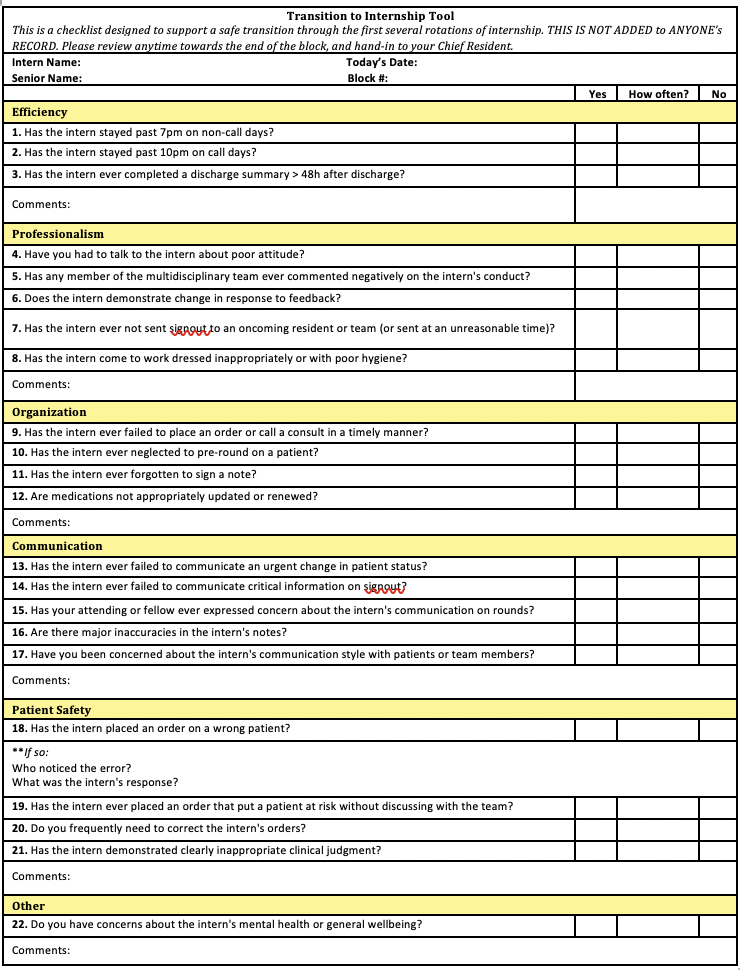
Background: The transition from medical student to resident can be challenging and daunting. The start of residency can bring many challenges as they begin their training potentially in a new healthcare system, new EMR, and new academic setting which can lead to stress and difficulty in adaptation. New interns also bring with them an array of medical school experiences that can vary broadly, leading to increased stress in their new role. Despite these differences, there is no early screening tool to gauge how a new resident is transitioning into their role over the first few months of training. Residency performance review committees often meet twice annually to review the performance and progress of trainees. This leaves a crucial early period of time where interventions may prove paramount that would otherwise be unaddressed for months until this committee's first meeting Objective: The focus of this tool is to perform screening by senior residents of new interns to potentially identify early interventions that could ease trainees into their new role and provide timely support. The aim is to reduce the timing of program support for trainees and identify initial points for improvement when integrating into residency. This may also serve to identify interns who are initially struggling to have more program leadership check-ins at the start of their training. Design/Methods: July - October 2025: We devised a screening survey comprised of 22 questions across 6 competency domains that senior residents filled during the last week of the first 4 rotation blocks assessing the intern's performance. This was conducted only during inpatient rotations where the senior resident served in a supervisory capacity.
October 2025: We compared these to formalized evaluation forms submitted via MedHub reports on Pediatric Resident Milestone Data which were completed by residents, fellows and attendings to compare overall performance.
11/12/2025 - Clinical Competency Committee (CCC) to discuss PGY-1s, document results of previous analysis to see if concerns noted earlier in evaluation tool mirrored concerns noted by the committee
December 2025 - Comparison of screening tool to CCC meeting decisions on PGY-1 progress and any notable areas of improvement.
January 2026 - Correlation analysis of each rotation block scores to pediatric milestone scores and to CCC notes to assess if for example block 1 or block 4 is more strongly correlated